• About
  • Blog Spots

Dynamics of Myth

~ using culture to shift our worldviews

Dynamics of Myth

Monthly Archives: May 2012

The Myth Boutique

28 Monday May 2012

Posted by royzuniga in Uncategorized

≈ 1 Comment

Last year I attempted to run a Community Mythology Project (CMP) in Duvall, WA. The premise was recognizing that myth making is fundamentally a human driven process – that seems obvious right? If it is, we can take control of the process. The Duvall CMP fizzled. Why?

I have a few possible explanations, and a theory for what to try next.

  • The community was not interested in thinking too deeply about culture
  • Other priorities conflicted
  • People didn’t understand it
  • Artists were more interested in their personal art that in creating art as a group
  • I did a lousy job
  • etc., etc.

I’m sure all of these, and more, played a role. On factor, however, that I’m fairly certain had a strong role in keeping people away is quite simple: people aren’t used to creating myths for their own consumption. We believe myths come from an authority. Actually, we don’t even think about them as myths. They are our religion, our national ethos, our consumer rights, the media addiction and so on. We also don’t think of ourselves as choosing a myth. Because we need it to be authoritative, we would rather believe it found us. When the time was right, God revealed it to us, we think.

The fact is we had choice. We may have abdicated the decision by accepting what our parents, or neighbors or pastor said. Abdication is still a choice. So we deceive ourselves on many levels. We think our faith is not a myth, we believe we didn’t choose it, and so on. So the biggest paradigm shift is to simply accept this fact: we pick our myths. The next level beyond that is to say we create our myths; but that might be too much for most.

So let’s start with picking our shared story. Where do we go shopping? Is there a local outlet? A myth boutique? Perhaps Amazon has a myth department?

Catering to that consumer mindset might not be a bad first step. If it is too hard for people to make up their own myths, perhaps they can just order one up? How would that work?

  1. First of all, we need to define the dimensions of their choice.
  2. Second, we need myth-creatives, the guys and gals who can bring one to life.
  3. Third, we need a group purchase order – shared story is by definition adopted by a community.
  • I was going to add shared locale as a constraint, meaning that people should be close to each other. With the internet and social media, however, that doesn’t seem to be a defining characteristic, even though people will meet up sooner or later.

That’s enough to start with. So let me recap: the first baby step in making community mythology more acceptable is to introduce the myth boutique. Think of it as an agency, a proxy authority that prepares myth for consumption. This introduces a layer of indirection that may be enough for us to make the leap. Someday we may mature to participating, and indeed the boutique system will allow creative to participate, and won’t stop them from consuming their own product. How exactly this work? Let me narrate a little scenario. Let me know how it resonates.

John is 21 and fed up with his parents trying to ram their religion down his throat. It seems archaic to him, and just doesn’t resonate. However, they take it extremely personal and he hates to disillusion them. ‘Why can’t they be more rational?’ he wonders. As much as he loves them, he wishes the topic wouldn’t always come up, and he feels it gets in the way of a truly reciprocal relationship. Why can’t things be more direct and simple? He is also tweaked a bit by the questions of origin and purpose. Where did we come from? Where are we going? What should we strive for in life? Is there a redemptive purpose, or is living for experience all there is? Should he just enjoy his youth, or should he sacrifice his own pleasures for the sake a God or country?

Vexed, he decides to Bing on the Internet to see what other options are out there. He knows about other religions – Buddhism, Judaism, Mormonism, etc. However, these seem just as archaic and outdated as the stolid belief system of his parents. New Age stuff seems a bit out there, with irrational believers who use pop science to justify all kinds of stories. The worst part is they actually believe in galactic alignments dictating Earth history, astrology and messages from aliens in crop circles. That’s too far out for him. He’s a rational man.

He thinks he might as well make one up! For grins, he types ‘how to create a mythology’ into the Search input and hits enter. Many results come up, including references to books about mythology, personal myth counselors, psychologists and, to his surprise, a link to a myth creation wizard. What strikes him about the description is that it is both rational and creative. The language resonates with him – it assumes that the myth making process is human process, which is what he has always known in his heart.

Elated, he goes to the site, which explains a number of things, including the background, assumptions and choices. As a consumer, he really likes the idea of imputing some parameters and getting a relevant mythology as an output. The best part about it is that the mythology comes with a community of like-minded people. ‘Genial!’ he exclaims, catching himself. He’s alone in his room. But the walls just ‘fell off’. Suddenly he feels like the universe just opened up, and the moon and stars are within his grasp.

Eager to get started, he begins with the profile. A guided set of questions help him identify with a worldview tendency. It makes him think about his assumptions, and then his values. In the end, he gets a summary, which he doesn’t like, not because it’s inaccurate, but because it shows a side of him he’s not too content with. He’s delighted he can see what other options there are, and then aligns with a set of values he wants to have.

After completing the Value Profile, he goes into an aesthetic profile – he selects movies and music he likes, picks from various images and statements until the system presents him another summary, this time of his aesthetic direction. He validates that as well, also tweaking it towards the direction he would like to go. He does have a conscience after all, and if he’s going to have a hand in creating his own belief system, he applies high standards.

After a few more quick profiling questions, including social preferences (he’s more of an introvert that thrives with small groups), he’s finally done. The whole process took about an hour of concentrated effort, and he feels like the system has a good handle on what he wants. All that is needed is the myth and corresponding community. This is where his expectations get realigned – not so fast!

It turns out he’s part of a longer running process, and while there are others who are potential cohorts in his myth community, it turns out the myth has not been created yet. This is actually not a bad thing, since he now has the chance to influence its development. He’s strongly encouraged to participate in the validation process, which is systematic and straight forward. He is also asked to pick a sponsorship level. Creating myths costs money, of course. There are creative people, editors and publishers to pay. Since this is more exciting than church, he signs up as a Sponsor and pays his dues.

Once there is critical mass for the myth creation to start (there are enough participants and sponsors), the myth requirements and timeline are published. John monitors progress as writers and artists respond to the call. They get their creative brief which includes the values and aesthetic direction, and they start work. Over a three month process, they go through brainstorming sessions, establish a myth framework (which has been put to a vote to the sponsors), go through a creative process to write the story arch, characters and embellish them artistically. This involves poets, playrights, dancers, photographers, painters and many more who mostly volunteer their time out of passion for the process. They get some compensation, and sponsors have the option of rewarding stellar output.

Once the myth reaches a critical mass, the community site is launched and everyone receives a brief in email so they can study up on the story. A big kickoff event brings everyone together. Participants meet in person and online, including the artists, to participate in a rich presentation that includes poetry, performance and art exhibitions. The goal is complete immersion. This is not unlike a Star Trek or Star Wars convention, except in this case, the consumers were directing the content, and the individual artists were free to express themselves as they saw fit, based on the creative brief. There is some creative direction, but it is not coercive; the artists are encouraged to express themselves in their own artistic voice. This brings out a plethora of interpretations around a shared story, which is a crucial practice in community-driven mythology. It teaches people to think for themselves, fosters tolerance and a richer artistic experience for all.

John is delighted with his new found ‘religion.’ It pre-occupies his mind in a good way, he has community, feels a sense of purpose and collaboration. After a while he is willingly consumed by the new ‘cult’. In the back of his mind he knows it’s partly his own concoction. He relaxes about that and plays along because his imagination has been ignited with creative meaning. His soul is in play with creative imagination, and it satisfies the non-rational side, which he now recognizes. Because he knows he had a level of control in its inception, he believes in it in a healthy way. He’s not deceiving himself into thinking it was handed down by God. The community validation and the fact that it agrees with his own conscience makes it even more cogent than the ‘revealed’ religions in his mind. He uses the shared story and rich artistic artifacts surrounding it to deeply internalize the values and lessons, and this guides his behavior. Finally, he thinks, he has a ‘religion’ he can believe in, and live out its values in his daily life.

Is this the scenario we have to build to get Community Mythology to take off? Let me know your thoughts. Also, contact me if you’d like to help implement this story!

— Roy Zuniga
Ballard, WA

——
Copyright Roy Zuniga 2012 – all rights reserved
Another Normal

27 Sunday May 2012

Posted by royzuniga in Uncategorized

≈ Leave a comment

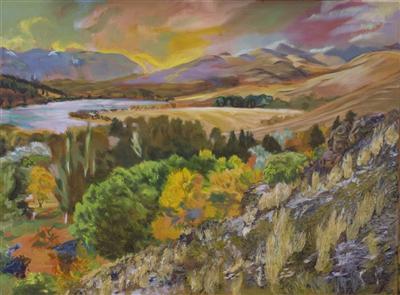
‘Another normal’ – this simple phrase captures what I’m after through abstractscapes. These paintings are inspired by nature; realizing them draws upon experience painting in the open air, aka ‘en Plein Air’ in French. My painting style was developed doing ‘traditional’ impressionistic works on a portable easel outdoors. Their abstract metaphysical bent comes from me ruminating about the need for a world view shift. Our civilization needs fundamental change because consumerist culture is leading to an unhappy population and a depleted planet. Shifting a ‘normal’ impressionistic landscape into the realm of abstraction within a canvass is analogous to the paradigm shift we need even as we go about our daily lives. How do we reprogram ourselves into living new values? How do we think ‘otherwise’? Start by shifting your paradigm – it is possible!

The process is teaching me a lot about how the mind works – or maybe it’s just my twisted brain. Writing about this process will – to the extent that my journey is analogous to yours – help us discover how to shift our own thinking. I mean not just what we think, but how we think about belief. Ultimately, a new worldview requires a new mythology, which is not typically something we invent for ourselves. We’d rather have an authority tell us. So any exercise in self mind shifting is useful. I encourage you to try it.

The dance the artist does with his canvass is between action and observation. You paint and then step back. For it to ‘make sense’ (to the artist in the first place, art consumer later), there has to be an explanation for what you put on there. As I created I found that forms that just appeared on the canvass could not be accepted without explanation.  ‘They were put there for a reason’, thinks the private critic. During the creative process the art conscience is driving and you’re just creating as an artist (when you learn to let go and quit worrying about being analytical). You step back to be an observer, and what you just created strikes you. It needs an explanation.

Image

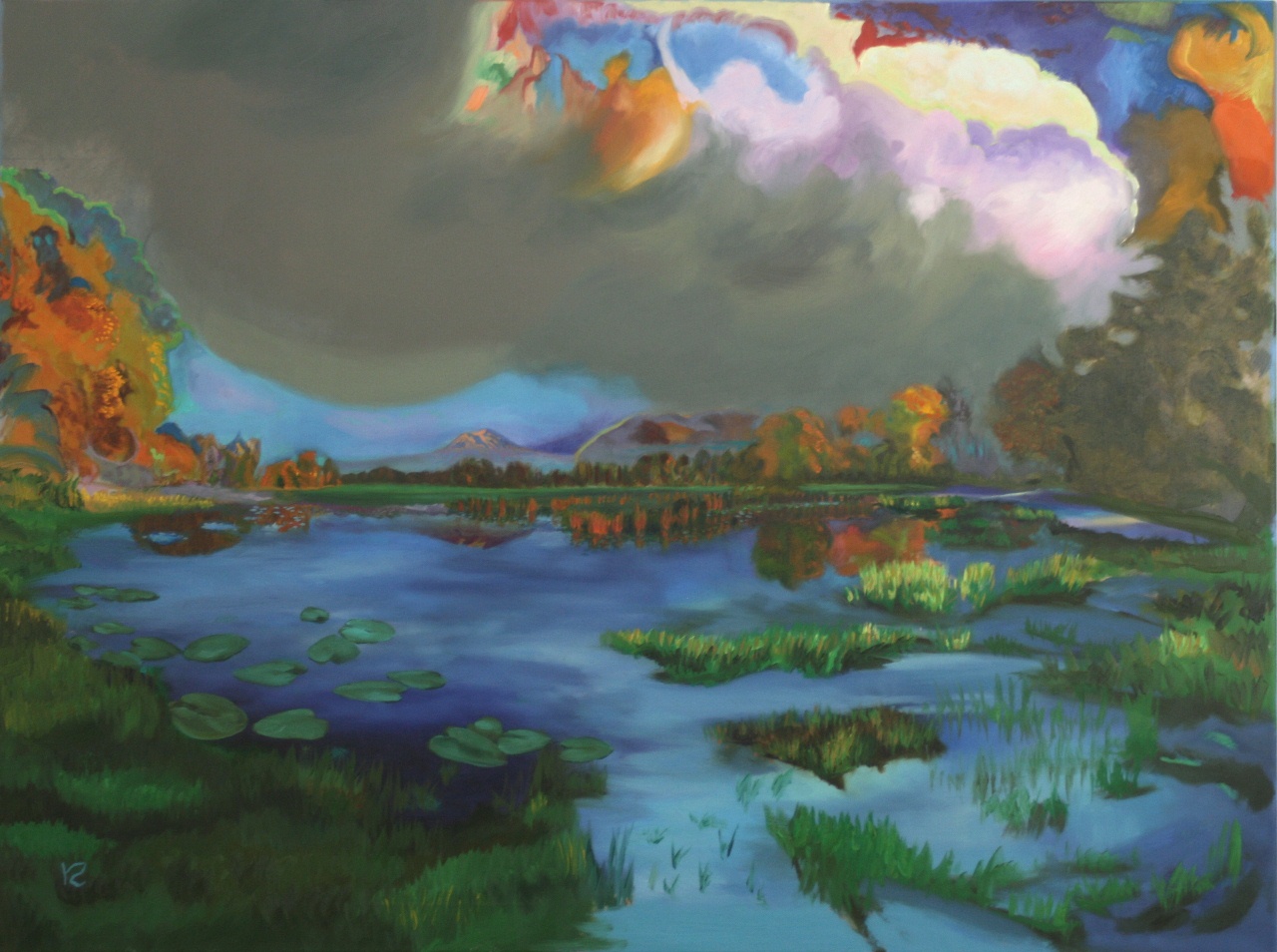
For example, looking at the shapes in the sky, it turns out that what were strokes carried over from painting lilies looked like a little creature in the orange cloud/tree on the left. I know where the shape came from, but why were the strokes combined as a pair? Evidently my mind has an affinity for two shapes in proximity. Even abstractions need their own rules, or at least a vocabulary. We need a mental model. What can we map them to? What is the metaphor? The gremlin angel in a morphing tree.

This is all very subjective, and involves a shift in the mid of the artist. For example, as you approach the landscape, you create an idealized composite. When I introduced the color abstractions in the clouds, I found some shapes were acceptable, while others weren’t. One of the reasons, it seems is that even though the colors were not natural, the ‘behavior’ of the forms were cloud-like and could be mapped mentally to cloud phenomena. At this point I realized I was dealing with forms that seemed meaningful because of their allusion, not their representation.

‘Symbols’ is too strong a word. As the shapes wanted to resolve themselves into objects or transitions between objects, I was reminded of our compulsive need for explanation. I rationalized art theory. Instead of giving the names, thinking of them as allusive preserves ambiguity of interpretation and therefore the right of the viewer to participate in the interpretation. Those two dots in a head shape are an unknowable ghost peering at us, perhaps?

Cloudscapes are powerful in that we are used to seeing all kinds of strange formations and contrasts in the sky. We are very forgiving with clouds and often see shapes. You can create a grounded landscape and a very dreamy cloudscape with surreal colors and it delights the viewer, as in the example below which has generally resonated very well.

 Image

It’s a tension between the existing and the disruption. Un-conventional shapes need a meaning before they can be accepted and the assessment of the work’s integrity can continue. How was the success of the first cubist painting assessed if the language did not previously exist? Did Picasso and Braque have a rational model ahead of time that allowed them to even talk about the success of the works? Or did they intuitively know it before there was rationalized. Did philosophy or brush break space into cubes? Or did a hunch spawn both?

In the case of the hard lines in the clouds, we can easily interpret them as a type of ‘silver lining’, and so they are arbitrary or out of place. Something’s going on, no matter how beautiful or strange, there’s an explanation. We need it. We create little stories – and abstractions draw us into the work inviting us to create them. Personally satisfying as that can be – and I don’t want to minimize positive aesthetic experience – they are still highly personal moments. We live them and move on to catch another vignette, a reflection or sunset, to add to the satisfaction of the day. Healthy as a home cooked meal or the sunshine on newly blossomed rhodies.

With our emphasis on the epic shared stories, we’re tempted to denigrate private aesthetic moments. That would be a mistake. Think about it: how often do you get to introduce a new vocabulary and have it become part of ordinary life, like smelling the flowers, enjoying supper and watching the sunset? Isn’t culture about a shared vocabulary that is normal? New art pushes the edge of normalcy, like traditional clouds morphing into abstractions. If you can live at peace with it, perhaps others will too. That’s why it’s so important to get past the semantic hurdle with disruptive elements in art – if they are taking us in the right direction. When the disruptive becomes normal, you have shifted a worldview a notch.

The language of normalcy is programmed into our brains. After a while, we just think in the language. I have a hunch this maps to how we assimilate the semantics of value decisions, and hence can be an entry point into shifting worldviews. Not that these abstractscapes themselves represent an ideal future state – they are more an omen of disruption. However, moving the mind from the status quo (analogous to traditional impressionism) and into the conversation about change (the abstractscape) is a useful step. They soften our minds for change as we relax semantic clutches and let them be. We intuitively know it is coming . . . the question is who defines ‘it’.

— Roy Zuniga
Ballard, WA

——-
copyright 2012 Roy Zuniga – all rights reserved

Using Art to Drive Value into our Economy

27 Sunday May 2012

Posted by royzuniga in Uncategorized

≈ Leave a comment

The American dream is fundamentally about growth, about hard work paying off in expansion of personal and aggregate affluence, i.e. more and newer stuff that makes us look and feel good. Growth is fueled by demand and sustained through cash liquidity, often as debt to banks. Debt continues to crush countries like Greece, and its burden threatens to undo the American dream. Growth is driving a rush for more cheap dirty energy, like hydraulic fracking and tar sands oil. Growth, which is the direct result of consumerism, sacrifices the difficult-to-restore ecosystem in the interest of short term gain. It only takes a few days of bull dozing ‘useless’ dirt while mining for gold to destroy an ecosystem that took centuries to build. Permaculture enthusiasts seek to raise awareness and bring health to our planet, which is already a certain percentage dead.

Reversing the symptoms and manifestations of the consumer illness is important. It doesn’t, however, undo the root cause. What drives the destructive behaviors are deeply ingrained worldview assumptions about our entitlements as communities, and what we value as individuals (or what we believe gives us value). For some, gold or diamonds are a differentiator and it imputes value to them, so they pay a high price for it. If no one valued gold or diamonds, they would be cheap. If no one liked football, we wouldn’t have a billion dollar industry. If we valued old cars over new, the yearly release cycle might not be there. What drives all this consumerism is obviously what we covet, which is driven by our values. As long as we compare each other, there will always be a need for differentiation between us. One tactic is to shift the dimensions of comparison so that so we can covet what’s good for us.

If our values are not compatible with sustaining our habitat and indeed our race, can we change them? If so, how do we change them and what values should we have? The short answer is yes, there are value systems that are synergistic with a healthy environment and personal satisfaction, and we can discover and adopt them. At some point we can compare them. To start, however, I’m more interested in the dynamics: how does the mythical mind work? And how do we become proactive in creating myths.

I will argue that we re-program ourselves by shifting our worldview, using the dynamics of myth. (Note the ‘Dynamics of Myth’ is the title of a book I wrote with early thinking on the topic and published on Amazon Kindle). We shift our worldview by changing the myths we buy into – this is fundamentally a cultural endeavor with the value-import of religion. That means art with a shared purpose.

We have to first discover what we should believe – exercises in mythic awareness can help here. Once we know where we want to go, it comes down to the mechanism of our reprograming, which I argue is actually art created locally around a shared story. This is not unlike the dynamics of the Renaissance, where locally minted doctrine changed the shared story, and local art infused the lessons and values into the psyche of the faithful.

However, recreating a hierarchical religious order patterned after a Renaissance religion is not what I have in mind. A mechanism to dictate myth ex-cathedra would be handy, I must admit, since getting people to adopt an ‘objective theology’ is much easier than getting them to immerse themselves in a subjective mythology of their own invention (even though we do it all the time, whether by believing in Santa or by suspending reality during a super hero movie). Somehow acknowledging a belief system came from a prophet makes it easier to suspend disbelief.

So, you might ask, saving the planet has everything to do with getting people to make up stories, enchanting them into believing the tales long enough to create rich art, and use that program new default behaviors of the next generation? Simply put, yes.

Simple is rarely easy.

This blog will explore themes around these assumptions, weaving purposive art into culture and exploring what is worthy to value an economy. It’s an ambitious endeavor that cannot, by definition, be completed by an individual. I therefore will consider it a success if you also engage with me constructively on these topics.

— Roy Zuniga
Ballard, WA

——–
copyright 2012 Roy Zuniga – All Rights Reserved

Recent Posts

  • Can we still paint ideal figures?
  • Language in the Service of Myth
  • Channeling Intent
  • The Divine Right of Christ
  • The Space God

Archives

  • December 2020
  • August 2020
  • December 2017
  • July 2017
  • June 2017
  • May 2017
  • January 2016
  • December 2015
  • February 2015
  • December 2014
  • November 2014
  • October 2014
  • August 2014
  • June 2014
  • April 2014
  • February 2014
  • April 2013
  • March 2013
  • June 2012
  • May 2012

Categories

  • art
  • mythology
  • Uncategorized
  • Worldview

Meta

  • Create account
  • Log in
  • Entries feed
  • Comments feed
  • WordPress.com

Blog at WordPress.com.

  • Subscribe Subscribed
    • Dynamics of Myth
    • Already have a WordPress.com account? Log in now.
    • Dynamics of Myth
    • Subscribe Subscribed
    • Sign up
    • Log in
    • Report this content
    • View site in Reader
    • Manage subscriptions
    • Collapse this bar