• About
  • Blog Spots

Dynamics of Myth

~ using culture to shift our worldviews

Dynamics of Myth

Monthly Archives: June 2012

Defining Scalable Behaviors

10 Sunday Jun 2012

Posted by royzuniga in Uncategorized

≈ Leave a comment

Scalable behaviors are everyday practices and actions that allow billions of people to coexist peacefully and equitably on the same planet. We have an idea of what some of them are, and what they are not. We won’t get into specific behaviors here, since that requires a lot of discussion and will be controversial. Rather, I’d like to focus on the idea of scalable behaviors, how to identify and nurture them, and how they can impact the codified norms of society. Scalable behaviors are really the set of acceptable behaviors from the perspective of globally sustainable living.

Acceptable behaviors have to be defined in the context of meta-models. Most people are religious, and they need a meta-model to buy into, whether it is Christianity, Buddhism, Mormonism or whatever. Historically we’ve seen any single religion cover a lot of different and sometimes conflicting behaviors. Christianity has been used and abused to justify everything from the Conquest of Native Americans, to Hitler’s Reich, to prosperity doctrine to ascetic missionaries. Parallels can be drawn to other religions. A meta-model, it turns out, can be adapted to cover many sets of behaviors. Likewise, a simple behavior like charity is embraced by many religions. Since we don’t expect scalable behaviors to contradict any fundamental premise of a religion, then can we simply be agnostic to religion in our discovery?

It is a bit of a conundrum: it’s best to define universally applicable behaviors outside of a religion (so they can become parcel of any religion). Religion, however, provides a structure to govern the recognition, certification and dissemination of behaviors. So how do we go about this? For now, let’s just call this process ‘The New Sacred’ – we haven’t defined it yet, but I have blogged about the need for it recently. The New Scared also includes structures for the facilitation of myth making. It can be the myth-agency or myth boutique described in another post recently.

Qualifying behaviors as good or bad can’t just be an academic exercise: excellence has to be experienced to be discovered. Behaviors are simply the manifestation of individual decisions to act. It comes down to how we define our choices in a specific context. We have to both define and teach them. What are some of the techniques we can use?

Classification is an obvious start. Defining behaviors in the context of a sustainable lifestyle will obviously have everything to do with a healthy planet. Best practices in farming and permaculture, recycling, conservation, energy self-sufficiency, etc. will naturally come into play. We must have a tolerant attitude towards the behaviors of other communities as well. Behaviors that foster healthy commerce are of course required. We need a new pattern for consumption – we have to generate a new demand. We just identified three classes: food production, energy and commerce. There are many.

Once classified, however, how do we structure them? This will require more research. Behaviors will be judged in relation to outcomes. There are likely to be typical conflicts that force the choice. There might be techniques for forcing the decision, much like evangelicals use the constructs of sin and damnation to force a choice for the Savior. Relevant values can be associated with the decision to be highlighted in any argument or artistic dramatization that drives a character into the right choice.

Eventually we’ll de-construct these behaviors into specific decision patterns that can be assimilated into our shared stories and new cultural myths. Movie making has many tricks that can help us teach the behaviors. Well-crafted movies put characters we empathize with in dramatized scenarios that can be translated to something in our own lives. We follow along his or her decision making process and side (or don’t side) with them. The rules that apply in the character’s mind become patterns in our own minds. We recall these when we face similar circumstances. If the perspective is different from our own, we are educated and may change the way we view the topic or decision. That’s part of the power of great movie making.

A deep knowledge of behaviors and their associated drivers can become a subversive skill used for good. The pathology of sustainable choices could prove quite useful. If people want guidance, why not lead them into a positive cycle. We’ve been in negative cycles too long.

— Roy Zuniga
Shilshole Beach, WA

copyright 2012 roy zuniga – all rights reserved
Changing the Rules with Scalable Behaviors

10 Sunday Jun 2012

Posted by royzuniga in Uncategorized

≈ Leave a comment

I’ve been thinking about the collective failures in society that necessitate heroes to save us. Personal computing is an example. Could we have gotten an iPhone without Steve Jobs? I’m thankful that in the tech industry we’re all coming around to making more usable products. We seem to be asking ourselves, What would Steve make? Did getting that compliment kill him? We shouldn’t require someone to go through what he did in order to get great products. We should just expect them; and producers should just know that. What set us to up to require an epic character like him ‘save us’ from bad design? What reductionist worldview put us on the track where we had settled for mediocre, disconnected user experiences that required a savior in the first place?

Perhaps it was the profit motive that made Microsoft separate hardware from software in order to allow more companies to create products on the Windows OS. This created a disjoined clunky user experience. Mac OS was more tightly coupled to the hardware, and the expectation for a Zen-like product essence drove Steve to form a seamless user experience. Motives have their own logic. We see it today with politics as well. Corporations, whose behaviors are driven by the profit motive, seem to run everything these days, from the Supreme Court who rules corporations are people in Citizens United, to the politicians who fast-track approve for environmentally detrimental dirty energy projects. The game of democracy has been changed for the worse by it’s own rules.

How you frame the game has everything to do with how we play it. The annual review process in a corporation is another example: the rules of the game dictates someone is going to lose. So the behavior dynamics kick in, and while everyone is playing by the rules, at the same time they are stretching them as necessary to ensure they are not the losers. The loser is the guy who let’s failures stick to him. The company values talk about collaboration and respect. It is all win-win, except for the last person on the stack, for whom it is no-win. If you’re last, by definition you don’t belong, so we tune you out! Otherwise, we continue to stroke each other’s career. This is the zany logic inherent in the corporate performance game.

It comes down to what we measure, because that drives the behavior. Campaign money making such a difference in success indicates we are valuing the wrong things. We are used to listening for sound bites to cue our political choices because we’re so busy consuming stuff and too lazy to get informed. We’re programmed to listen in the wrong way. We don’t know how to look for the right metrics in a politician’s behavior. Is this ignorance our fault or just a function of how the political game is setup? Should we blame ourselves or the game for the need for heroes? If a company had a different performance review game, would people behave less like they are on an episode of Survivor where collaboration is always short term, and each one is ultimately out to cut as many competitors out as necessary to win?

I’ve written a lot about shifting our worldview. Shifting our way of thinking won’t change anything if the underlying rules of the game work against that, however. Revolutions change the rules of the game. Revolutions are driven by pain points and ideas that promise to make those go away. Art and innovation can change our way of thinking, the questions we ask and how we frame solutions. Perhaps there is a slow way to change rules in the right direction without revolution? The fact that democracy has morphed in one direction would give us hope it can be morphed in the other.

In any case, the need for heroes is a symptom of a broken game. The more saviors we need, the more messed up our socio-political structures are, and the more likely we will need a revolution. What does this mean for our worldview shift? One thing is for sure: to impact the game, the world view must be practical. It has to have a pragmatic applicability dimension that applies to behavior. Otherwise our ideas won’t be a foundation for a new game. We can’t be looking to a hero from outer space – whether it’s Jesus coming back or the aliens who communicate through crop circles.

We’re an over-gamed society. Why do we need a game in the first place? Good games should optimize how fit we are to attain a certain benefit, a desirable outcome. They put us on the same plane, with the same rules, and give us vocabulary that all the players understand. They give us cohesion. They also produce losers. The interesting thing about losers, though, is that many of them could be winners in a different game. On the flip side, many of our winners are really quite disgusting soulless predators. It seems our games have failed both winners and losers.

Can we get many of these benefits without a win-lose game? We tend to think of economic growth as good for all. What we mean is that it’s good for the First World, primarily North Americans and Europeans. However, that growth pattern won’t scale – the planet won’t sustain five billion people living a First World lifestyle. In assessing the worthiness of the game, the question of the game’s horizon comes into play. Rules that work well for one scope break down as that scope is increases. We see that in cloud computing, where old assumptions about high availability servers are untenable at web-scale. Availability has to be pushed to the software so data centers can scale with commodity servers with higher failure rates. What works for enterprise IT does not work for the cloud. So what are the new rules that should apply?

Perhaps we can reverse engineer them: what rules foster scalable humane behavior? The issue really comes back to discovering the right behaviors. The game will fall out of that – if we even need a game. Let’s pivot that idea in our minds: you don’t start with a game and define the rules. You start with behaviors that work for everyone at scale, and drive the right rules and games out of that.

You don’t need a game to have all the benefits of games. Social cohesion can come from the culture, the common language fostered by shared stories and the camaraderie comes from collaboration in artistic endeavors. Thus to shift our world view we have to shift our focus to understanding scalable behaviors. Values, while absolutely important, are not strictly personal, or simply a matter of collective preference. They can be judged by the behaviors they foster.

Scalable behaviors with pliable games will save us from the tyranny of bad rules, and mitigate the need for heroes on that dimension. Scalable behaviors won’t save us from mediocrity, bad taste, crassness and perversity. We will still need heroes, but these will be more like the exemplary role models: the artists, engineers, doctors, teachers, craftsmen and others who elevate our humanity. They are idols of example, not revolutionary heroes.

To the extent Steve Jobs elevated our aesthetic sensitivity, he should be idolized. He also provided tools for us to think differently. Unless the pattern for Apple as a company can scale to all companies, he actually failed as a hero of fundamental transformation. He created another mega-corporation, which only validates the current game. There may have been a desire in him to change the game itself, and perhaps the beautiful tools were a first step. But it was not sufficient. The Apple aesthetic hinted at a new game, and loyalists pine for the real thing. Essential products as a tokens of another game. That’s the Apple mystique.

Re-writing the game will require us to think differently about the means, not just the ends. As long as we’re empire building in our product plans, we’ll only be validating the current game. That’s one reason there’s an open-source community and open organizations. Personally I would like mythic awareness to be an organic movement of voluntary participation, and not an IP holding company — which is why I publish these ideas freely. Yes have to make a living; but not an empire. We have to change the value network, as my friends at Sensorica like to point out. We need a new village-ethos in the West.

Scalable behaviors have to be our new religion. When the rules of the current game work against them, we have to change those rules at all cost; otherwise keeping the rules will cost us everything. So how do we change the rules? Can we start with understanding those behaviors and making a collective effort? Supposedly we’re still a democracy in America. It must be possible to change the rules if enough of us will it so. The test for democracy is not whether we can change our politicians and lawmakers. The test is whether we can change the rules.

— Roy Zuniga
Ballard, WA

Copyright 2012 roy zuniga – all rights reserved

The New Sacred

03 Sunday Jun 2012

Posted by royzuniga in Uncategorized

≈ Leave a comment

Last year I prepared a talk for the New Livelihoods Job Fair in Fall City, WA. The gist of my talk was that as we shift what we value, we can also shift our economy. Art can play a key role in that. For example we have to shift from a mode where the individual or an institution is consuming content created by other individuals or institutions, to a mode where a community creates art in concert based on the agenda set by the community. I talked about the virtuous cycle of creating, embellishing and consuming art based on shared story, which I’ve described elsewhere and I won’t recap here. However, I did ask one question which has not been blogged, and which addresses the economic question.

The fact that interesting art can drive commerce is not a new concept. However, so many local arts attractions don’t have a greater purpose. There was talk in Duvall about having a piano drop because years ago that was a defining moment in local lore: a piano was dropped from a helicopter. The concrete Troll under the bridge, along with a rocket lodged in a building, a statue of Lenin and countless other weird stuff brings people to Freemont, WA, and that drives their commerce. Another example is the work of muralists in towns who paint very graphically interesting commercial subject matter. All of these can be interesting if not gimmicky; it is pop culture driving commerce. Can we drive commerce with something more meaningful?

The question then becomes about special content, and adoption of that content. While it’s not hard to get people to gawk at trolls or dropping pianos, driving adoption of a mythology with values requires shifting people’s minds. We have to both overcome the hold of the old mythology and gain adoption of the new. What drives adoption of a meaningful cultural phenomenon?

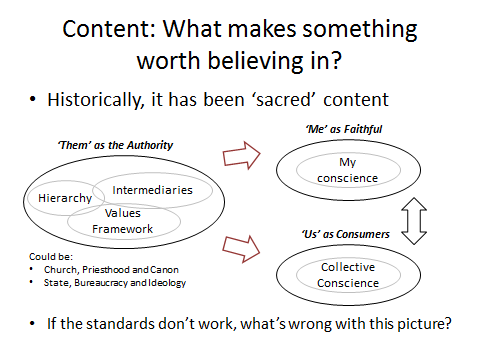
I had been thinking of the shared Christian story during the Renaissance in Florence, and how the economy around it worked because there was broad adoption. Church, artists, businesses and consumers all contributed to the great rebirth of culture. It was largely driven by the church and government institutions which we don’t necessarily want to recreate, right? So how do we achieve the same effect? Perhaps looking at the perspective of the consumers will help – what was it in their minds that drove them to participate? Regardless of where the message came from, what was the dynamic in the minds and souls of the faithful that made them adopt it? The answer is sacred content. The following two slides from that presentation address topic.


I adopt what I believe in, and if the content is sacred, then it is beyond question. Why do pilgrims line up to shrines of the Virgin, Buddha, dead (divine) kings or even Elvis? An authority has determined these are sacred and therefore worthy. Note that this authority is external to me as a faithful participant or consumer. The Authority establishes a values framework, a ruling hierarchy directs and stewards the sacred content, and a host of intermediaries that carry it out to the faithful consumers. We now have a strong distrust of authority, which has lost all legitimacy:

  • We don’t believe in elections because they are controlled by two self-serving political parties that are in the back pocket of corporations.
  • We’ve been betrayed by big banks that helped us get into loans we couldn’t afford. They’ve squandered our retirement savings and continue to lose money with risky investments.
  • We’re fighting intractable and unwinnable wars for what? Oil? We don’t believe in just wars.
  • The understaffed regulators who are supposed to be protecting our environment are asleep while big corporations permanently damage the environment by mining and drilling for non-renewable sources of energy.
  • Farmers can’t even save seeds for next year because they have been genetically modified by Monsanto, and the authorities are protecting the patents.
  • Politicians change their stories with the winds of election polling and don’t keep their promises.
  • Priests are preying on the young boys they should be nurturing into godly men.
  • The courts are passing rulings that allow foreign entities to fund candidates without limits.
  • and on and on it goes . . .

All around us there’s a collapse of the legitimacy of authorities, with much cynicism from the population. There’s never been a greater need for sacred content that can be trusted and deemed legitimate. How to achieve it without authorities? This is where we have to pivot our minds. We have to replace the dynamics of creation of sacred content within the authority to something else. This slide suggests an alternative:


We can create a values framework using collaborative culture techniques like community mythology projects. Out of these come sacred content that is legitimate because we created it according to shared values and a collective conscience. We have to put in place processes and rituals to establish, enshrine and communicate it.

That sacred content, together with excellence in art, can have an impact beyond commerce. Many communities have institutions dictating sacred content that don’t achieve an economy of culture. There no substitute for high quality production: excellence has its own logic (more on that later). When paired with sacred content, adoption is all but guaranteed.

— Roy Zuniga
Carillon Point, WA

copyright 2012 roy zuniga – all rights reserved

Pivot your Mind with Art

03 Sunday Jun 2012

Posted by royzuniga in Uncategorized

≈ Leave a comment

In the face of a somewhat dysfunctional civilization, the biggest challenge facing us individually and collectively is figuring out how to think differently. The good news is that we know that the way we currently think is screwed up. We also know that people can change the way they think. Here we’ll explore a practice that leverages art (of course): learning to do a mental pivot.

As we express ourselves in art we are making decisions and manifesting our personalities, our emotions and our skill level. Art is inherently expressive and subjective. When we do art, we are not thinking ‘this is Truth’, as a theologian would when writing or interpreting the inspired word of God. There is no such pretention. When we look at what we’ve made, we expect it to tell us about our individual state of mind. The subject matter may tell us we like fantasy, or we take things very literally. The line quality can be clear – which speaks of precision – or fuzzy and poetic. The colors tell us if we’re subdued or loud, whether we like harmony or clashes. The choice of medium says something about our personality – do we want to be done quickly with water colors or do we have the patience for oils? Art gives us a picture of our state of mind in the most powerful way. It’s hard to get as much out of an essay, although poetry can tell us a lot.

Looking at my own art work recently, for example, I’m seeing muted colors and bad drawing. It takes an act of the will to pump up the chroma and get the perspective and proportions correct. Some of that is just refreshing skills – I know how to draw; I’m just a bit out of practice. Other aspects require digging a little deeper into an artistic vision – the colors are muted because I want subtle color harmonies, or because I’m not mixing them well? If the colors are muddy, applying good mixing practices will clear that up. Muted color harmonies may be my intention. Or I might be interested in a stronger impact, in which case I can invoke my artistic license to amp up colors more intensely than they appear in nature.

Both solid skills and artistic license are standard practices for artists. They help us gain control of our works and make them say what we intend – to manifest our world view. While this is valuable in and of itself, what if we need to shift that world view?  Let me give you an example: as an artist I believe in the moment, and I express what I see – the boats in the harbor, the country roads, the flowers, the humor in a person as I paint their smiling eyes in a portrait. I’m using my skill and will as an artist to create great paintings. In my world view representing the moment, that completing a painting, expressing myself in color are good things to do. Someone else’s world view might lead them to create angry abstract art, or just combine objects in jarring ways. A socialist artist may want to create murals to educate an ignorant population about the evils of capitalism.

In each of these examples, the artist is living their world view. If you asked me to create angry abstract art, I would say I don’t do that anymore – I don’t see the world that way; I’m not an angry young man. If you encouraged me to paint ideological murals, I would not be interested. That’s just not my vision, not my world view. Should it be? I can see alternates, and yet not agree. That’s nothing unusual. We all do that. We also can come to realization that how we think is somehow messed up. For example, creating art for individual consumption will never fundamentally change the world, although a changing world may change the content of such art. Instead of painting boats in a placid harbor, we may end up painting boats on top of buildings after another natural disaster.

We’re also accustomed to going to galleries and art shows and having our world view rattled by other artists. Good artists will do that. However, often there’s not much of a point beyond the rattling itself. When was the last time shock art left you with a better alternative? What I’d like to learn to do is use art to shift my view of the world, and that is not something that is very common. I want to rattle myself – and you – into a better state. This may feel a bit like what a chiropractor does – applies measured violence to leave you sorely well adjusted!

The exercise I have in mind I haven’t quite conceived of yet. Maybe we’ll discover it together. It has to do first and foremost with becoming aware of why we make certain artistic decisions, like the format of the art work, to the medium chosen, the subject matter, expressive language, and so on. We have to get to the underlying drivers for those decisions, our assumptions about the world and our role in it. We have to pinpoint the values that are good, and those that are not so good. Once we find something to change, we have to get an objective look at it, ‘pick it up with tweezers’ so to speak and put it in a jar for observation. We have to look at objectively to consider the alternative ‘healthy’ counterpoint. We have to train our minds to pivot.

Even if we don’t yet know what to pivot to – learning how to pivot has value in and of itself. I do this my my abstractscape paintings. I’ll be representing a tree and also allude to a cloud. Actually artists do a subtle form of this all the time. We find rhythms in forms, patterns that repeat and echo in things that are. Pivoting is taking this to the next level and jamming something that is into something that it is not. The negative spaces between branches in a tree become the animated extremities of an unseen spirit.  The rounded facets on a peach become the stage for tension between colors that set each other off. The regular intervals of palm trees on a coastal boulevard allude to the bars in cage that keeps tourists locked in. These are mental pivots, albeit not very transformative. They are useful exercises that get us mentally in shape to pivot to new values in a new view of the world. So next time you are painting, let your subconscious nudge you into pivoting into another world. Learn to think otherwise. Until we all do, we won’t have a successful transition.  

— Roy Zuniga
Carillon Point, WA


Copyright 2012 Roy Zuniga – All Rights Reserved  

Good Practices from a Previous CMP

03 Sunday Jun 2012

Posted by royzuniga in Uncategorized

≈ Leave a comment

Before we look to future exercises in mythic awareness, let’s look back at what was done last year in the Duvall Community Mythology Project (see Duvallcmp.net). The purpose of a CMP is to take organize the myth making process into a six month effort. I don’t know of anyone who’s tried this before. As I mentioned in a previous post, we ran into issues, which I won’t recount here. We did actually accomplish a few things, from which we can learn:

–          The concept resonated – there are segments of society that agree we need to change our myths and who are eager to participate, or at least explore. The Duvall CMP has about a dozen active participants at one point. The Facebook page has about a hundred ‘likes’. While not a lot, it does validate the concept.

–          Mythic awareness exercises helped people become aware of how myths are working in our lives. We dissected the story arch from a couple of movies (The Wizard of Oz and Avatar), identified themes and values and rated them.

–          The shared framework exercise led to the creation of themes to guide the next stages of custom myth making.

–          We selected a theme, called Primal Satisfactions, as the basis for the first shared story, and drilled into more detail on the conflicts, morals and values that we wanted to foster.

–          People got creative and wrote stories.

–          The endeavor also helped me flush out more concepts, such as the notion of ‘sacred content’ which I will elaborate more in a future post.

–          The project brought people together in person for creative fellowship around a shared purpose.

So even if we didn’t actually get to the point of creating a new myth and embellishing it with art, we did make a great start. I felt that people understood, at least intuitively, what we were after.

— Roy Zuniga
Kirkland, WA 

Recent Posts

  • Can we still paint ideal figures?
  • Language in the Service of Myth
  • Channeling Intent
  • The Divine Right of Christ
  • The Space God

Archives

  • December 2020
  • August 2020
  • December 2017
  • July 2017
  • June 2017
  • May 2017
  • January 2016
  • December 2015
  • February 2015
  • December 2014
  • November 2014
  • October 2014
  • August 2014
  • June 2014
  • April 2014
  • February 2014
  • April 2013
  • March 2013
  • June 2012
  • May 2012

Categories

  • art
  • mythology
  • Uncategorized
  • Worldview

Meta

  • Create account
  • Log in
  • Entries feed
  • Comments feed
  • WordPress.com

Blog at WordPress.com.

  • Subscribe Subscribed
    • Dynamics of Myth
    • Already have a WordPress.com account? Log in now.
    • Dynamics of Myth
    • Subscribe Subscribed
    • Sign up
    • Log in
    • Report this content
    • View site in Reader
    • Manage subscriptions
    • Collapse this bar
 

Loading Comments...