• About
  • Blog Spots

Dynamics of Myth

~ using culture to shift our worldviews

Dynamics of Myth

Category Archives: art

The Divine Right of Christ

20 Wednesday Dec 2017

Posted by royzuniga in art, mythology

≈ Leave a comment

Tags

Christianity, faith, monolithic religions, Story telling

Who gave Christ his divine right? Was it not theologians? As understood by Christians, we didn’t have a visit from the Father to explain things to us for all to see because by definition he can’t visit us or related to us. He’s wholly Other, he’s omnipresent and omniscient. Therefore, He had to send an intermediary, his very own son, the Christ, begotten but not created, to be human and to dwell among us, to experience and suffer our frailty and victimhood, so that through our ultimate rejection of Him, his corresponding sacrifice, God the Father could exercise forgiveness to the repentant, to those who understand they are sinful. The murder of Christ was the rejection of the Father God and as such the ultimate rebellion. In his infinite Love and Grace, however, by allowing the death of his Son and then demonstrating resurrecting power, the Father provided a path towards reconciliation because ultimately, we are all his children. Like Christ, we will also all be with Him in the heavenly, physical dwelling, someday. If we believe.

By now this is an old story that has not been allowed to evolve fundamentally. Why? Because of the canon of narratives, the Bible had to be locked to support the theology of the church. Without that lock that is the Bible, the myths told would naturally evolve, as they do outside of the monolithic religions (which I’ll just call ‘monoliths’ for the purpose of brevity and metaphor).

In the study the African or Polynesian myths, and you can hear how the stories are fluid, with particular emphasis on this or that god, and this or that behavior of that god, changes by location and time in response to the needs of the peoples and the influence of other myths. Selection and articulation of myth are guided by the intent of the population. For example, trickster gods (and by inference trickster men) come to be expected in Africa, and this is reinforced by the myths.

Such fluidity is the enemy of theology, which needs to lock down the protagonists and their essential nature. In classical Christianity, we have the Trinity and other doctrines defined by conventions and councils with great seriousness. Yet over time, cultural currents inevitably erode the pillars of theology, which must be constantly reinforced. Maintaining the edifice of theology is a full-time job for many, and thus a livelihood. It’s easy to see how those invested in the institution of doctrines will consciously or subconsciously reinforce that institution. Given that humans love conflict and battle, staging conflict should be part of the business model. Intellectual wrestling, even about godly topics, is conflict.

Christianity wants the monuments of the ‘false gods’ to erode and wither in order to replace them. By way of comparison, monolithic soccer would replace monolithic football if given a chance. To theologians of any given monolith, Christianity can’t just be ‘another sport’, so to speak. Key differentiators must be found – the ‘us vs. them’ distinctions – because without them religions would be moral equivalents. When salvation is put forth as the ultimate purpose of religion – and thus is in turn required by the exclusivity of the chosen savior – then only one religion must survive. Denying that means denying the exclusive nature of their message, i.e the reason the religion exists.

Once asserted, the exclusivity principle must be upheld at all costs. It can be made more palatable through syncretism, there can be overtures of tolerance and loosening up of the rules of behavior that pass for doctrine (can gays be married? etc.) or the norms that seem anachronistic (can only men be priests?). Despite this tug of war within the camp, the lynchpin that can’t be pulled is the exclusivity of the means of salvation. Without it, there is no monolithic religion. By definition, therefore, the need for salvation must be established. In this light, a mechanism for salvation is an assumption. It’s the defining characteristic of religion, i.e. a well-defined and achievable path to life with God. Faithful fans will argue about rules and uniforms, but denying the need for winners and losers in eternity would nullify their own investment. Like sports, the monoliths are a self-sustaining ecosystem.

Thus, for Christians to be on the winning side is to have a single Omni-god (with a diversity of attributes), and not a pantheon. We could ask about the merits of one vs. many, but that would be sacrilege. It is, however, an irresistible digression. Is it really easier to discuss the wrath of the one Righteous God, the mercy of the same Forgiving God and the regeneration of Christ the Redeemer than to just have a separate god for each aspect? One with many attributes or many with single attributes could be argued to be functional equivalents. Mars, Venus, Mercury, etc. Perhaps the universality of these attributes is why harmonization across Roman and Greek, Greek and Egyptian gods is possible to some extent. We’ll have to leave those questions for now. God archetypes is a curiosity to be explored on another day.

The real point of these distinctions is not to come out with an understanding of the true monolithic religion as if the choice was between the One God and one of the god sets. We’re blind sighted by that polemic. It’s a diversion. The fight for ultimacy sucks all the energy out of the earnest and faithful, who don’t realize they can take control of their own stories. Minds shaped by religious wars can’t think creatively.

Ideally, story evolution would be nurtured. We can see this in the ‘apostate’ creative hive that is Hollywood. Characters from the Greek pantheon are evolved – like Thor. New ones have been added, like Wonder woman, whose backstory is tied to the ancient myth of the Amazon women. How fun! Moviegoers don’t take offense at the evolution of the stories because that’s what they want: change, creativity, new ways of expressing the values they cherish. Superhero movie making is picking and reinforcing new values, programming a new generation in new behaviors that are important. We can learn from the craft of screenwriting, which has matured to recognize the response of a protagonist in the face of challenges to their driving intentions defines the strength of their character. The cycle of the Hero’s Journey has gone mainstream. Thus, powerful and buff kick-ass women are a new standard set by feminist producers who are tired of the old sexist stereotypes. These views will themselves evolve over time, as Men respond to defend their right to act on their testosterone levels. The ebb and flow of emphasis in stories are natural. Superhero agendas of today will also pass.

Theology and mythology are at odds. Theology needs an assertion of exclusivity to be realized. A hero must be picked as the Anointed One, the one whose journey exemplifies key learnings and behaviors, one with whom we can empathize, and thereby internalize their values, behaviors, and responses to circumstances.

To see the religious ecosystem for what it is, one must step back. It helps to question the assumptions (as I have done elsewhere in the dynomyth.net blog posts). For example, does ‘hell’ make sense, how do we know Christ himself wasn’t deceived and later impersonated by higher beings who are gaslighting us like our own public ‘servants’ do (the so-called ‘n-level problem’), etc. Above and beyond the criticism, it is helpful to have an alternative paradigm, and that’s where intention-based belief comes into play. A benefit of coming out of theological controversies is that you become familiar with some of the key questions, like pre-determination vs. free will. These are real struggles for many of the faithful.

How to know the will of God? To what extent can I mold my own destiny? Put simply, intent-based faith assumes there is an ‘orchestration engine’ out there – call it God, call it the Universe, call it what you will. We don’t know it directly like we know a person. There is no objective incarnation. The Universe doesn’t have an avatar to talk with us, although certainly through stories we can invent one. We just accept it exists. I gave it a name, Uranthom, for expediency (it should be in the dictionary). You can call it what you will.

The model is simple. As individual articulates and expresses his or her own intentions, without assuming they know how they will be realized. This articulation is otherwise known as prayer. Uranthom then takes over. Over time, if there is enough alignment on intentions, the intent will be realized in ways that are both directly related to the original intention but at the same time, surprising. This is why it is important to separate intent from a specific prejudice for its realization, otherwise, you might be disappointed. This is analogous to God’s sovereignty in religion – you don’t always get what you want in the way you want it. It also explains free will because you get to pick your intentions. Uranthom’s effects could be interpreted as the actions of a loving, personal god (especially if you already created a divine personality).

Moreover, there’s a greater chance of having your intent realized if you get other people to align the intent (which is analogous to group prayer). What better way to do this than via story-telling. Are you passionate about your intent? Then get creative. Write a story, make a play, create a movie and get it distributed. This exercises the mind and energy of the faithful, who are no longer spectators and mere financial supporters.

Without story, theology has no legs. Theological concepts are abstractions most of the faithful don’t care about. So, stories have to be created to tie it all in. Biblical stories, which were originally created by the people, have been appropriated as canon and are now the top-down delivery mechanism that sustains theology. Clergy of the past did pick some good stories, stories that people can empathize with and learn behaviors from. The interpretation of which has been self-serving to the ecosystem. It doesn’t have to be.

The natural course of myth-making based on a people’s intent denies the divine right of Christ to rule over our thoughts in decision-making. Story making is a fundamental act of rebellion against monolithic religions, and the affirmation that your intent – and especially the community’s intent – is what matters. Hasn’t it always been that way? We pick an existing religion that aligns with our intent. That act of choice proves we pick our own flavor of the One Way. Let’s just acknowledge the dependency of sacred stories to our personal intents, roll with it and get creative. Start influencing.

— Roy Zuniga

Campeche, Brazil
December 2017
A Universal Process for a Personal Worldview

02 Sunday Jul 2017

Posted by royzuniga in art, mythology, Uncategorized, Worldview

≈ Leave a comment

Tags

art, Community, community mythology, faith, intent, intention, Jesus, mythology, religion, Worldview

My worldview guides me, as does yours. I believe in expressing intent as the basis for experience. This world view is also a process that can be applied by everyone. The key is to let ‘the Universe’ have its say in how our intent is fulfilled, considering the intent of others in our domain, and trusting that a suitable outcome will be orchestrated. This is fundamentally a positive outlook. It is also simple. The goal is to have humanity spend less time rationalizing manmade theological problems, and more time actually experiencing life. Nature is in danger from those who don’t know her, who don’t know how connected they really are to her.

I am approaching topics of ultimacy from the personal experience of what works. Praying to Uranthom works for me. Reflexive prayer, i.e. the notion that all spoken prayer for our own benefit, reinforces my intent. Understanding self is so important because being aligned with what makes you tick is the best possible experience for you as an existential ‘node’ in this collective and connected existence. If physical creatures can achieve a ‘heavenly’ experience on earth, why look forward to a non-corporeal existence? Consciousness without physicality is a hell. Whether our souls go to ‘Heaven’ or blend back into a mystical cosmic consciousness, I do not know. I am confident that the Universe that makes Uranthom possible will have a suitable resolution of my consciousness existence.

We get into trouble when we make ‘authoritative’ and exclusive assertions about God the way both Muslim and Christian theologians have over the ages. Conflict arises when the respective believers take the God-speculation literally and defend mutually exclusive absolutes. The line of thought that tries to define God is a dead end. We can be believers without absolutes. In this mode, all world views are necessarily individualistic, which is what I think happens anyway, even to those who believe in the ‘heaven first’ approach where guidance comes down from God.

If you find your mind caught in a web of theological conundrums, it may be helpful to trace back the chain of ideas that led to your beliefs. I did, and it led me to start fresh, from scratch. What kind of conundrums? For example, conflicting ideas about free will vs. predestination; obsession with a physical God who cannot be touched; someone we talk to but who never talks back.  Reconciling undeserved mishaps and tragedies with God’s good purpose for pious people. Talking about both love and eternal punishment in the same conversation. Advocating the never-ending exploitation of a finite earth. Advocating equality of genders while keeping the man as the ‘head.’ Preaching compassion and acceptance while attributing people’s sicknesses and disabilities to sin or laziness. Teaching forgiveness while always finding an enemy to fight. Asserting world peace is on the other side of a war. Thinking like this is making our planet sicker, and we need to change it.

Trace the origin any one of these ideas and you find they go far back, some thousands of years. The writers we read were influenced by ideas they might not properly credit. The Christian worldview goes back to the Greek philosophers, the Stoics, Christianity, kings since Charlemagne who believed in the divine right, the Protestant Reformers, and American conservatism. For example, we celebrate Easter because it recalls Christ’s death and resurrection. Why did He have to die? Shed blood was the atonement for sin. Why can blood atone? Because of pagan beliefs that God(s) demand it for transgression, and to earn favor. Why did Christ specifically have to die? Because he is God incarnate, and as such can atone all of humankind. Why does God have to be incarnate? Because of the theological tradition that requires God to be involved in human affairs, and the certainty that God(s) have to exist somewhere physically, like the Greek pantheon on Olympus. Change your worldview, and you change your destiny.

The tumor of over analyzed worldview tends to grow bigger as each generation tries to sort out one conundrum or the other, resulting in more spaghetti theology. Topics like ‘how do I stay out of hell?’ and other questions become irrelevant. That is all a huge distraction that myopic and weak-willed theologians debate ad-infinitum. Like addicts, they can no longer recognize the simple life and how good it can be. To those invested with years of study of treatises and intellectual traditions, real happiness and peace are a sign of apathy! They can not recognize a completed human being if she was sitting next to them in Sunday morning pew because such people are only expected in heaven. We could play their game and argue with every position that has been taken since Socrates. I do not have the life-energy to do that. Theology for its own sake only produces secure employment for professional mental wrestlers. We have to keep it simple. We can just snip that chain of beliefs at the source, let the weight of conundrums fall to the floor. Life goes on, and we can experiment with alternate foundational principles.

The fundamental worldview question we have to answer is ‘how should we live?’ I have arrived, for now, at a process build on existence as an experience of intent. Intent is simply an affirmation of the desired outcome. This is just a hunch, but so far, it is working for me, manifesting peace of mind and a good life. Note that intent is not the same as will. To will something implies a certain coercion, even if it is your own actions, which is a more aggressive stance that may in fact work against you.

Intent is a passive internal assertion that can be either be silent or can also be reinforced through vocalization, by saying it aloud (as in prayer). Lack of vocalization does not diminish the power of the intent. The ‘Universe’ realizes your intent based on an orchestration process that is opaque to us. I do not see the value of postulating what ‘God’ or ‘the Universe’ thinks and does since by definition it is beyond our grasp. This is why I invented the notion of Uranthom, which is my abstraction layer to what happens ‘out there’.

We express intent many times a day, thinking ‘yes I want a new shirt’, or ‘we pray for a new school for those missionaries, amen!’, or ‘I’d like to sleep in this morning’, or ‘I’d like to be paired with a woman (or man) like that’, or ‘my energy is better spent painting’, for example. We often try to execute on the intent, and this is where we should rather pause and listen to the Universe. Mindfulness is important before taking action, as is patience. I call it ‘manifesting’, which simply means that given some time for processing, those outcomes you intend will be orchestrated along with the intent of others for a more satisfactory resolution. It may not be exactly what you had in mind to start, but examining those desires in light of the outcomes, you will find a good state, one, which inevitably leads to new intent. Thus life evolves in a dialectic with Uranthom, the receptor of our expressions of intent.

If you have a communal intent, like ‘I wish to go to the ball game with my friends’, or ‘we need supporters to donate money to pay for fuel for the ship’, then expressing it helps align the intent of others. The expression can be a post on social media or a prayer in church. Because intent is bubbling up regardless of whether you are in a religious house or not, we do not distinguish between prayer and other expressions of intent. Intent that aligns with that of others is more likely to be realized. This is a driver for social awareness and political action, because, without the expression of an alignment on values, we are not likely to get our way.

Happiness comes from a realization that as you let go, and the manifestations are real, you stop being frustrated about what happens (or doesn’t happen), and start being present to recognize and enjoy goodness. This is parity for the assurance religious people feel when they believe ‘it’s all in God’s hands’. This mindset does not come overnight, especially if you are mired in the conundrums your ancestors fed you with our mother’s milk. Intent that aligns with that of others is more likely to be realized. As is intent that aligns with the progression of the Universe towards harmony, (this assertion, by the way, is an expression of my own intent). If we all share that intent, it will be. The simplicity of the model is the conscious expression (internal or external) of your intent, coupled with a letting go so ‘the Universe’ can manifest that intent.

This all sounds so simple and even mystical. What about all those conundrums that theologians and philosophers have spent lifetimes debating. Are we going to address those questions? I believe a lot of it gets sorted out on its own when you pivot on intent. For example, we don’t have to account for an all knowing God, since ‘God’ knows through our experience. I don’t believe in a God object, a person-like entity who somehow both sits on a throne and at the same time knows everything everywhere and has all power as Christian doctrine affirms. God may, in fact, have some of those attributes, but it is in a distributed fashion.

It is my hunch – and you don’t have to believe this, it’s just my way of dealing with categories of thought that need an accounting – that the ‘the Universe’ achieves omnipresence and omniscience through physical instances of people and other creatures who are embedded within it. ‘Creation’ is a mechanism for self-discovery. Good and evil are really just relative ideas based on the quality of the outcome of intent. Suffering is not a consequence of sin, but rather a consequence of intent and actions that don’t align with a viable existence. Mistaken experiments fail, people learn and change their intent. Look at the Chinese stance towards pollution. They have gone from not caring about it to engineering forest cities. We just have to learn from misguided policies, improve, and move onward towards a healthy expression of a society that doesn’t leave people behind.

Predestination is a moot point, since you are the agent of destiny, if you intend it, it was meant to be. As you realize it, it is also known. As the universe experiences and understands itself through each one of us, this universal consciousness grows. As we expand our experience, we expand the instantiation of knowledge of that area. And we move on. Now don’t ask me about the mechanics of all this. It’s just a myth that helps me explain things I don’t understand, as all good myths do. All this assumes positive intent and has yet to be proven. What will be the intent that wins out in an over-populated world?

Now don’t ask me about the mechanics of all this. It’s just a myth that helps me explain things I don’t understand, as all good myths do. All this assumes positive intent and has yet to be ultimately proven good by humanity. What intent will win out in an over-populated world?

Since you are so important in this whole evolutionary process, it is important to understand the criteria by which you affirm intent. This is the domain of values. Decisions are based on what you consider worthwhile. Some of these are instinctual and innate. We naturally want intimacy or a fun night out with the guys (or gals). We dote on our children by nature. Some behaviors are learned. We defer to elders, distrust strangers or hate to accept help from others. Some values are ideological, such as patriotism and loyalty to a class structure.

Good values come from a common humanity. Despite all the theological conundrums, good values undergird every major religion and provide the redemptive glue that gives them longevity. This is where ‘culture forming’ or ‘cultural engineering’ come into play. What you call it depends on your temperament, but the gist is the same: we understand the dynamics of how humans internalize worldviews, i.e. through prevalent myths, which program the depths of the mind that impact the process and scope of decision making. The arts define these myths, and thus through art, we can change the operating system of the psyche.

As I’ve written elsewhere, Community Mythology is a technique that uses the arts to ‘craft’ a world view into a culture. The idea is that we collectively agree on the set of behaviors, and their underlying values, our common humanity, as colored by the experience of mistaken communities of the past (such as the Nazi experiment). A group comes to mythic awareness by recognizing when cultural artifacts, such as movies, advertising, and political rhetoric are impacting their value system. Awareness is the pre-requisite to a conscious decision process, a kind of ‘pre-qualification’ of the values we let into our intentional decision making. Allowing certain values into our lives is itself an intent.

Make no mistake about it, this a powerful ideological cocktail. The power of the Universe is harnessed with intent, and intent shapes its destiny with humans. Mis-guided collective intent results in ‘evil’, and people consequently suffer. Properly guided intent results in goodness for all those involved. Based on values we deem to be sacred, we have to express our intent, and then, as the saying goes, let go ‘and let God’.

— Roy Zuniga
Langley, WA

Creating Mythic Art

21 Saturday Feb 2015

Posted by royzuniga in art, mythology

≈ Leave a comment

Tags

art, Christianity, community mythology, comparative religion, dynamics of myth, Joseph Campbell, myth making, mythology, religion, Sacred Story

So far I have been looking at myth-making from the perspective of how communities can ‘re-program’ themselves to implement more sustainable behaviors. We can think of this as the ‘human software’ role for myth. The theory is people will empathize with mythic heroes on their journeys and mimic their decision making when faced with analogous circumstances.

However, there is another role for myth as a way to connect to ‘the world behind’, or ‘the other plane’. In this view, myth is the portal, the mystical means by which we can make things right with the gods, and in so doing enhance our spiritual survival. In other words, we go from mythology as a systematic and somewhat objective study of the stories of culture, to a faith-full ‘mythism’. This is a belief in the power of the myth itself. In Campbell’s terms, myth gives you ‘a line to connect with that mystery which you are.’

If we take either one of the approaches without considering the other, we miss out. Focusing on the hereafter without regard to the planet does not lead to integral living: as the planet sours, the daily reality of living contrasted with the spiritual journey towards bliss causes us to live with tension, dissonance and conflict. All sorts of dysfunctions result, including the creation of artificial environments, denial, retreat, escapism and even hatred. Some of the most vitriolic chronic ‘haters’ are those who feel others have come in between them and their journey to bliss.

On the other hand, while focusing on the here and now can help organize and clean up society, it doesn’t address the basic human need for meaning and an explanation of the soul’s afterlife. Do we have to choose between approaches? I think not.

The duality between the pragmatic behavior-focused approach and the spiritual journey has something in common: sacred stories. For community myth-making, these are the stories that hold our core values as exemplified by normative behaviors. For the spiritual pilgrim, these very same stories hold the metaphorical images and concepts that provide a connection with the gods and their normative behaviors. Align the two and we have the formula for cultural transformation. Myths give us the sense that today’s acts can be brought in line with how things are done on the higher plane. It’s imperative, therefore, that we align our mythical world with what life on earth should be. What does that look like?

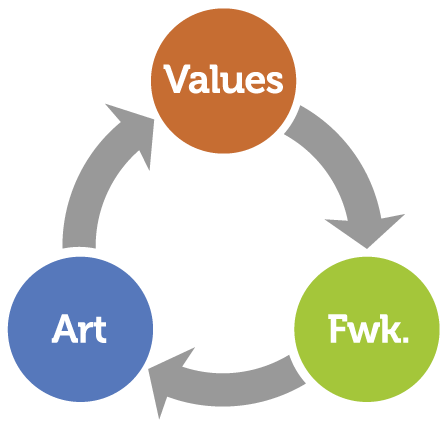
Myths are all around us and every culture has them, but where do they come from? I dare say none of us has invented a widely adopted sacred story (yet). Let’s face it, we’re not accustomed to bootstrapping our sacred myths. Historically, no one person invents a religion; even if it came from a founder or prophet, it only has the legs the community choses to give it. In other words, myths are community creations. Given the need to elevate our behaviors, we can think of the process in three phases:

Three Phases of Myth Making

  1. Sacred Values: We need the notion of sacred values and behaviors, and this is best defined by the community itself. We really do know the answers; we just have to agree and write them down.
    • This is actually not that hard. It starts with mythic awareness, and then coming together to define themes for change.
  2. Myth Framework: We need the masters of metaphors, those who actually create the allegorical imagery and story that we can use to re-program ourselves.
    • This is perhaps the most important phase because it will scope the realization of the myth. Mythical art expresses a shared purpose.
    • The a-priori to mythical art is the shared story. The narrative phase, therefore, is a necessary pre-requisite. This is why we stress the need for a story framework early on in the community myth-making process, which is just a natural expression of a shared belief.
  3. Artistic Myth-crafting: After this come the execution, or creative phase.
    These three phases are described in more detail at Cultera.org.

Artists are the myth realizers – making sacred stories tangible, a necessary pre-requisite to belief. Think about the dimensions of illusion here. For example, a two dimensional surface (the canvass with paint) provides an illusion for a three dimensional form. If the work is figurative, we can infer another dimension, namely the sense of presence of a personality when done well (like a Rembrandt portrait), a fourth dimension. Moreover, if it provides a sense for time past or alternate worlds, we have a fifth dimension (like allegorical art on the Sistine Ceiling). So far we have described qualities what many great works in museums have. They are not necessarily mythical without additional context. The next dimension is narrative context and symbolic meaning. This is what puts art in the realm of myth. The sixth dimension is the portal to the world behind the world, and it’s actually something the viewer brings to the work, i.e. a knowledge of the story. Art has these six dimensions is mythical.

With mythical art, the artist is facilitator of transcendence. Connecting with ‘the world behind’ actually validates current decisions when they are seen as consistent of the laws of that other world, as revealed by mythical art, which by the way, can include dance. Artists with community-sacred values are to be valued as a myth-crafters, those who create the means of collective healing and transformation.

Artists don’t have to dress as priests, mediate and set themselves apart from carnal desires in order to create this sacred art. In fact, it’s not really about the artists themselves. Myths will do their work regardless. It’s the job of the artists to be faithful to the theme and express in the works a heartfelt conviction. This view of the artist, while not new to civilization, is strange to the modern mind.

On a personal note, I’ve come full circle from being an artist who threw away his paint brush to preach a reductionistic gospel of Jesus Christ during two years as a missionary back in the early 1980s, to one who now advocates an expansive vision for making myths as communities write their own gospels, which serve functions of religion. What’s more, this process requires artists to pick up their paint brushes, chisels, pens, musical instruments and whatever other art crafting tools they have at their disposal.

This is trippy because the traditional missionary comes to a people with a message, and seeks to find an aesthetic way to present the pre-conceived – and often ancient – pathways to God. In our new practice, we don’t come with the message – that is the responsibility of the local community. No, we come with a methodology for letting them create their own and helping artists understand the crucial role of mythic art. This pre-supposes a great faith in humanity.

— Roy Zuniga
Feb. 2015 – Langley, WA

copyright © 2015 roy zuniga – all rights reserved

48.040095 -122.406257

Art as a local economy of discovery

30 Tuesday Dec 2014

Posted by royzuniga in art, mythology

≈ Leave a comment

Tags

alternate economy, art, community mythology, modern art, new stories, technology innovation, transition movement

In the book Zero to One, Peter Thiel notes that a large segment of society has stopped looking for secrets in relation to new technology. People think all the hard problems have been solved, and what remains is either easy to do or a mystery and impossible to know. The book is very insightful in other respects as well. What struck me as an artist who uses very old technology (painting with pigmented oils) is that the mysteries artists discover have nothing to do with technical secrets. Scientists look for the undiscovered technologies. Artists, on the other hand, manifest mysteries with mundane means on everyday walls.

Both are valid, and both can be used to drive commerce. In today’s world where we are drowning in gadgets, it’s time to explore how art can be used to bring forth an alternate and more humane economy.

Technical consumerism is choking our planet. Clearly there is a thirst for progress out there. While a small segment of innovators is looking for discoveries, the rest of the population is looking to compete over the production and consumption of commoditized technologies. We gloat in the benefits of yesterday’s stellar innovations having been made available to us at ever cheaper prices. At the same time our actions are diminishing the biodiversity of life on a finite planet. The producers don’t tell us about this hidden cost. That job is left to the activists who raise awareness and prick our consciences. If we can’t channel this demand elsewhere, we risk being awash in real garbage as we enjoy virtual worlds.

The problem is not with the innovators or activists. The problem is with producers and consumers, who have a tight inter-dependence. Lust for products is generated by the producer’s marketers and advertisers. This message is then internalized and expressed by consumers. Like members of a bizarre cult, after a while we can’t let go of our consumerism because doing so would invalidate our beliefs, practices and past choices. It’s a sick symbiosis, but let’s be clear the problem lies squarely with the consumer addiction that is fueled by the product mythologies. Myths of personal productivity, of connectedness, of sharing images, of fast shopping and shipping, etc.

The key to change is therefore breaking the addiction on the consumer side, possibly by replacing the mythologies and their perceived benefits. We can, for example, have anti-consumerist stories put the old behaviors in a negative light, while at the same time not detracting from the innovators who can provide technologies to overcome our current pollution problems. Technology is not the enemy: the wrong version of consumerism is our collective mad obsession, and to change we need new world view stories.

We can imagine a world where consumers skip a few generations of innovations, much like some developing countries leap frog technical adoption that the West leveraged. This is a multi-facetted problem to solve, but there may be a glimmer of an answer in art, which can play two roles: a) helping to change the mythology of consumerism by providing a vehicle for new desired content, and b) by becoming a new target of consumption.

Why would art become something to lust after by the change-hungry tech crowd? This is just a hunch, but there is a link between consumerism and discovery. Tech junkies are thrilled when we can have the latest the latest technology. Remember when touch screens came out, and what an amazing experience it was to have the physical buttons replaced with screens that can change? Many of us who thirst for progress felt compelled to upgrade. That thirst has not abated, and the tease of ever bigger screens and thinner phones and tablets has us on a consumer craze that is fueling an unprecedented rate of exchange for gadgets.

Today, we don’t look at the phone the way grandma looked at the Maytag washer in the past, i.e. as a reliable machine that would do its job well for many years with little to no maintenance. To sell product, technology companies have convinced us that what counts for ‘doing the job well’ changes every six months, and that therefore our relatively recent purchases need to be upgraded frequently. Heck, recent advertising suggests you can just upgrade for next to nothing, so why not do it, regardless of the state of your old phone. This is not a sustainable mindset; but it is the current madness of the masses.

One of the biggest ironies of social media today is that people have to be focused on a gadget – their computer, phone or tablet – in order to share about themselves with others. There’s an illusion of connectedness that, if we are honest, is strangely not deeply satisfying. This was highlighted recently with Facebook’s mass production of image timelines for a person’s year, as if the machine could determine what defines you in the year by what you post online. We all adopt certain personas online. To have the system provide you with a digest of your online persona for your approval so you can share it with the world is really an inversion. The machine is now defining the person, and consumers obediently share out of a misplace sense of duty to false connectedness.

This cult of technology is dehumanizing producers as well as consumers. With the race to the bottom on price comes the inescapable logic that the production systems and cloud infrastructure should standardize. While the customers should have ‘choice’, the product companies have to streamline, and that means fewer choices for the producers. Deviation from simple, repeatable automation on standard equipment works against the bottom line. People who have to deal with exceptions in the standard process are expensive. So end-to-end processes are being designed to leave the human out of the production as much as possible. Ostensibly this frees key people to focus on strategy and direction. Ultimately, the number of people required for the new roles is much smaller, and layoffs ensue when standard automation is fully realized.

So we have the paradox of choice – increasing the choices to consumers necessarily means reducing choices on production. Get more people to buy more things produced by less and less people. In fact the two forces are linked – standardization on production means that more and more competing companies will end up having different flavors of the same essential product. How does the human benefit from this craziness? We don’t. We get absorbed in the incremental consumerism where we obsess over micro-differences in products and constantly upgrade to get the next version to compare and show off.  Or, if we are on the producer side of things, people experience becoming as fungible as the machines in the cloud data centers that can be swapped out at a moment’s notice. ‘Progress’ has hijacked humanity.

Therefore we have to slow down on the consumerism, and at the same time decouple innovation from that cycle so that scientists can work on unlocking secrets of the universe that will benefit humanity. Art can play a partial role here, I would like to argue, in diverting the consumer thirst for innovation away from the production of commodity gadgets to a discovery of mysteries through art. Not that art is the superhero to save the planet, but there is a dynamic of attention incited by artistic discovery to be valued here. And it’s not technical discovery. Let me explain.

The core of consumerism is a lust for the new. Modern art capitalized on this and accepted formal changes in how art was rendered as innovation, and connoisseurs lapped it up like iPad junkies on a new release. Yet there is another segment of artists who don’t look to formal innovation as the measure of the works. These traditional artists don’t understand the madness of the modern art scene because they view art through a content lens, not a technical one. Perhaps this explains the modern art craze that drives up bidding on dumb empty works: the buyers are seeing art innovation as a kind of technical innovation, and that is valued for its own sake.

Regardless, artists should apply the mastery of old techniques in the services of new images that convey values that are relevant to the day. So it’s not about technology; it’s about content. With art, the technology and content must support each other, as expressive use of the medium is integral to the impact of the work. Formal expression can’t be an end in itself, however, even in the pursuit of ‘sacred’ content. If the expressive execution precludes or overwhelms the users’ ability to connect with the subject matter, we haven’t achieved our ends.

What is this desirable content that will seduce consumers? I can envision two levels: a) a lively community discussion about shared values, and b) the rendering of mystery. Of course, these can be complimentary efforts and one work can even manifest both. The consumer’s role is unpacking the nuances of mysteries rendered in art, mysteries which touch on the shared values being targeted by the community. To achieve this, we have to learn to look, not for features, but for meaning. In a very tangible sense, an artist can render her response to mystery for you to contemplate, to consume, internalize and respond to. The role of producers as advertisers is replaced by the community as advertisers of values, which generates the desire for works. This is a good consumerism that is not an opportunity cost to a viable planetary ecosystem.

How can this work? As I’ve written elsewhere on community mythology, a creative lifecycle or season of embellishment can be chartered by a given town or region for the express purpose fostering the production of art aligned around certain themes.

Care must be taken to value high quality, so we’re not talking about newfangled consumerism of large quantities of low quality works. This raises the question of the market: where will the purchasing power come from if not from the production of technologies. The simple answer lies in reverting back to old models for local economies. Much has been written about this in the Transition and other movements, and I won’t cover that here.

Let’s also keep in mind that mythologies that stick with people generate economy. We have only to look at Star Wars, Harry Potter, The Hobbit and Lord of the Rings, superhero movies, etc. to know that these shared stories can take a life of their own, with very passionate participants. All this hunger for stories and artifacts is a proven driver of commerce.

Art can help us reclaim our humanity from the sea of technology. As we find our dignity as beings, we will hunger for true connection with others. For the cycle to be complete, art should focus on the shared values the local community holds scared. Only then can we have a deep and meaningful conversation that elevates our existence and frees us from reducing the planet’s resource stock even as we pile up used tablets and phones.

— Roy Zuniga
Dec. 2014
Kirkland, WA

copyright (c) 2014 Roy Zuniga

Recent Posts

  • Can we still paint ideal figures?
  • Language in the Service of Myth
  • Channeling Intent
  • The Divine Right of Christ
  • The Space God

Archives

  • December 2020
  • August 2020
  • December 2017
  • July 2017
  • June 2017
  • May 2017
  • January 2016
  • December 2015
  • February 2015
  • December 2014
  • November 2014
  • October 2014
  • August 2014
  • June 2014
  • April 2014
  • February 2014
  • April 2013
  • March 2013
  • June 2012
  • May 2012

Categories

  • art
  • mythology
  • Uncategorized
  • Worldview

Meta

  • Create account
  • Log in
  • Entries feed
  • Comments feed
  • WordPress.com

Blog at WordPress.com.

  • Subscribe Subscribed
    • Dynamics of Myth
    • Already have a WordPress.com account? Log in now.
    • Dynamics of Myth
    • Subscribe Subscribed
    • Sign up
    • Log in
    • Report this content
    • View site in Reader
    • Manage subscriptions
    • Collapse this bar
 

Loading Comments...