Exploratory Creativity

Painting is creative precisely because it differentiates, explores highlights, loses and finds forms represented by a variety of strokes of paint and color. Art renders the artist’s perception, not of what he or she sees with his eyes, but what is projected by the mind and will as notable. This is not strictly a reflection of reality, but a recreation by the directed hand of the artist, who is exploring.

By choosing to perceive the work of art, the viewer in turn participates in the both the exploration of the artist’s handiwork and the outcome he or she came to. The work is notable to the community if it was exhibited, and then perceived by you, the observer, who explore and move on. This is the ecosystem of meaning, where meaning is defined as the perception of notable events. You have to make a selection in order to perceive, and evaluate to accept the notable. This is akin to how evolution happens, when certain notable traits crucial for viability are selected through an exploratory process.

Mother earth tried billions of molecule combinations before arriving at one that enables photosynthesis, for example. Artists create by exploring a domain, one area at a time. The evolutionary principle that gave us photosynthesis also works for aesthetic creation. Pushing paint around with an exploratory mindset is akin to the biological process that gave us critters.

In an afternoon painting session we can imitate what the earth did in a million years. In this sense, we behave like the earth does. Explore through creation, accepting and rejecting what to perceive, and evaluating what to recognize as notable, and as an artist, you are a recursive instance of ‘earth-thinking’, which in turn is an instance of ‘galactic-thinking’, and so on. In other words, through exploratory art you are expressing creation through an accelerated version of the creative process that made you.

Nature does not have a systematic set of experiments that it executes to evolve itself, like a planned research project has. Evolution is not centrally directed, as atoms, molecules, cells and organisms interact with their surroundings according to their own agency. Creatures are not really planning life out. They just move about as best they can. Moreover, the discovery mindset is the antithesis of looking for revelation. You are not discovering when you are looking for an authority to interpret and prescribe life for you.

Evolution advances when things stick together in new ways during the various epochs of life. From the way the elements were formed from a few primal molecules, to the way life evolved from single celled to multi-celled organisms, to the way multiple species of primates, and eventually humans evolved. There is a kind of meandering about with chance meetings triggering new interactions, responses and eventually a stickiness of things that get along well until notable transactions result in a meaningful process.

Have you had meandering thoughts as you walk, without trying to have a specific outcome, you just think about life and things, and then somehow come to some worthy insight or conclusion? If you wander through the galleries and find art, you learn to see in a new way. Wander outside after being saturated with new ways of seeing, and things look different. The experience of perceiving the work of art can change the meaning of something that you had seen in the past. In other words, the present has changed the past because now you have recognized something as notable that previously was undervalued. In this process, you changed the meaning of your own past by more or less choosing which works of art to look at.

Exploration is not linear; we can evolve creations from the past. The early work of an artist is given context and meaning by the late work. How we resolve our remaining existence on this planet will give meaning to all the struggles and achievements that came before us.

This pattern is happening to religions that once brought us meaning and drive. When we realize that the world view is not sustainable, what we elevated to being notable is no longer so. For example, the religions that propped up an extractive industries diminish in value as we find we can no longer drink the water or breathe the air because of them. Thus religions with immutable truths are routinely changed in the mind of the newly ‘no-longer-believers’, and that’s okay. Letting go of the old is the flip side of becoming available for the new. That is the essence of creative evolution.

— Roy Zuniga
Kirkland, WA


Copyright (c) 2016 Roy Zuniga

The Plane of Uranthom

Disclaimer: what follows is a human-authored myth. Any association with science is unintentional. Although this story may contain insights that are true for you, the author makes no claim to universal or exclusive Truth. Side effects of reading this may include cognitive dissonance.

We long to be connected to something out there that can’t be pinned to a location. Sure we try, for example by talking about ‘the ascension to heaven’, etc. The more we think about that, the more nonsensical it becomes. Where exactly is this platform in the sky?

On earth, we strive to attain a sense of place, of where we are. We compare our physical self with people, places and things around us; we increase or diminish our sense of importance and worth through correlations. The comparison game is what we do, and depending on how we visualize the prescient void, we can either build ourselves up, or tear ourselves and each other down. We sense we can influence the comparison, and so influence the outcome. We feel lifted up when we believe we’re doing well in the comparison, that we’re ‘doing what we’re supposed to’. We feel depressed and worthless when we fail God.

Moreover, how we succeed or fail in our earthly comparisons impacts our spiritual comparison. If a parent always put you down, you will feel put down by God. On the other hand, if you were the apple of Daddy’s eye, you will be succeeding with God. Thus the belief we bring, makes the difference. To succeed with God, therefore, you must change your comparative belief.

We can’t really compare ourselves with our spiritual source, which is not any of the things around us. Yet because we’ve been programmed for comparison as finite agents in this culture, we can’t help but to compare ourselves with that distinctive spiritual something ‘out there’. How to get a handle on it? How do we really interact with it in a meaningful way?

To make the comparisons with this other presence, we need real images, so we make up representations of aspects God via prophets, saints and mythological creatures. Myth-making goes hand in hand with the intent of our beliefs. We attain a system of spiritual comparison that leverages perceptible icons, imaginable heroes and villains to anchor our comparisons, according to the belief we bring. The approval or disapproval of parental figures in our youth to a large extent determines how we believe. That’s why religions spread geographically, passed on over generations. If you’re not satisfied with what you inherited, how do you change your beliefs to attain a positive comparison with God? It takes a lot of mental and spiritual discipline. Do this you will be changing the game you grew up with and hopefully find a better center for your being and a good life. Many do in fact onboard to another religion. We must realize that this whole religious game is there just so we can get up in the morning with a sense of purpose.

The thirst for meaning and the fact that there is a comparison game going on clues us into the fact that there is something else going on. We must become aware of the mechanisms of perception for this ‘other’ presence. We are receivers and transmitters, and we don’t sense how the information flows though us. How do our prayers get to the other side? We know we are connected, but we don’t see any wires, so to speak, or perceive the transmissions themselves. This is because it happens at a level of being we can’t perceive directly. It’s like looking a leaves waving from a distance. We assume there is a wind even if we’re not feeling it directly. This flow to the other can only be described by metaphor.

Let’s give this ‘other plane’ a name. I’ll call it ‘Uranthom’. We’ll also call the traditional comparison game we play on earth ‘malgod’. I want to replace malgod as my primary mode of obtaining meaning and importance. We may have to make up more names for other concepts later. To keep it simple, this will do for now. Uranthom is the place, and malgod the game. Both will be defined as we explore the ideas here.

Let’s think Uranthom as a plane of existence devoid of time. Our interaction with it can be thought of in terms of spiritual transmissions. Keep in mind, this is only simile and not accurate from an engineering perspective. Instead of meaning by comparison with others on earth, let’s look at meaning by quality of the experience transmitted to Uranthom. We could combine the comparison games by sharing the quality of experiences with others. However, we’ll keep the two games apart for now, and assume that the Uranthom transmissions are for their own sake. Others may be involved, but the goal is not to have them validate you by comparing each other’s experiences.

What exactly is being done with these experiences on Uranthom is not something we have any firsthand knowledge of. Perhaps we are the eyes and ears of God, and since he’s bored being Other, he built in a connection with creatures so that He could know everything that happens through us. Uranthom could be a massive accumulation of information that God uses for his own assessments. After all, how do you know you are all-knowing? We can explore the Uranthom mythology at another time. For now, let’s concern ourselves with the phenomenology of the transmissions.

Since we are concerned with meaning, not every transmission to Uranthom is the same. Some matter more than others. I appreciate excellence. Others may have a different intuition. Experiences necessarily involve other people, places and things. We can consider them transactional in the sense that one thing interacts with another and there’s an exchange of some kind. You can’t really have a meaningful experience without interchange, which is foundational to our sense of existence.

In this life, we can choose to engage or not. Other things and people will either respond to your action, or poke your inaction. In either case, there is action/reaction and these are experienced by both parties in the transaction. The meaning of the transaction is subject to interpretation, as there is no true ‘fact of the matter’, there is only perception of the importance which is imputed by the actors and the spectators around who happen to be watching and who are also impacted by that same transaction.

Actors transact with other actors, who in turn push others, and on the game goes on, as we all bounce around existence like kayakers in a stream. We can apply our will through the paddles, for example, and influence where whether we park our kayak in a safe eddy to rest, or drive head on into the whitewater. We have that choice, and either is important based on the interpretation you give it.

Whether you are a watcher or an action maniac doesn’t matter. What matters is the meaning you impute to it. You may work in a corporation and be ‘winning’ by not being the CEO, or alternatively only ‘win’ by becoming the CEO. It is up to you. Of course, if you can’t become the CEO due to lack of qualifications, then that’s not a game you want to play. We all adjust the games we participate in, but not all adjust it in a way they can win. Many will adjust the game, but not enough, and so they are always losing.

Finding a romantic partner in life is a similar game. Those who are in a lifelong marriage have adjusted to their partner. Those who value freedom may orbit around another, but never quite fuse their lives. Both can be happy. Miserable is the one who wants a lifelong partner and picks a partner who only wants to orbit. She may bend the rules of the game to accommodate, but if she doesn’t change her own game fundamentally, she will be miserable in the unfulfilled co-dependency.

Defining your game means selecting the people you interact with so you can have successful transactions. Transactions with the wrong people may be collisions and ultimately both parties will learn. So both defining the game and picking who to interact with can have a huge impact on your sense of importance and place in the world. Getting in a zone where both the game and the transaction partners are in harmony means you have found peace in life.

In a way, conceiving the metaphysical Uranthom, the metaphorical ‘plane of the other’, is an example of a transactional relationship. Lack of transactions is lack of meaning, and not all transactions are meaningful. Sitting without interactions can be quite miserable (unless you’re a meditative monk), and so we disturb the peace by interacting with others. We get to decide what is notable. For example, as an artist delighted with artistic excellence, high quality paintings are meaningful to me. Great art, as I’ve written elsewhere, is art that connects you with a perceived personality. For you, on the other hand, it might be meaningful to jump off a high mountain in a squirrel suit, drive the fastest cars, complete a round trip to the North Pole or sign at Carnegie Hall.

I want to eliminate the sense of linear progress that is required by the malgod game, where continual improvement is required, and riches can be amassed. Richness to me is an aesthetic moment. Achievement is not imputed to a lifetime; it is likewise a moment. A great achievement in a career does not define you for life. Neither does a failure. There is no need for forgiveness; we may learn from failure or pay the penalty for our actions. Once the transaction has played out, you are the tabula rasa, the blank canvass on which to paint your next great experience. This is a project-oriented existence where you define success, and it can change from project to project.

Uranthom has no time, and it is not finite in any sense. We can only talk about Uranthom in metaphor, so we’ll think of it as a plane. Notable experiences appear as blips of varying sizes on this surface, and the size of the blip corresponds to how notable the experience is, and each of us gets to define what notable is. Prayer and heartfelt affirmations of experiences are our way of identifying what we consider notable.

Uranthom is not cyclical either, since the notion that all things originate from nothing and dissolve back to nothing is nonsensical to me. Such a view makes existence a meaningless game, and any sense of purpose, progress or success is perceptual only, i.e. it has no objective meaning other than being an example of an archetypical behavior in the mind of God. No, everything we think is notable appears in Uranthom. We project importance to the ‘timeless’ event.

Since there is no time in Uranthom, we don’t even have to use words like ‘timeless’ and ‘eternal’. By definition, what we chose to project to Uranthom abides and becomes the core of our soul that we can interact with during our lifetime. It only follows that we can access these notable experience ‘blips’ on the plane of Uranthom at any point in our life. You can access lessons you have not yet experienced because the plane of Uranthom has them all simultaneously. Even now, if you chose to receive all your experiences, you can, including ones you’ll project in the future.

Note that even horrific experiences can be projected and received, so that we may be forewarned and avoid certain types of situations. Note that the reception is devoid of details. I can’t see great paintings I will make because those exist in time. However, I can tap into the emotions and evocations of my notable transactions. There is no need for death to do that. Thus without projecting experiences, spiritual life is dull. We must experience and project and we will develop a drive for more.

Learning from both the negative and positive experiences evolves our consciousness. The collection of these is our consciousness. In our lifetime, we can share our notable experiences with others so they can perhaps evolve their own consciousness. Thus we have collective improvement as humanity.

Uranthom is not finite in any sense we would understand. It can receive transmissions indefinitely, as far as we are concerned. Everyone can transmit. Moreover, what is meaningful to one person in a human-to-human transaction may not be meaningful to the other. I’m not interested in creating another rule set-based religion.

The myth of Uranthom provides principles that help me focus on the quality of aesthetic creations and the transactions that influence their creation. I can get into a zone when creating without regard to time, and this experience has deep meaning because I can project the best onto the plane of Uranthom. I also don’t have to worry about a career progression, or the feeling of inadequacy that not having an artistic trajectory brings with it in the traditional model. You are insulated from the insulting eyes of those who might judge you.

The plane of Uranthom also provides a framework for change, as we can adopt new goals for meaningful experiences and likewise cast those on the plane of Uranthom. It provides a framework for recasting your life from time to time, which is essential not only in our various life stages, but also in times where world-view shifts are required for us to keep the possibility of differentiated experiences on a healthy planet earth.

— Roy Zuniga
Kirkland


Copyright (c) 2016 roy zuniga

Cultural Micro-shifts

Building faith around something you want to hold sacred requires defining success criteria. Otherwise, how do you know you’re focusing on the right behaviors? How do you know you’re done?

To start, we’re not talking about creating an entire religion. Religions impact our sense of the Holy, elicit certain emotions, like awe, wonder, fear and reverence. They provide us with ultimate meaning. Religions are associated with cosmologies, origin stories, an ontology of spiritual beings, dogma about the nature of God and life after death, existence before birth, social norms, rituals and holy days, and the identification of exemplary believers and saints. They address universal themes like reconciliation, brotherhood and forgiveness. They use archetypical characters, like the Devil, angels of light, sages, tricksters, etc. Some participants have religious experiences they assert have physical manifestations, like ‘baptism in the spirit’, accelerated healing from sickness, and deliverance from spiritual forces. Religions have a corresponding rich body of art and literature. They cross geographical boundaries and can extend across the world. Incubating a new religion takes many years, even lifetimes.

The urgency of the climate challenge should shift our focus to changing crucial behaviors in order to reverse environmental degradation. As the environmentalists say, we’re now at ‘decade zero’, meaning that if we don’t drastically change greenhouse emission this decade, it will be too late to avert catastrophic climate changes. Thus taking time to create a broad religion seems like the wrong approach for now. What we need are tactical shifts in beliefs that impact crucial behaviors. We can call these ‘cultural micro shifts’, i.e. a modular faith building.

Let’s review a specific example:

  • Crucial behavior – consume less fossil fuels
  • Supporting values – high standards for the environment (clean air and water, etc.), reverence for the earth and its creatures
  • Success criteria – no fossil fuel used in daily transportation

As this case illustrates, cultural micro shifts aren’t necessarily easy. They can be a big deal for a given individual. They are ‘micro’ shifts because they don’t require the person to change any other dimension of their life or religion, although inevitably there will be a cascading effect. The shifted behavior is in fact somewhat of an arbitrary definition for the sake of measuring progress.

For me to achieve this shift, for example, I have to change a good cross-section of my value system. I drive an SUV and feel entitled to have the option to go off-roading if I want. I feel entitled to drive alone to work, and to go out on a whim. I see this as part of many rights as a consumer. I value my freedom, and it’s very hard to change that mindset. This is where we can apply the tactics of community mythology in order to:

  1. Gain awareness of the existing and new values, where they conflict, and where the shift that has to occur.
  2. Envision alternate outcomes – use the power of story and art to paint a picture of a better life with the new values. In other words, create a sense of that alternate reality that is very specific to the person and their community. Think of this as community-driven propaganda.
  3. Embrace, embellish and enact the new story – become a true convert, and socialize the new behaviors to others. Become an example and an activist, i.e. a ‘saint’ and an ‘evangelist’ for the micro shift selected.

Each of us can use our talents to build up the new storyline. If you’re an artist, you may create a film, write a short story or paint an image to drive home the negative of current behaviors, and the positive of the future. Repurposing your talents is the same type of thinking societies adopt during times of war, when factories and technologies used for civilian life are retooled for making arms and vehicles. We are at this level of urgency with regard to the climate. Business as usual is not an option. To win the race against climate disaster, we all have to retool our decision making.

Thinking about climate change as a mission reminds me of when I forsook art 30+ years ago to become an evangelical missionary. For two years I joined 300 young people from 35 nations on a ship visiting 18 countries. While my fine art production came to a standstill, I did apply my artistic talents to becoming the ship’s printer and a graphic designer. Thus the idea that we can personally retool our talents for a period of time for a cause is something I have first-hand experience with. I left everything to join the mission, and it was exhilarating. Now I’m thinking about retooling my art production for a different cause: the viability of a biodiverse ecosystem.

— Roy Zuniga
Kirkland, WA


copyright © 2015 roy zuniga

A New Sacred, a New Faith

Having come to understand that we, as humans, have always created our own mythologies as explanations for life, and that cultures everywhere have done this with astonishing variety, you’d think there would be a religion for each of us. How do we pick?

Consider that every religious person has in fact picked their religion, whether he or she realizes it or not. If you are religious, you picked one church or temple over the other, or chose not to worship in a building but rather connect with God in the woods. If you grew up Catholic or Jewish and just accepted the faith of your ancestors, recognize that some person in your past picked the religion you now call yours. So the faith that you hold to be absolute for you is actually a relative choice. As such, it cannot be absolute for everyone.

Understanding this is both the beginning of tolerance, and if we’re honest, the recognition that our understanding of God has been made up by people. After all, if your God is not the same as another’s, and both were picked by the faithful, then neither can be ‘True’ in the absolute sense. What may be true to your faith, catalyzing the dynamics of belief in your life and functioning as The Word of God, is another man’s mythology. Others cannot be compelled to accept it based on some objective veracity. For one person, Christ was resurrected and ascended into heaven to be seated at the right hand of the Father God. For another, that’s a superstitious story about a middle eastern blue collar worker being elevated into the outer atmosphere without a space suit to sit next to his Dad. For yet another, aliens abducted the so-called Christ.

I haven’t found a religion that satisfies me completely. I do like elements of Christianity, like the emphasis on responsibility, on loving your neighbor, on non-violence on keeping bad spirits out. I like elements of Zen Buddhism, like the polar thinking that recognizes the background space is just as important as the subject (in art). I like the Mormon emphasis on family, social cohesion and preparing for disaster. I find fascinating native dances and rituals that are artistic portals to the ‘world behind’. I like indigenous peoples’ emphasis on humans being part of a family of creatures, which leads to respect for nature. I like the Catholic church’s sponsorship of the arts (especially in the Renaissance). I like Buddhist notion that we are part of a process and flow and are one with our environment, the earth and ultimately the universe.

On the flip side, I’m not fond of the mystical idea that the earth expresses itself and humans are the universe becoming conscious of itself. I don’t like the pagan-ish idea that blood atones for sin to satisfy a rather blood thirsty god. Nor the idea of God sending souls to hell to be tortured for eternity. Nor do I like exclusive thinking about an individual human the ‘one way’ to God, or the corollary that a priestly caste has to mediate. I’m also not fond of the faithful holding on to centuries old stories from a Holy Book (take your pick) that get shoe-horned into present relevance by a dutiful expositor constrained by theology. I’m not superstitious about spells and smells changing our future, or about casting bones or cards to predict it. I also don’t like the counter-intuitive teachings of Buddhism that make my life just a drama being played out by a self that doesn’t recognize it’s all an illusion. Anything to do with passive fatalism and introspection doesn’t sit well with me, especially when our planet needs urgent regenerative intervention.

Instead, I desire a belief system that can catalyze passionate, principled action in my life. I want to focus on cherishing, nurturing and protecting the sacred. You know, we actually get to choose what is sacred! Not in an arbitrary way, but based on principles deeply ingrained in our humanity. How do we choose to not choose greed and exploitation? Doesn’t humanity have a negative imperative that is as strong, and often stronger, than the will to do the collective good? The simple answer, for me at least, is that I have to have faith in humanity.

Where there is education and well managed prosperity, people settle into peaceful co-existence. When there’s a collapse scenario at play, otherwise ‘normal’ people can turn to cannibalism. The longer we see required lifestyle changes as just lifestyle choices, the closer we come to a collapse situation. In other words, the absence of an effective religion will only expedite the rise of an oppressive one. Dictators get power when people are oppressed, poor and powerless to change things themselves. We really have no other choice than to believe in humanity.

So what should we believe in? How should we then live? Today, there is no more an urgent topic than reversing climate change.

Imagine if the earth’s environment was more sacred to us than our right to consume whatever we like from Fred Meyer or Amazon. Not only would we save money, but we would drive demand for different types of goods and services. For me today, doing the right thing for the planet is just a lifestyle choice. I may choose to buy organic, or to advocate against extractive industries, raise awareness for alternative energy sources and recycle my new monitor’s box. However, I still feel entitled to drive a SUV, to have two monitors on my desk and drive alone just because I like my own mind space. If I fail to eat 100% grass fed beef, I don’t really feel deeply about it. I think factory farmed meat is unethical and will share YouTube videos about its cruelty, and consequently look for local sustainable beef (as long as it’s available on my way home from work).

Here’s the problem: while such lifestyle level of choices are laudable, they are not stopping climate change. We need something more drastic that is at the same time not externally coercive. Governments may set quotas, and industries may cooperate if they can find profits. The more hurricanes, floods and droughts we see as the result of extreme weather, the more we will shift behaviors for the sake of survival. Yet all of this will not be enough, and it won’t stop the exploitative instincts of those with power to find new ways to influence the green NGOs into compromise. We need to change the human heart, and here is where religion comes in.

Think of the transformative power Christianity has had on Western civilization. While there have been dark periods, at the same time, the happiest countries in the world have Christian roots. The faithful will of course impute the power of change to Christ himself, and interpret success as evidence of his divinity. I look at it differently, however, i.e. more in terms of changed behaviors. The Christian religion catalyzed people to behave in certain ways that were conducive to a civil society. It wasn’t just Christianity that helped. Local culture and values morphed the religion into an effective, cohesive social structure. Once those values and behaviors become deeply embedded in the society, countries can secularize.

Early faith is fanatical. Think about the level of personal sacrifice that religious extremists are willing to suffer. Ascetics deny themselves food, live in the desert, make pilgrimages on their knees. Believers will fight holy wars, and fanatics blow themselves up in the hope of a getting a direct pass to heaven. What drives these people to extreme behavior? It is their world view, the internalized story line that they have accepted for their lives. I’m not advocating that people blow themselves up to stop logging trucks, no. But I do see the power of the commitment to defend what is held as sacred, like the Sea Shepherd activists putting their boats between the poachers and the whales. We need to define a new sacred worthy of sacrifice.  

So while all kinds of external pressures from the harsh environment, from dutiful governments, corporate philanthropy and peer group shaming can drive us towards good behaviors, there’s nothing more powerful than people making dramatic lifestyle choices based on their own conviction of faith.

Thus, when we combine the notion that religions are manmade, and that faith systems are the most powerful internal motivators, along with the imperative to save the planet, we can create new faith that drives people to action.

Do we start a new monolithic religion? Isn’t that politically untenable? Won’t we find peace only on the other side of major religious wars? I don’t think so. We can’t spread the new sacred through political and military power. It has to spread person to person.

Rather than startup a new major world religion to compete with Christianity, Judaism, Islam, Buddhism, Hinduism and the like, we should instead teach communities to self-serve. This is all made possible through an understanding of the democratic nature of dynamics of faith. Historically, we have looked to the religious elites, to the prophets and holy scriptures for the contours of our faiths. Now we can use the principles of community mythology to put structure around faith building. The result will be an endemic set of shared values expressed in a plethora of local cultures.

— Roy Zuniga
Kirkland, WA 

 copyright (c) 2015 roy zuniga

Faith Connection Entities

A friend was out in the woods recently, talking to trees; some more than others. A Douglas Fir in particular seemed to be a great one to interact with. And she ‘heard’ words come back. The message was to head back after eight days alone in a rainy Northwest forest. This turned out to be for a very good reason; her horse was about to be put down due to injury and old age. She arrived with minutes to spare to say her goodbyes after over twelve years together.

‘Doug Fir’, as she identified the tree that warned her, rose to prominence during her forest quest to re-kindle faith. As a child, she also talked to trees while playing, and to Jesus while praying. Somehow both were part of a magical world where she experienced answers to her prayers. Grown up and educated as a scientist, she later stopped believing in Christianity, or rather, she started believing Christianity is a mythology, a man-made story system. The heart-felt magical belief faded with childhood. This particular week in the woods, however, she missed it and wanted to rekindle her faith. Not having Jesus available, she fell back on the wonderful trees. I won’t recount the entire adventure here, other than to say she did find answers to words directed at the universe. The connection point was Doug fir.

Listening to her retell the story, I was struck by how humans of faith seem to need to talk to something. Even religions that appear very introspective and seek to evade the mundane through inward meditation nevertheless have statues of their prophets and gods. We can all visualize the laughing Buddha, or the Virgin Mary, Thor and Zeus. In popular mythologies, citizens talk to superheroes. Jews and Muslims denounce graven images, yet there always seems to be some object, some connection point – like the Wailing Wall or Mecca – that is special, sacred. Humans, it seems, can’t connect to God without directing their prayers towards something tangible.

In the case of our Northwest forest sprite, the connection artifact came into focus after she re-started her journey towards faith. In other words, desire for connection comes before the connection point is identified. Abraham saw his burning bush as he sought after God. This may explain the localization of connection points, like the ‘Virgin of Lourdes’, or the sacred nature of Medina. Some confuse the connection artifact with the connection, as if the locale is the catalyst. In fact, pilgrimages to holy sites are not required.

If the various mythologies around the world that function for their believers as religions are in fact created by peoples over time, it is reasonable to assume that connection points can be created and conjured, much like our forest pilgrim transformed the tree in front of her. With eyes of faith, she turned an ordinary tree into a sacred intermediary point. You see, she has been well versed in the principles of community mythology and knows there is no religion apart of story. Having moved away from the exclusive God of Christians after much thought and soul searching, she was not about to conflate the artifact with the faith. It’s quite remarkable that despite the knowledge that her prior faith was connected to a concocted mythology, she was still able to find faith again. This time, the faith artifact was also conjured by a human (quite opportunistically). In a way, the Doug fir is a ‘found’ connection point.

Listening to her speak, it was clear that the Douglas fir had been elevated into something more than a tree. It became a spiritual entity by virtue of its function as a connection point of faith. This transmutation is to be expected when the mythical imagination is in play. It is an important mental shift because it points the way forward on the dynamics of faith and myth. One of the concerns I have had was whether someone who knowingly creates a mythology can participate in it as effectively as one who has it handed down. Her experience suggests that this can be the case.

It is one thing to believe in Jesus because that is the truth as told to you by parents. It’s quite another to believe in a tree that you’ve just elevated to a connection point with God! Yet for her it worked, and this is a great lesson for us. Apparently, you can pick your connection point and activate it yourself through the mythic imagination, and it can be effective for faith.

The dynamics of myth become the dynamics of faith when you express your thirst for connection with God or the universe through a found connection point. This makes faith much more portable and malleable. Artifacts and their location shouldn’t define your faith. Rather, your mythic imagination identifies and defines the artifacts you’ll need to light that fire of faith. These become portals to the world beyond, and they are at your disposal, regardless of how you feel about traditional religion.


— Roy Zuniga
Kirkland, Dec. 2015

Creating Mythic Art

Tags

, , , , , , , , ,

So far I have been looking at myth-making from the perspective of how communities can ‘re-program’ themselves to implement more sustainable behaviors. We can think of this as the ‘human software’ role for myth. The theory is people will empathize with mythic heroes on their journeys and mimic their decision making when faced with analogous circumstances.

However, there is another role for myth as a way to connect to ‘the world behind’, or ‘the other plane’. In this view, myth is the portal, the mystical means by which we can make things right with the gods, and in so doing enhance our spiritual survival. In other words, we go from mythology as a systematic and somewhat objective study of the stories of culture, to a faith-full ‘mythism’. This is a belief in the power of the myth itself. In Campbell’s terms, myth gives you ‘a line to connect with that mystery which you are.’

If we take either one of the approaches without considering the other, we miss out. Focusing on the hereafter without regard to the planet does not lead to integral living: as the planet sours, the daily reality of living contrasted with the spiritual journey towards bliss causes us to live with tension, dissonance and conflict. All sorts of dysfunctions result, including the creation of artificial environments, denial, retreat, escapism and even hatred. Some of the most vitriolic chronic ‘haters’ are those who feel others have come in between them and their journey to bliss.

On the other hand, while focusing on the here and now can help organize and clean up society, it doesn’t address the basic human need for meaning and an explanation of the soul’s afterlife. Do we have to choose between approaches? I think not.

The duality between the pragmatic behavior-focused approach and the spiritual journey has something in common: sacred stories. For community myth-making, these are the stories that hold our core values as exemplified by normative behaviors. For the spiritual pilgrim, these very same stories hold the metaphorical images and concepts that provide a connection with the gods and their normative behaviors. Align the two and we have the formula for cultural transformation. Myths give us the sense that today’s acts can be brought in line with how things are done on the higher plane. It’s imperative, therefore, that we align our mythical world with what life on earth should be. What does that look like?

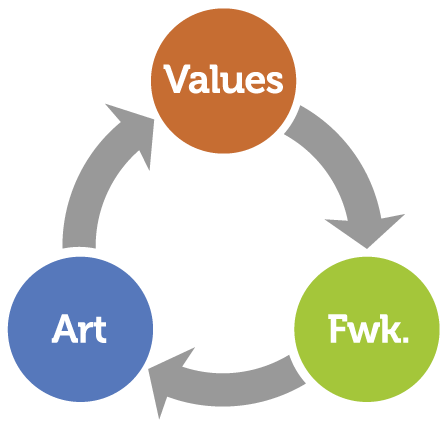
Myths are all around us and every culture has them, but where do they come from? I dare say none of us has invented a widely adopted sacred story (yet). Let’s face it, we’re not accustomed to bootstrapping our sacred myths. Historically, no one person invents a religion; even if it came from a founder or prophet, it only has the legs the community choses to give it. In other words, myths are community creations. Given the need to elevate our behaviors, we can think of the process in three phases:

Three Phases of Myth Making

  1. Sacred Values: We need the notion of sacred values and behaviors, and this is best defined by the community itself. We really do know the answers; we just have to agree and write them down.
    • This is actually not that hard. It starts with mythic awareness, and then coming together to define themes for change.
  2. Myth Framework: We need the masters of metaphors, those who actually create the allegorical imagery and story that we can use to re-program ourselves.
    • This is perhaps the most important phase because it will scope the realization of the myth. Mythical art expresses a shared purpose.
    • The a-priori to mythical art is the shared story. The narrative phase, therefore, is a necessary pre-requisite. This is why we stress the need for a story framework early on in the community myth-making process, which is just a natural expression of a shared belief.
  3. Artistic Myth-crafting: After this come the execution, or creative phase.
    These three phases are described in more detail at Cultera.org.

Artists are the myth realizers – making sacred stories tangible, a necessary pre-requisite to belief. Think about the dimensions of illusion here. For example, a two dimensional surface (the canvass with paint) provides an illusion for a three dimensional form. If the work is figurative, we can infer another dimension, namely the sense of presence of a personality when done well (like a Rembrandt portrait), a fourth dimension. Moreover, if it provides a sense for time past or alternate worlds, we have a fifth dimension (like allegorical art on the Sistine Ceiling). So far we have described qualities what many great works in museums have. They are not necessarily mythical without additional context. The next dimension is narrative context and symbolic meaning. This is what puts art in the realm of myth. The sixth dimension is the portal to the world behind the world, and it’s actually something the viewer brings to the work, i.e. a knowledge of the story. Art has these six dimensions is mythical.

With mythical art, the artist is facilitator of transcendence. Connecting with ‘the world behind’ actually validates current decisions when they are seen as consistent of the laws of that other world, as revealed by mythical art, which by the way, can include dance. Artists with community-sacred values are to be valued as a myth-crafters, those who create the means of collective healing and transformation.

Artists don’t have to dress as priests, mediate and set themselves apart from carnal desires in order to create this sacred art. In fact, it’s not really about the artists themselves. Myths will do their work regardless. It’s the job of the artists to be faithful to the theme and express in the works a heartfelt conviction. This view of the artist, while not new to civilization, is strange to the modern mind.

On a personal note, I’ve come full circle from being an artist who threw away his paint brush to preach a reductionistic gospel of Jesus Christ during two years as a missionary back in the early 1980s, to one who now advocates an expansive vision for making myths as communities write their own gospels, which serve functions of religion. What’s more, this process requires artists to pick up their paint brushes, chisels, pens, musical instruments and whatever other art crafting tools they have at their disposal.

This is trippy because the traditional missionary comes to a people with a message, and seeks to find an aesthetic way to present the pre-conceived – and often ancient – pathways to God. In our new practice, we don’t come with the message – that is the responsibility of the local community. No, we come with a methodology for letting them create their own and helping artists understand the crucial role of mythic art. This pre-supposes a great faith in humanity.

— Roy Zuniga
Feb. 2015 – Langley, WA

copyright © 2015 roy zuniga – all rights reserved

Art as a local economy of discovery

Tags

, , , , , ,

In the book Zero to One, Peter Thiel notes that a large segment of society has stopped looking for secrets in relation to new technology. People think all the hard problems have been solved, and what remains is either easy to do or a mystery and impossible to know. The book is very insightful in other respects as well. What struck me as an artist who uses very old technology (painting with pigmented oils) is that the mysteries artists discover have nothing to do with technical secrets. Scientists look for the undiscovered technologies. Artists, on the other hand, manifest mysteries with mundane means on everyday walls.

Both are valid, and both can be used to drive commerce. In today’s world where we are drowning in gadgets, it’s time to explore how art can be used to bring forth an alternate and more humane economy.

Technical consumerism is choking our planet. Clearly there is a thirst for progress out there. While a small segment of innovators is looking for discoveries, the rest of the population is looking to compete over the production and consumption of commoditized technologies. We gloat in the benefits of yesterday’s stellar innovations having been made available to us at ever cheaper prices. At the same time our actions are diminishing the biodiversity of life on a finite planet. The producers don’t tell us about this hidden cost. That job is left to the activists who raise awareness and prick our consciences. If we can’t channel this demand elsewhere, we risk being awash in real garbage as we enjoy virtual worlds.

The problem is not with the innovators or activists. The problem is with producers and consumers, who have a tight inter-dependence. Lust for products is generated by the producer’s marketers and advertisers. This message is then internalized and expressed by consumers. Like members of a bizarre cult, after a while we can’t let go of our consumerism because doing so would invalidate our beliefs, practices and past choices. It’s a sick symbiosis, but let’s be clear the problem lies squarely with the consumer addiction that is fueled by the product mythologies. Myths of personal productivity, of connectedness, of sharing images, of fast shopping and shipping, etc.

The key to change is therefore breaking the addiction on the consumer side, possibly by replacing the mythologies and their perceived benefits. We can, for example, have anti-consumerist stories put the old behaviors in a negative light, while at the same time not detracting from the innovators who can provide technologies to overcome our current pollution problems. Technology is not the enemy: the wrong version of consumerism is our collective mad obsession, and to change we need new world view stories.

We can imagine a world where consumers skip a few generations of innovations, much like some developing countries leap frog technical adoption that the West leveraged. This is a multi-facetted problem to solve, but there may be a glimmer of an answer in art, which can play two roles: a) helping to change the mythology of consumerism by providing a vehicle for new desired content, and b) by becoming a new target of consumption.

Why would art become something to lust after by the change-hungry tech crowd? This is just a hunch, but there is a link between consumerism and discovery. Tech junkies are thrilled when we can have the latest the latest technology. Remember when touch screens came out, and what an amazing experience it was to have the physical buttons replaced with screens that can change? Many of us who thirst for progress felt compelled to upgrade. That thirst has not abated, and the tease of ever bigger screens and thinner phones and tablets has us on a consumer craze that is fueling an unprecedented rate of exchange for gadgets.

Today, we don’t look at the phone the way grandma looked at the Maytag washer in the past, i.e. as a reliable machine that would do its job well for many years with little to no maintenance. To sell product, technology companies have convinced us that what counts for ‘doing the job well’ changes every six months, and that therefore our relatively recent purchases need to be upgraded frequently. Heck, recent advertising suggests you can just upgrade for next to nothing, so why not do it, regardless of the state of your old phone. This is not a sustainable mindset; but it is the current madness of the masses.

One of the biggest ironies of social media today is that people have to be focused on a gadget – their computer, phone or tablet – in order to share about themselves with others. There’s an illusion of connectedness that, if we are honest, is strangely not deeply satisfying. This was highlighted recently with Facebook’s mass production of image timelines for a person’s year, as if the machine could determine what defines you in the year by what you post online. We all adopt certain personas online. To have the system provide you with a digest of your online persona for your approval so you can share it with the world is really an inversion. The machine is now defining the person, and consumers obediently share out of a misplace sense of duty to false connectedness.

This cult of technology is dehumanizing producers as well as consumers. With the race to the bottom on price comes the inescapable logic that the production systems and cloud infrastructure should standardize. While the customers should have ‘choice’, the product companies have to streamline, and that means fewer choices for the producers. Deviation from simple, repeatable automation on standard equipment works against the bottom line. People who have to deal with exceptions in the standard process are expensive. So end-to-end processes are being designed to leave the human out of the production as much as possible. Ostensibly this frees key people to focus on strategy and direction. Ultimately, the number of people required for the new roles is much smaller, and layoffs ensue when standard automation is fully realized.

So we have the paradox of choice – increasing the choices to consumers necessarily means reducing choices on production. Get more people to buy more things produced by less and less people. In fact the two forces are linked – standardization on production means that more and more competing companies will end up having different flavors of the same essential product. How does the human benefit from this craziness? We don’t. We get absorbed in the incremental consumerism where we obsess over micro-differences in products and constantly upgrade to get the next version to compare and show off.  Or, if we are on the producer side of things, people experience becoming as fungible as the machines in the cloud data centers that can be swapped out at a moment’s notice. ‘Progress’ has hijacked humanity.

Therefore we have to slow down on the consumerism, and at the same time decouple innovation from that cycle so that scientists can work on unlocking secrets of the universe that will benefit humanity. Art can play a partial role here, I would like to argue, in diverting the consumer thirst for innovation away from the production of commodity gadgets to a discovery of mysteries through art. Not that art is the superhero to save the planet, but there is a dynamic of attention incited by artistic discovery to be valued here. And it’s not technical discovery. Let me explain.

The core of consumerism is a lust for the new. Modern art capitalized on this and accepted formal changes in how art was rendered as innovation, and connoisseurs lapped it up like iPad junkies on a new release. Yet there is another segment of artists who don’t look to formal innovation as the measure of the works. These traditional artists don’t understand the madness of the modern art scene because they view art through a content lens, not a technical one. Perhaps this explains the modern art craze that drives up bidding on dumb empty works: the buyers are seeing art innovation as a kind of technical innovation, and that is valued for its own sake.

Regardless, artists should apply the mastery of old techniques in the services of new images that convey values that are relevant to the day. So it’s not about technology; it’s about content. With art, the technology and content must support each other, as expressive use of the medium is integral to the impact of the work. Formal expression can’t be an end in itself, however, even in the pursuit of ‘sacred’ content. If the expressive execution precludes or overwhelms the users’ ability to connect with the subject matter, we haven’t achieved our ends.

What is this desirable content that will seduce consumers? I can envision two levels: a) a lively community discussion about shared values, and b) the rendering of mystery. Of course, these can be complimentary efforts and one work can even manifest both. The consumer’s role is unpacking the nuances of mysteries rendered in art, mysteries which touch on the shared values being targeted by the community. To achieve this, we have to learn to look, not for features, but for meaning. In a very tangible sense, an artist can render her response to mystery for you to contemplate, to consume, internalize and respond to. The role of producers as advertisers is replaced by the community as advertisers of values, which generates the desire for works. This is a good consumerism that is not an opportunity cost to a viable planetary ecosystem.

How can this work? As I’ve written elsewhere on community mythology, a creative lifecycle or season of embellishment can be chartered by a given town or region for the express purpose fostering the production of art aligned around certain themes.

Care must be taken to value high quality, so we’re not talking about newfangled consumerism of large quantities of low quality works. This raises the question of the market: where will the purchasing power come from if not from the production of technologies. The simple answer lies in reverting back to old models for local economies. Much has been written about this in the Transition and other movements, and I won’t cover that here.

Let’s also keep in mind that mythologies that stick with people generate economy. We have only to look at Star Wars, Harry Potter, The Hobbit and Lord of the Rings, superhero movies, etc. to know that these shared stories can take a life of their own, with very passionate participants. All this hunger for stories and artifacts is a proven driver of commerce.

Art can help us reclaim our humanity from the sea of technology. As we find our dignity as beings, we will hunger for true connection with others. For the cycle to be complete, art should focus on the shared values the local community holds scared. Only then can we have a deep and meaningful conversation that elevates our existence and frees us from reducing the planet’s resource stock even as we pile up used tablets and phones.

— Roy Zuniga
Dec. 2014
Kirkland, WA

copyright (c) 2014 Roy Zuniga

The End of Hermeneutics

Some believe reincarnation is a kind of undesirable state where you go to work out your karma issues. When you’re done with all that processing, you enter a state of Nirvana. Personally, I’d much rather be present in the moment on this world. To me, the aesthetic experience is life! I don’t want a Nirvana where all the beauty of our planet disappears as illusion. Such ‘enlightenment’ is alien. What life do we have apart from experience? To an artist, a place without aesthetic delight is separation from God.

However, I find the  concept that perception is illusion fascinating. It leads me to think we can layer perception:

  • Viewer perceives Art (perception + imagination = an illusion that is momentarily taken for ‘reality’)
  • Creator perceives Reality (perception + interpretation = Art)

Perception plays a role in both creator and viewer modes. Viewer has to know the art is an illusion; however the experienced aesthetic delight is substantial, it is an emotional reality. Likewise, to the Buddhist, life is an illusion even as happiness is not.

Thus there’s a certain type of perception, a process of viewing art, that can train the mystic how to enjoy illusory life by enjoying illusory art. The painting is a metaphor for understanding life spiritually because before immersion in the world of the work, all she has to do is turn the painting around to understand its physical truth as a collection of paint and canvass. This collection of intentionally arranged pigments cannot explain the joy of the art; neither can the collection of creatures and earth explain the joy of life. There is an ‘otherness’ to the experience of perception that when understood is true enlightenment. When you can both fully delight in the work and in the same mind fully understand how it works, you have attained a functional duality of serene existence. It’s the peace of both knowing and experiencing.

This is the skill required to fully participate community mythology. With it, you both create the myth (i.e. sacred story) and experience it with unfettered emotional empathy. We can most internalize the lessons of the work when we have childlike abandon in trusting faith. The more we understand the dynamics of myth like we understand the artist’s craft, the more our perceptive mind can cast off from creation analytics, so we can be truly open to the experience. Confidence in the product comes from understanding its origin, and this confidence improves aesthetic consumption.

We don’t really appreciate the value of confidence until we’ve come out of entanglement with traditional religions and their conundrums. Today there is a lot of suspicion about religion – people want to believe, especially if the ancestral etymology is there. However, suspicion incited by the stories themselves, by their ulterior power and organizational hidden agendas, keeps us from truly enjoying them. In such circumstances, suspicions have to be overcome with the noisy impact of oratory, of powerful preaching, and of emotional music and emotive lights. The religious experience is less about our analytical minds being truly free through understanding of the underlying story making craft. Instead, the analytical mind is suppressed, shut down temporarily by the religious mob experience. The religious service is a mental override that frees perception from analytical tethers so we can intake emotional experience and mold our psyche and innate responses.

Why expend all that energy to overcome our lack of understanding the hidden craft behind traditional religions? Instead, give people the tools to craft their own stories to hold sacred. There is no suspicion about the etymology because we ourselves created it. There is no need for hermeneutics because the intent is made explicit ahead of the experience. Thus the rational mind is appeased – it does not have to tolerate ignorance or conundrums, and hence does not have to be overcome with preachy showmanship or overridden with an emotive musical performance. Noise is replaced by impactful performances which themselves are the message, not the prelude. Emotions and the rational mind can both fully participate in shared myth, just like the viewer of art can have a real experience with the surface of a canvass that cannot be explained by the collection of smeared paints and pigments composing it. There’s a reason museums with great art are intended to allow a quiet experience – both your understanding and your perception are invited to be equally present, subject to your control.

Roy Zuniga
November 2014
Langley, WA

Sacred Stories

There is a synergy between story and meaning that gets played out every sermon and teachable moment in a religious house. We err when we confuse the holy relevance of the meaning with the immutability and sacredness of the story. The story is sanctified by the meaning conveyed, not by the other way around.

When we marvel at the beauty of the Sermon on the Mount or a parable of the Walls of Jericho falling down, it should be because of the interpretation given us by the speaker, and the interpretation of that which we ourselves process.

For that meaning, for that lesson, that take-away that we consider holy, we should be able to swap out the story without concern. We can update the parable and make it a sixteenth century anecdote, or a 23nd century projection, and as long as we can derive scared meaning from it, the stories are sacred.

Ultimately any lesson derived from a Biblical narrative can be distilled to essential behaviors and feelings. Reverence for God and family, devotion to a cause, inspiration to sacrifice, indignity over lying, repudiation of stealing, etc.

On the other hand, if we take the 2000 year old story ‘facts’ to be sacred in and of themselves, the behaviors that derive from them today might not be those intended by the original authors. For example, if one tribe was wronged by the other, and the version in the Holy Scriptures of one is taken to be the very word of God on the matter instead of being seen as a politicized spin by a biased stakeholder, then subsequent generations will be carrying a grudge long past what the original event merited, or what is really good behavior for the descendants of either party today.

In other words, the ‘sacred driver’ is not the story, but the meaning. When these get turned around, and you have a recipe for majoring on the wrong points and having an unholy effect. The faithful internalize divisive behaviors instead of inclusiveness and tolerance.

So when I visit a church with a friend, I look to take away great lessons regardless of the delivery vehicle. If the preacher gets hung up on doctrine and defending it for its own sake, we’re not taking away any good meaning. Instead, we’re learning to preserve an organization. No finite human can really make authoritative statements about God’s nature. Those who assert they can are really just asserting a privilege they want others to pay for somehow.

In the same manner, if the values being presented are about personal prosperity and the blessings of giving to the church, again we’re not really communicating sacred truth. The so-called canonical stories, when used to justify an organization’s prosperity, are really being defamed. They are no longer sacred. That is the irony of the prosperity church: the so-called ‘word of God’ is being made worse than secular, it’s being made consumerist.

So we see that story, in of itself, is neither sacred nor secular. Sacred are the values intended, and what we take away, values that are programmed into us via story telling and our attentive, imaginative listening. The utility of stories in this function of sacred programming is what makes the story sacred as well.

— Roy Zuniga
Langley, WA

copyright (C) 2014 roy zuniga

Values-first Faith System

Tags

, , ,

Can an understanding of God exist apart from religion? Theology so far has been so deeply intermingled with the stories about God that it’s hard to imagine doctrine without references to tablets and sermons on the mount. Apparently, for a faith-phenomenon to gain widespread acceptance it has to be infused by severe, wide-spread and hallowed embellishment. Based on that, it seems that story and tradition have to exist for a faith to succeed. The problem is that in most religions, the stories are rigid and outdated.

Assuming stories are still needed for religious success, how then can we turn the model upside down so we can have fresh stories as well as a good faith? A values-first approach can help. Let me explain.

If you assume for a moment that none of the stories in the Bible (or other scriptures) can be taken at face value, i.e. that they exist to justify an agenda, because of the conclusions they justify there’s really nothing objective about them even if some of the events they narrate are historical. In other words, the stories are essential to justify the conclusions being drawn out by the exegete. These conclusions are intended to team certain values and behaviors to the population, and to sanctify them via the veracity of the narratives. This means that you need to do certain things ‘because Jesus said so, and Jesus is God’ as evidenced by the stories of miracles. Ignoring the question of salvation from hell for a minute, that seems like a lot of overhead just to get at good behavior.

What if we just skipped the allusions and articulated the values first? The whole notion of heaven, hell, resurrection, salvation, etc. is not something we have to deal with to arrive at solid practices for life that derive from values we sanctify as a society.

We can even start by selecting the values and behaviors from historical religions that are relevant. We can also start fresh, ignoring the challenge of scrubbing stories that have too much historical baggage for some of us. Why not just start with values and let the population of believers develop practices and stories to help themselves assimilate those behaviors. There is more than one way arrive at value-driven behavior it seems. The traditional prescriptive doctrinal approach requires a supporting infrastructure of religious narrative and tradition. The values-first approach, as we may call it, focuses on the learnings first and lets the supporting narratives be develop organically.

When I speak of embellishment, I’m referring to the rich traditions, stories and other aesthetic dimensions that may be added to simple beliefs. A direct correlation can be made between embellishment and the success of a given religion. The richer the tradition, the more successful the religion. Catholicism comes to mind as a prime example. Counter examples exist in various ascetic sects that reject art and the ‘smells and bell’s, but these are minorities.

What comes first, the core beliefs, or the embellishment? Is it the lesson or the parable? The difficulty we have answering this is an indicator of how inextricably bound myth-making is with the growth of a religion. If the author’s only intent is embellishment for entertainment, as in a successful epic narrative like The Lord of the Rings, you end up with a ‘religious’ devotion to something that isn’t really intended to be a religion. People quote the novel like some would quote Scripture. Is the opposite also true? Can we have we have a value set accepted as sacred truth without the supporting narratives?

An example of the values-first approach is articulations of corporate values. Many companies will have a religion-agnostic set of values like ‘treat others with respect’, ‘assume good intent’, ‘focus on results’, ‘contribute to the success of others, leverage the contributions of others’, etc. These are intended to be internalized by employees so they manifest behaviors that foster collaboration and drive success. Supporting example stories may be given, but these are not seen as religious stories. They are fleeting justifications that can easily be replaced or altered without violation. If the story fits, use it. Sometimes games and exercises are developed to drive home the values as well. While some can become annual events, they are not give the significance of a religious tradition.

Can such ‘corporate’ values in the abstract be ‘sanctified’ and leveraged by the population at large to achieve the same ends as religion, i.e. to drive virtuous behavior of societies? This is an interesting question we should engineer into a pattern for reverse-religion, i.e. a values-first approach to ‘indoctrination’. There would be a certain ‘doctrification’ of narratives from the creative side of the population that is the playing a key role in establishing a new type of shared religion, one that is fuzzy around the narrative edges. The myths are made sacred by collective blessing of the values that drive them.

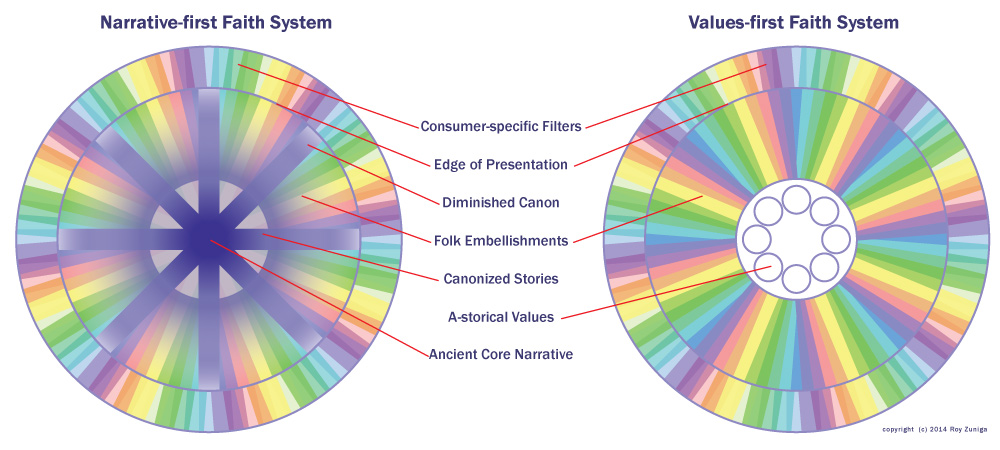
This diagram illustrates the difference between a ‘Narrative-first’ and the ‘Values-first’ approaches.

a-storical-values_sm

On the left, Narrative-first means that an ancient core narrative grew to have holy significance in the tribe, and out of that stories were canonized (into a Bible, for example). Over time as the stories failed to satiate people’s needs, additional folk embellishments were added that were not at the status of Holy Scripture, nevertheless were shared and revered. At a given point in time all of these – the fading canon stories and the sacred folk stories were what a person was presented, i.e. the ‘edge of presentation.’ However, people don’t just assimilate what they are presented, they apply their own filters and weighting, to the point where what they receive is what they want to believe. Note that in the end, the canonized stories blend and fade along with the cacophony of other messages people deem valuable and assimilate. What soaks in varies from person to person.

Note that the Narrative-first system can consume a lot of energy in maintaining the canon stories in the forefront of people’s minds. First, they must be established, which means filtering out anything that didn’t rise the standard. Second, this establishment is done by a select group of experts, which introduces social tension. Third, over time the stories become less relevant, and more and more energy is required to make them stick with people like they did in the beginning. Finally, to maintain a cannon, there is a constant battle between the ardent believers and those who would embellish the faith – the conservatives vs. the liberals.

Now let’s turn to the Values-first approach. Since ‘a-storical’ values are agreed upon first (‘a-storical’ simply means values in the abstract, that are not inherently justified by a sacred core narrative). We can think of them as humanitarian values. In any case, a set of values is made sacred by the community, with some definition and examples. From those values, the community is free to create stories to explain them to various audiences with locale-specific flavors and color. This suite of narratives likewise compose and edge of presentation that any given individual will encounter at a given time. As in the previous example, the user brings their own filters, so the end result is really about the same. People have assimilate what they want to believe in, and stories help tremendously with that programing.

With a Values-first approach, there is a lot less energy and strife expended on sustaining the canon-story establishment because it doesn’t exist. In its place is a tolerant culture of creativity. The key in all this is accepting the new pattern, and fostering a process for the establishment of the sacred humanitarian a-storical value set.

In this paradigm there is no hermeneutic of Scripture – there is only interpretation of art. The sacred values have already been articulated because they came first. Intent is clarified up front. There is no practice of interpreting the text to discern the will of God. The god-will, as we internally know it, was summarily recognized and articulated in the vernacular at the start. Interpretation comes during the embellishment process as we look at the work of artists and try to understand their response to subject matter based on the canonical values they have accepted as the soul-blood of their creative efforts.

Since all religious story is filtered by what the individual projects over it – their current struggles, pain points, pleasures or joys, there has never been a time when a sacred story has landed objectively, i.e. in the same way for everyone. We have been interpreting the narratives with personal filters and imaginative embellishments forever.

Being human is the certification of your right to appeal to your conscience, as validated by your understanding of collective norms, and your assessment of the output of the story writers and artists. The interpretation can be advocated but should not be contentious due to any exclusivity mandate. The idea that there’s one set of canon-stories is gone. Because the values are already clear, the interpretation is about understanding nuances of multiple meanings, each of which is valid from the person’s own perspective (as it always has been). Thus there are no denominational schisms with each side claiming the truth based on interpretation.

In other words, interpretation is not seen to narrow inwards where there’s only room for one truth. Rather, interpretation fans out from values, dividing into endless branches, each of which is capable of carrying and conveying truth for someone. Expansive interpretation based on core values affirms our creativity, variety and humanity and teaches us to co-exist in the process.

Traditional religion, it seems, has the flow of interpretation backwards: we should not narrow down narrative artifacts into a holy cannon, and then use interpretation to drive out the values and lessons. Rather we should start from values derived from our collective life’s lessons and let embellishment and interpretation fan out without limit. But remember, the ensuing unlimited interpretation of the embellishment is not the same as ‘anything goes’: the foundational values constrain the efforts. Thus we can achieve balance between unity of intent and variety of expression, and thereby realize the embellishment which seems to be a pre-requisite for widespread adoption of a faith.

— Roy Zuniga

August 2014
Kirkland, WA

copyright (c) 2014 Roy Zuniga