• About
  • Blog Spots

Dynamics of Myth

~ using culture to shift our worldviews

Dynamics of Myth

Tag Archives: art

A Universal Process for a Personal Worldview

02 Sunday Jul 2017

Posted by royzuniga in art, mythology, Uncategorized, Worldview

≈ Leave a comment

Tags

art, Community, community mythology, faith, intent, intention, Jesus, mythology, religion, Worldview

My worldview guides me, as does yours. I believe in expressing intent as the basis for experience. This world view is also a process that can be applied by everyone. The key is to let ‘the Universe’ have its say in how our intent is fulfilled, considering the intent of others in our domain, and trusting that a suitable outcome will be orchestrated. This is fundamentally a positive outlook. It is also simple. The goal is to have humanity spend less time rationalizing manmade theological problems, and more time actually experiencing life. Nature is in danger from those who don’t know her, who don’t know how connected they really are to her.

I am approaching topics of ultimacy from the personal experience of what works. Praying to Uranthom works for me. Reflexive prayer, i.e. the notion that all spoken prayer for our own benefit, reinforces my intent. Understanding self is so important because being aligned with what makes you tick is the best possible experience for you as an existential ‘node’ in this collective and connected existence. If physical creatures can achieve a ‘heavenly’ experience on earth, why look forward to a non-corporeal existence? Consciousness without physicality is a hell. Whether our souls go to ‘Heaven’ or blend back into a mystical cosmic consciousness, I do not know. I am confident that the Universe that makes Uranthom possible will have a suitable resolution of my consciousness existence.

We get into trouble when we make ‘authoritative’ and exclusive assertions about God the way both Muslim and Christian theologians have over the ages. Conflict arises when the respective believers take the God-speculation literally and defend mutually exclusive absolutes. The line of thought that tries to define God is a dead end. We can be believers without absolutes. In this mode, all world views are necessarily individualistic, which is what I think happens anyway, even to those who believe in the ‘heaven first’ approach where guidance comes down from God.

If you find your mind caught in a web of theological conundrums, it may be helpful to trace back the chain of ideas that led to your beliefs. I did, and it led me to start fresh, from scratch. What kind of conundrums? For example, conflicting ideas about free will vs. predestination; obsession with a physical God who cannot be touched; someone we talk to but who never talks back.  Reconciling undeserved mishaps and tragedies with God’s good purpose for pious people. Talking about both love and eternal punishment in the same conversation. Advocating the never-ending exploitation of a finite earth. Advocating equality of genders while keeping the man as the ‘head.’ Preaching compassion and acceptance while attributing people’s sicknesses and disabilities to sin or laziness. Teaching forgiveness while always finding an enemy to fight. Asserting world peace is on the other side of a war. Thinking like this is making our planet sicker, and we need to change it.

Trace the origin any one of these ideas and you find they go far back, some thousands of years. The writers we read were influenced by ideas they might not properly credit. The Christian worldview goes back to the Greek philosophers, the Stoics, Christianity, kings since Charlemagne who believed in the divine right, the Protestant Reformers, and American conservatism. For example, we celebrate Easter because it recalls Christ’s death and resurrection. Why did He have to die? Shed blood was the atonement for sin. Why can blood atone? Because of pagan beliefs that God(s) demand it for transgression, and to earn favor. Why did Christ specifically have to die? Because he is God incarnate, and as such can atone all of humankind. Why does God have to be incarnate? Because of the theological tradition that requires God to be involved in human affairs, and the certainty that God(s) have to exist somewhere physically, like the Greek pantheon on Olympus. Change your worldview, and you change your destiny.

The tumor of over analyzed worldview tends to grow bigger as each generation tries to sort out one conundrum or the other, resulting in more spaghetti theology. Topics like ‘how do I stay out of hell?’ and other questions become irrelevant. That is all a huge distraction that myopic and weak-willed theologians debate ad-infinitum. Like addicts, they can no longer recognize the simple life and how good it can be. To those invested with years of study of treatises and intellectual traditions, real happiness and peace are a sign of apathy! They can not recognize a completed human being if she was sitting next to them in Sunday morning pew because such people are only expected in heaven. We could play their game and argue with every position that has been taken since Socrates. I do not have the life-energy to do that. Theology for its own sake only produces secure employment for professional mental wrestlers. We have to keep it simple. We can just snip that chain of beliefs at the source, let the weight of conundrums fall to the floor. Life goes on, and we can experiment with alternate foundational principles.

The fundamental worldview question we have to answer is ‘how should we live?’ I have arrived, for now, at a process build on existence as an experience of intent. Intent is simply an affirmation of the desired outcome. This is just a hunch, but so far, it is working for me, manifesting peace of mind and a good life. Note that intent is not the same as will. To will something implies a certain coercion, even if it is your own actions, which is a more aggressive stance that may in fact work against you.

Intent is a passive internal assertion that can be either be silent or can also be reinforced through vocalization, by saying it aloud (as in prayer). Lack of vocalization does not diminish the power of the intent. The ‘Universe’ realizes your intent based on an orchestration process that is opaque to us. I do not see the value of postulating what ‘God’ or ‘the Universe’ thinks and does since by definition it is beyond our grasp. This is why I invented the notion of Uranthom, which is my abstraction layer to what happens ‘out there’.

We express intent many times a day, thinking ‘yes I want a new shirt’, or ‘we pray for a new school for those missionaries, amen!’, or ‘I’d like to sleep in this morning’, or ‘I’d like to be paired with a woman (or man) like that’, or ‘my energy is better spent painting’, for example. We often try to execute on the intent, and this is where we should rather pause and listen to the Universe. Mindfulness is important before taking action, as is patience. I call it ‘manifesting’, which simply means that given some time for processing, those outcomes you intend will be orchestrated along with the intent of others for a more satisfactory resolution. It may not be exactly what you had in mind to start, but examining those desires in light of the outcomes, you will find a good state, one, which inevitably leads to new intent. Thus life evolves in a dialectic with Uranthom, the receptor of our expressions of intent.

If you have a communal intent, like ‘I wish to go to the ball game with my friends’, or ‘we need supporters to donate money to pay for fuel for the ship’, then expressing it helps align the intent of others. The expression can be a post on social media or a prayer in church. Because intent is bubbling up regardless of whether you are in a religious house or not, we do not distinguish between prayer and other expressions of intent. Intent that aligns with that of others is more likely to be realized. This is a driver for social awareness and political action, because, without the expression of an alignment on values, we are not likely to get our way.

Happiness comes from a realization that as you let go, and the manifestations are real, you stop being frustrated about what happens (or doesn’t happen), and start being present to recognize and enjoy goodness. This is parity for the assurance religious people feel when they believe ‘it’s all in God’s hands’. This mindset does not come overnight, especially if you are mired in the conundrums your ancestors fed you with our mother’s milk. Intent that aligns with that of others is more likely to be realized. As is intent that aligns with the progression of the Universe towards harmony, (this assertion, by the way, is an expression of my own intent). If we all share that intent, it will be. The simplicity of the model is the conscious expression (internal or external) of your intent, coupled with a letting go so ‘the Universe’ can manifest that intent.

This all sounds so simple and even mystical. What about all those conundrums that theologians and philosophers have spent lifetimes debating. Are we going to address those questions? I believe a lot of it gets sorted out on its own when you pivot on intent. For example, we don’t have to account for an all knowing God, since ‘God’ knows through our experience. I don’t believe in a God object, a person-like entity who somehow both sits on a throne and at the same time knows everything everywhere and has all power as Christian doctrine affirms. God may, in fact, have some of those attributes, but it is in a distributed fashion.

It is my hunch – and you don’t have to believe this, it’s just my way of dealing with categories of thought that need an accounting – that the ‘the Universe’ achieves omnipresence and omniscience through physical instances of people and other creatures who are embedded within it. ‘Creation’ is a mechanism for self-discovery. Good and evil are really just relative ideas based on the quality of the outcome of intent. Suffering is not a consequence of sin, but rather a consequence of intent and actions that don’t align with a viable existence. Mistaken experiments fail, people learn and change their intent. Look at the Chinese stance towards pollution. They have gone from not caring about it to engineering forest cities. We just have to learn from misguided policies, improve, and move onward towards a healthy expression of a society that doesn’t leave people behind.

Predestination is a moot point, since you are the agent of destiny, if you intend it, it was meant to be. As you realize it, it is also known. As the universe experiences and understands itself through each one of us, this universal consciousness grows. As we expand our experience, we expand the instantiation of knowledge of that area. And we move on. Now don’t ask me about the mechanics of all this. It’s just a myth that helps me explain things I don’t understand, as all good myths do. All this assumes positive intent and has yet to be proven. What will be the intent that wins out in an over-populated world?

Now don’t ask me about the mechanics of all this. It’s just a myth that helps me explain things I don’t understand, as all good myths do. All this assumes positive intent and has yet to be ultimately proven good by humanity. What intent will win out in an over-populated world?

Since you are so important in this whole evolutionary process, it is important to understand the criteria by which you affirm intent. This is the domain of values. Decisions are based on what you consider worthwhile. Some of these are instinctual and innate. We naturally want intimacy or a fun night out with the guys (or gals). We dote on our children by nature. Some behaviors are learned. We defer to elders, distrust strangers or hate to accept help from others. Some values are ideological, such as patriotism and loyalty to a class structure.

Good values come from a common humanity. Despite all the theological conundrums, good values undergird every major religion and provide the redemptive glue that gives them longevity. This is where ‘culture forming’ or ‘cultural engineering’ come into play. What you call it depends on your temperament, but the gist is the same: we understand the dynamics of how humans internalize worldviews, i.e. through prevalent myths, which program the depths of the mind that impact the process and scope of decision making. The arts define these myths, and thus through art, we can change the operating system of the psyche.

As I’ve written elsewhere, Community Mythology is a technique that uses the arts to ‘craft’ a world view into a culture. The idea is that we collectively agree on the set of behaviors, and their underlying values, our common humanity, as colored by the experience of mistaken communities of the past (such as the Nazi experiment). A group comes to mythic awareness by recognizing when cultural artifacts, such as movies, advertising, and political rhetoric are impacting their value system. Awareness is the pre-requisite to a conscious decision process, a kind of ‘pre-qualification’ of the values we let into our intentional decision making. Allowing certain values into our lives is itself an intent.

Make no mistake about it, this a powerful ideological cocktail. The power of the Universe is harnessed with intent, and intent shapes its destiny with humans. Mis-guided collective intent results in ‘evil’, and people consequently suffer. Properly guided intent results in goodness for all those involved. Based on values we deem to be sacred, we have to express our intent, and then, as the saying goes, let go ‘and let God’.

— Roy Zuniga
Langley, WA
Creating Mythic Art

21 Saturday Feb 2015

Posted by royzuniga in art, mythology

≈ Leave a comment

Tags

art, Christianity, community mythology, comparative religion, dynamics of myth, Joseph Campbell, myth making, mythology, religion, Sacred Story

So far I have been looking at myth-making from the perspective of how communities can ‘re-program’ themselves to implement more sustainable behaviors. We can think of this as the ‘human software’ role for myth. The theory is people will empathize with mythic heroes on their journeys and mimic their decision making when faced with analogous circumstances.

However, there is another role for myth as a way to connect to ‘the world behind’, or ‘the other plane’. In this view, myth is the portal, the mystical means by which we can make things right with the gods, and in so doing enhance our spiritual survival. In other words, we go from mythology as a systematic and somewhat objective study of the stories of culture, to a faith-full ‘mythism’. This is a belief in the power of the myth itself. In Campbell’s terms, myth gives you ‘a line to connect with that mystery which you are.’

If we take either one of the approaches without considering the other, we miss out. Focusing on the hereafter without regard to the planet does not lead to integral living: as the planet sours, the daily reality of living contrasted with the spiritual journey towards bliss causes us to live with tension, dissonance and conflict. All sorts of dysfunctions result, including the creation of artificial environments, denial, retreat, escapism and even hatred. Some of the most vitriolic chronic ‘haters’ are those who feel others have come in between them and their journey to bliss.

On the other hand, while focusing on the here and now can help organize and clean up society, it doesn’t address the basic human need for meaning and an explanation of the soul’s afterlife. Do we have to choose between approaches? I think not.

The duality between the pragmatic behavior-focused approach and the spiritual journey has something in common: sacred stories. For community myth-making, these are the stories that hold our core values as exemplified by normative behaviors. For the spiritual pilgrim, these very same stories hold the metaphorical images and concepts that provide a connection with the gods and their normative behaviors. Align the two and we have the formula for cultural transformation. Myths give us the sense that today’s acts can be brought in line with how things are done on the higher plane. It’s imperative, therefore, that we align our mythical world with what life on earth should be. What does that look like?

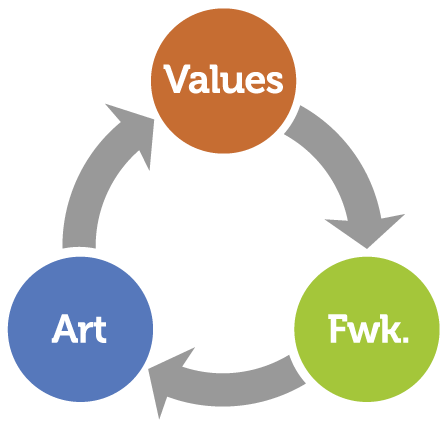
Myths are all around us and every culture has them, but where do they come from? I dare say none of us has invented a widely adopted sacred story (yet). Let’s face it, we’re not accustomed to bootstrapping our sacred myths. Historically, no one person invents a religion; even if it came from a founder or prophet, it only has the legs the community choses to give it. In other words, myths are community creations. Given the need to elevate our behaviors, we can think of the process in three phases:

Three Phases of Myth Making

  1. Sacred Values: We need the notion of sacred values and behaviors, and this is best defined by the community itself. We really do know the answers; we just have to agree and write them down.
    • This is actually not that hard. It starts with mythic awareness, and then coming together to define themes for change.
  2. Myth Framework: We need the masters of metaphors, those who actually create the allegorical imagery and story that we can use to re-program ourselves.
    • This is perhaps the most important phase because it will scope the realization of the myth. Mythical art expresses a shared purpose.
    • The a-priori to mythical art is the shared story. The narrative phase, therefore, is a necessary pre-requisite. This is why we stress the need for a story framework early on in the community myth-making process, which is just a natural expression of a shared belief.
  3. Artistic Myth-crafting: After this come the execution, or creative phase.
    These three phases are described in more detail at Cultera.org.

Artists are the myth realizers – making sacred stories tangible, a necessary pre-requisite to belief. Think about the dimensions of illusion here. For example, a two dimensional surface (the canvass with paint) provides an illusion for a three dimensional form. If the work is figurative, we can infer another dimension, namely the sense of presence of a personality when done well (like a Rembrandt portrait), a fourth dimension. Moreover, if it provides a sense for time past or alternate worlds, we have a fifth dimension (like allegorical art on the Sistine Ceiling). So far we have described qualities what many great works in museums have. They are not necessarily mythical without additional context. The next dimension is narrative context and symbolic meaning. This is what puts art in the realm of myth. The sixth dimension is the portal to the world behind the world, and it’s actually something the viewer brings to the work, i.e. a knowledge of the story. Art has these six dimensions is mythical.

With mythical art, the artist is facilitator of transcendence. Connecting with ‘the world behind’ actually validates current decisions when they are seen as consistent of the laws of that other world, as revealed by mythical art, which by the way, can include dance. Artists with community-sacred values are to be valued as a myth-crafters, those who create the means of collective healing and transformation.

Artists don’t have to dress as priests, mediate and set themselves apart from carnal desires in order to create this sacred art. In fact, it’s not really about the artists themselves. Myths will do their work regardless. It’s the job of the artists to be faithful to the theme and express in the works a heartfelt conviction. This view of the artist, while not new to civilization, is strange to the modern mind.

On a personal note, I’ve come full circle from being an artist who threw away his paint brush to preach a reductionistic gospel of Jesus Christ during two years as a missionary back in the early 1980s, to one who now advocates an expansive vision for making myths as communities write their own gospels, which serve functions of religion. What’s more, this process requires artists to pick up their paint brushes, chisels, pens, musical instruments and whatever other art crafting tools they have at their disposal.

This is trippy because the traditional missionary comes to a people with a message, and seeks to find an aesthetic way to present the pre-conceived – and often ancient – pathways to God. In our new practice, we don’t come with the message – that is the responsibility of the local community. No, we come with a methodology for letting them create their own and helping artists understand the crucial role of mythic art. This pre-supposes a great faith in humanity.

— Roy Zuniga
Feb. 2015 – Langley, WA

copyright © 2015 roy zuniga – all rights reserved

48.040095 -122.406257

Art as a local economy of discovery

30 Tuesday Dec 2014

Posted by royzuniga in art, mythology

≈ Leave a comment

Tags

alternate economy, art, community mythology, modern art, new stories, technology innovation, transition movement

In the book Zero to One, Peter Thiel notes that a large segment of society has stopped looking for secrets in relation to new technology. People think all the hard problems have been solved, and what remains is either easy to do or a mystery and impossible to know. The book is very insightful in other respects as well. What struck me as an artist who uses very old technology (painting with pigmented oils) is that the mysteries artists discover have nothing to do with technical secrets. Scientists look for the undiscovered technologies. Artists, on the other hand, manifest mysteries with mundane means on everyday walls.

Both are valid, and both can be used to drive commerce. In today’s world where we are drowning in gadgets, it’s time to explore how art can be used to bring forth an alternate and more humane economy.

Technical consumerism is choking our planet. Clearly there is a thirst for progress out there. While a small segment of innovators is looking for discoveries, the rest of the population is looking to compete over the production and consumption of commoditized technologies. We gloat in the benefits of yesterday’s stellar innovations having been made available to us at ever cheaper prices. At the same time our actions are diminishing the biodiversity of life on a finite planet. The producers don’t tell us about this hidden cost. That job is left to the activists who raise awareness and prick our consciences. If we can’t channel this demand elsewhere, we risk being awash in real garbage as we enjoy virtual worlds.

The problem is not with the innovators or activists. The problem is with producers and consumers, who have a tight inter-dependence. Lust for products is generated by the producer’s marketers and advertisers. This message is then internalized and expressed by consumers. Like members of a bizarre cult, after a while we can’t let go of our consumerism because doing so would invalidate our beliefs, practices and past choices. It’s a sick symbiosis, but let’s be clear the problem lies squarely with the consumer addiction that is fueled by the product mythologies. Myths of personal productivity, of connectedness, of sharing images, of fast shopping and shipping, etc.

The key to change is therefore breaking the addiction on the consumer side, possibly by replacing the mythologies and their perceived benefits. We can, for example, have anti-consumerist stories put the old behaviors in a negative light, while at the same time not detracting from the innovators who can provide technologies to overcome our current pollution problems. Technology is not the enemy: the wrong version of consumerism is our collective mad obsession, and to change we need new world view stories.

We can imagine a world where consumers skip a few generations of innovations, much like some developing countries leap frog technical adoption that the West leveraged. This is a multi-facetted problem to solve, but there may be a glimmer of an answer in art, which can play two roles: a) helping to change the mythology of consumerism by providing a vehicle for new desired content, and b) by becoming a new target of consumption.

Why would art become something to lust after by the change-hungry tech crowd? This is just a hunch, but there is a link between consumerism and discovery. Tech junkies are thrilled when we can have the latest the latest technology. Remember when touch screens came out, and what an amazing experience it was to have the physical buttons replaced with screens that can change? Many of us who thirst for progress felt compelled to upgrade. That thirst has not abated, and the tease of ever bigger screens and thinner phones and tablets has us on a consumer craze that is fueling an unprecedented rate of exchange for gadgets.

Today, we don’t look at the phone the way grandma looked at the Maytag washer in the past, i.e. as a reliable machine that would do its job well for many years with little to no maintenance. To sell product, technology companies have convinced us that what counts for ‘doing the job well’ changes every six months, and that therefore our relatively recent purchases need to be upgraded frequently. Heck, recent advertising suggests you can just upgrade for next to nothing, so why not do it, regardless of the state of your old phone. This is not a sustainable mindset; but it is the current madness of the masses.

One of the biggest ironies of social media today is that people have to be focused on a gadget – their computer, phone or tablet – in order to share about themselves with others. There’s an illusion of connectedness that, if we are honest, is strangely not deeply satisfying. This was highlighted recently with Facebook’s mass production of image timelines for a person’s year, as if the machine could determine what defines you in the year by what you post online. We all adopt certain personas online. To have the system provide you with a digest of your online persona for your approval so you can share it with the world is really an inversion. The machine is now defining the person, and consumers obediently share out of a misplace sense of duty to false connectedness.

This cult of technology is dehumanizing producers as well as consumers. With the race to the bottom on price comes the inescapable logic that the production systems and cloud infrastructure should standardize. While the customers should have ‘choice’, the product companies have to streamline, and that means fewer choices for the producers. Deviation from simple, repeatable automation on standard equipment works against the bottom line. People who have to deal with exceptions in the standard process are expensive. So end-to-end processes are being designed to leave the human out of the production as much as possible. Ostensibly this frees key people to focus on strategy and direction. Ultimately, the number of people required for the new roles is much smaller, and layoffs ensue when standard automation is fully realized.

So we have the paradox of choice – increasing the choices to consumers necessarily means reducing choices on production. Get more people to buy more things produced by less and less people. In fact the two forces are linked – standardization on production means that more and more competing companies will end up having different flavors of the same essential product. How does the human benefit from this craziness? We don’t. We get absorbed in the incremental consumerism where we obsess over micro-differences in products and constantly upgrade to get the next version to compare and show off.  Or, if we are on the producer side of things, people experience becoming as fungible as the machines in the cloud data centers that can be swapped out at a moment’s notice. ‘Progress’ has hijacked humanity.

Therefore we have to slow down on the consumerism, and at the same time decouple innovation from that cycle so that scientists can work on unlocking secrets of the universe that will benefit humanity. Art can play a partial role here, I would like to argue, in diverting the consumer thirst for innovation away from the production of commodity gadgets to a discovery of mysteries through art. Not that art is the superhero to save the planet, but there is a dynamic of attention incited by artistic discovery to be valued here. And it’s not technical discovery. Let me explain.

The core of consumerism is a lust for the new. Modern art capitalized on this and accepted formal changes in how art was rendered as innovation, and connoisseurs lapped it up like iPad junkies on a new release. Yet there is another segment of artists who don’t look to formal innovation as the measure of the works. These traditional artists don’t understand the madness of the modern art scene because they view art through a content lens, not a technical one. Perhaps this explains the modern art craze that drives up bidding on dumb empty works: the buyers are seeing art innovation as a kind of technical innovation, and that is valued for its own sake.

Regardless, artists should apply the mastery of old techniques in the services of new images that convey values that are relevant to the day. So it’s not about technology; it’s about content. With art, the technology and content must support each other, as expressive use of the medium is integral to the impact of the work. Formal expression can’t be an end in itself, however, even in the pursuit of ‘sacred’ content. If the expressive execution precludes or overwhelms the users’ ability to connect with the subject matter, we haven’t achieved our ends.

What is this desirable content that will seduce consumers? I can envision two levels: a) a lively community discussion about shared values, and b) the rendering of mystery. Of course, these can be complimentary efforts and one work can even manifest both. The consumer’s role is unpacking the nuances of mysteries rendered in art, mysteries which touch on the shared values being targeted by the community. To achieve this, we have to learn to look, not for features, but for meaning. In a very tangible sense, an artist can render her response to mystery for you to contemplate, to consume, internalize and respond to. The role of producers as advertisers is replaced by the community as advertisers of values, which generates the desire for works. This is a good consumerism that is not an opportunity cost to a viable planetary ecosystem.

How can this work? As I’ve written elsewhere on community mythology, a creative lifecycle or season of embellishment can be chartered by a given town or region for the express purpose fostering the production of art aligned around certain themes.

Care must be taken to value high quality, so we’re not talking about newfangled consumerism of large quantities of low quality works. This raises the question of the market: where will the purchasing power come from if not from the production of technologies. The simple answer lies in reverting back to old models for local economies. Much has been written about this in the Transition and other movements, and I won’t cover that here.

Let’s also keep in mind that mythologies that stick with people generate economy. We have only to look at Star Wars, Harry Potter, The Hobbit and Lord of the Rings, superhero movies, etc. to know that these shared stories can take a life of their own, with very passionate participants. All this hunger for stories and artifacts is a proven driver of commerce.

Art can help us reclaim our humanity from the sea of technology. As we find our dignity as beings, we will hunger for true connection with others. For the cycle to be complete, art should focus on the shared values the local community holds scared. Only then can we have a deep and meaningful conversation that elevates our existence and frees us from reducing the planet’s resource stock even as we pile up used tablets and phones.

— Roy Zuniga
Dec. 2014
Kirkland, WA

copyright (c) 2014 Roy Zuniga

Creating the Greatest Art

16 Sunday Feb 2014

Posted by royzuniga in Uncategorized

≈ Leave a comment

Tags

art, dynamics of myth, masterpieces, mythology, oil painting, portraiture

by Roy Zuniga

Art has an impact. Without someone actually being touched by the work, who can say a painting is art? If it’s not perceived then it is just another object reflecting light. Any item can be seen; beauty is perceived. Art’s essential meaning does not register on a light sensor. Neither does everyone who views a work of art actually perceive its artistic import. The presence we think of being ‘in’ the work is actually only in the viewer’s mind – there is no objective presence in the paint and canvass. Of course, without a work there’s nothing to respond to. Light may reflect from the unobserved art like the sounds of the proverbial unwatched tree falling. Perception of the work as art is everything, which makes judging great art very subjective.

To excel as artists, we need to know what makes truly great art. This actually depends on what we value as individuals, which correlates to what we have learned to value as a culture. Cultural values can go sideways and degenerate. The question should really be ‘what great values should art embody well?’ These question forces us to think about what we need to value going forward as a population, and what stories are we going to develop to ingrain them in our psyche.

Myths, which carry a peoples fundamental beliefs, are manifested through art. Great art in turn has impact by embedding those cultural values and behaviors in our being. In other words, there is cycle that perpetuates certain values, with each generation spinning old myths in a new format. Think of how many incarnations of American superheroes have manifested themselves over the years.

We all participate in this cycle but many of us are not aware of how it’s working on us. Art is central. Impact art and you impact culture and ultimately civilization. Art can be an entry point for change to impact more suitable economic, technical or political decisions. Make people aware of values driving culture, and we have a wedge into this cycle of myth that allows us to adjust the direction of observer’s future choices.

Thus answering the question of what art is, and what great art should be, starts with identifying subjective values that are great. For me, having a sense of connectedness is a supremely good value to have. As do most people, I value a connection with other human beings and creation. This is the foundation for co-existence and long term sustainability. Of course as humans we connect best with our own kind. In my mind, the greatest art has to be the great portraits and figurative works that connect us with the personalities portrayed. So to me, a great work is:

Figurative art that makes us feel we are facing a personality.

To understand this higher calling for the artist, it will help to sort out some of the dimensions that make art excellent, and understand which dimension specifically takes art to that higher level:

  1. Historical import: art valued for its historical role and impact, not just for the merits of the work as art. Like classic cars, the value of the work increase because of scarcity and historical context.
  2. Technical mastery of the artist: the work astonishes us with innovation, competence, skill, execution of the paint and materials.
  3. Subject matter expertise: the work demonstrates deep knowledge of anatomy, perspective, foliage, topography, engineering, etc.
  4. Formal interest: The composition, how the eye is directed by shapes and teased by color, texture, perspective, golden proportions, balance, dynamism, etc. all work together for maximum impact in relation to the concept of the image.
  5. Narrative curiosity: the subject matter makes us think about events and a story. For example, it betrays the artist’s struggle, a fairy tale plot line or someone’s success. Something in the work’s subject or how it’s rendered elicits an involuntary response brings us into the context of the work emotionally. The rendering of a beggar boy, or little girl with a bird for example.
  6. Personal presence:  the most elusive quality – the work of art instigates the perception of a personal presence. Think master portrait. We come to respect and even empathize with the subject. That’s part of the beauty of portraits; the only sensitivity required is the ability to recognize other people!

It’s the last one – personal presence – which I’m most interested in. The others can be acquired through study and practice. Rendering personal presence, however, is a sort of alchemy that enables all kinds of mystical scenarios and raises questions about existence. Before we get into that, however, let’s review some of the dimensions of art that no matter how great don’t add up to great art on their own.

1. A dimension that I don’t think is a defining characteristic of the greatest art is historical import. The analogy is of course classic cars. Rare cars are more valuable because of how much of the original car is actually there, not by how well they function. Knock-offs made today my look just as good and be lighter, more efficient, safer, quieter, etc. and still not be worth what a fragile original is. Same for art – the perceptive impact of a medieval painting could be lesser than the work of a modern master, but because of its historical import, the medieval work could be worth more. It may have been the first painting to show two point perspective, for example.  

2. Neither is the differentiator having absolute mastery of the illusion. A pencil, a fruit, a hat, a bowl may seem to pop off the surface. We admire what a skilled craftsman can do and may be tempted to try the technique ourselves; after all, if it’s rational, it can be learned. We marvel at these works in the same way we marvel at fine woodworking or precise engineering. Aesthetic delight is in acknowledging the elevated actions of other humans, which somehow projects back on us. Ultimately a heroic effort on a ten foot hyper-realistic portrait is only that unless it also connects with our souls.

3. Medical text books have amazing art that illustrate anatomy in detail. Artistic anatomy books display a mastery of surface anatomy. Yet neither of these in and of themselves translate into us feeling a human connection with the subject matter, although the greatest masters demonstrate knowledge of human anatomy. The reverse is of course true. We may feel a presence in the work – a real empathy and connection at an emotional level. However, if the anatomy is off, we take points off.

4. The key differentiator is not the work’s ability to fool the mind into reacting as if it were encountering something. The mind assesses warm and cool greys and evaluates one to be ‘in front’, for example. The same for colors that are said to be acidic, hot, cool, airy, peaceful, etc.  Invoking these associations are an important tool in the artist’s kit. However, in and of themselves these stimulated associations are not the key differentiator. Advertisers use similar techniques to sell products and vacations. And a great work might be devoid of strong visual stimulation.

Neither do formal techniques differentiate great art. As artists we use all sort of gimmicks to trigger involuntary responses, like embedding primal geometry and the golden mean in the composition. Our mind can’t help but perceive the underlying structure, and this creates interest. It’s a way to hold attention on a work that otherwise might not have real depth of content we can connect to. In this category are letters in the background that we can’t help reading any more than a billboard when we’re stopped at a red light. Puzzles that work our sub-conscious can be delightful, and certainly a master portrait that also works in this dimension will be even more fascinating.

5. In a similar vein, an artist might leave marks in paint that are a testament to struggle, which is interesting as a biographical note, and fascinate us, pulling us into the drama. This pricks our curiosity about the plight of the artist and what he was thinking about and struggling with. The wrestled work provides an opportunity for empathy for the audience to be sure.

Aesthetic delight can also come from interpreting symbols in works, like detectives deciphering a Da Vinci code. We want to look for meaning in shapes, animals, coats of arms, etc. Investigative delights can certainly augment the aesthetic experience, as in for example, van Eyck’s ‘The Arnolfini Marriage’ painted in 1434. We can respond at many levels – the wedding narrative invokes our curiosity about the commitment; the symbolism of the dog, the slippers, etc.; the discovery of reflections in the mirror; the sublime execution and richness of contrasting red and green colors all provide us with entertainment. However, do we really feel we know the souls people represented? Or just that we know about them via the symbols?

6. I also don’t believe the greatest art can be achieved without a human component we can empathize with. Sure there are amazingly intimate still life painting like those of Richard Schmidt or Daniel Keys. However, the best still life painting dims when compared to an encounter with a portrait by Rembrandt or Velazquez because we, as humans, value an encounter with a real person above the encounter with a real fruit bowl.

The experience I’m referring to is not instigated empathy, i.e. like the feelings elicited by someone who is tugging your heart strings to get attention. That is not the highest calling for art because it is no more an encounter with a personality than passing by someone on the street whom we might feel for, but don’t deeply engage with. That’s not to say you can’t have a deep engagement through a great portrait of a beggar. That would happen despite the trappings of the subject’s circumstances.

So we’ve seen what can make for great art, but not what I’m really after with understanding the greatest art – art that you can connect with in your soul. When I encounter a Rembrandt or Velazquez portrait I feel a connection the person depicted. This experience is repeatable, although it will vary from observer to observer. What are we connecting to? There is no breathing person there. Here’s where it gets mysterious. If the significance in the recognition, then is the perception of an art work a kind of soul revival? Does it matter if the original subject doesn’t really get any benefit from our adulation of a work about the person? Does art truly immortalize?

Great art has a type of spirit that comes to life when you observe it. If you’ve ever stood mesmerized in front of a Sargent, then you know something is there you can relate to as a person. It would be creepy if it wasn’t so wonderful. Reflected light doesn’t make art; our perception of an entity does. A full experience of art is somewhat mystical, and thus hard to define.

Figurative art that betrays a presence that cannot be explained by a scientific language that only understands paints and canvass as objects, pigments and chemicals. We need a more metaphorical language. The great paintings function as a unit, with a spirit that comes to life as it is observed and internalized. Your attention is what animates it; but the work must first hook you, and it does so with one or more of the visual techniques described above. Look away and it lives not. Look back and it is there engaging you with the intensity only you can throttle. Great art will give to you as long as you let it.

If people are not sensitized to understand and interpret what is before them, art is ineffective, diminished. Thus, paradoxically, the greatest art can only be created in partnership with an audience. No matter how good the work, it won’t be great with an audience of one. When one takes art history, learns the vocabulary of art and visit museums, you are in fact sustaining the art. When the public ceases to participate, the works have no beauty. They revert to being a collection of colorful molecules. As values change, old masterpieces may just fade away. Does that matter? If they were masterpieces to a past generation, does it diminish the works if they are not so to today’s viewers? What value is there in being a historical footnote saying that at some point in time, art we ignore was once valued?

Those who can educate the faithful about what counts in art are very powerful, like the priests of old who educated the religious on what god is and how to worship his attributes. We tend to think of masterworks as having a fixed value. In reality, they are more like stock options, but instead of price fluctuating by demand, the true impact of art fluctuates by the number of people who can perceive them, and the quality they assign to that perception. Perhaps this explains why modern art works can exact such high prices – there is a group that nurtures the appreciation of the works and thus makes them more valuable. However, our institutions have it all wrong if they think a small elite can determine worthiness and masterworks.

There’s a certain protective entitlement of artifacts in museums that, rightly or wrongly, is not tied to any broader audience-impact index. There are many who consider contemporary artists as great as, or even greater than, the pantheon of the ancients. If display space in publicly funded art facilities went to work being appreciated, I suspect we would still see Rembrandts and Sargents, as people still connect to them. But alongside these we would likely see the work of modern masters like Kassan, Assael, Shanks and Liberace.

To appreciate the art, the audience itself must hone its ability to perceive. Wherever you live, you don’t have to go far to enhance your sensibilities. Visit the local farmers market and take time to see the colors, the textures, the smells, the sounds. Pick up objects and feel them. Say hi to the soapmaker and wonder at the materials used. Take it to the next level and open a paint box, look at subject matter and start responding. Study the color transitions on a peach, discern the violet shades in an evening shadow crossing the way, and reveal the warm tones on a blushing cheek, and use highlights and edge to describe where bones meet flesh. A shadow may look grey to you at first, but with every differentiated thought you open up your ability to perceive and translate that insight into paint so that others can perceive as well.

Taken to its highest calling, perception must go beyond invoking the deliciousness of a peach or the sensuousness of a nymph. As in real life, deeper satisfaction comes from establishing a relationship. The ability to discover a person and generate the same response in others through paint is the highest level of art. It goes without saying that to be able to invoke the perception of a personality, the artist himself has to be able to perceive the subject. There are of course varying degrees of perception; not all people can empathize with others or develop deep friendships.

For example, John Singer Sargent’s letters a full of anecdotes about his sitters personalities and lives. Taking a class with David Kassan, one of the things that struck me was the conversation he has with his models. It’s prodding, playful, getting them to respond, to reveal character. It’s no co-incidence that many of his masterful portraits are in fact of people he knows really well, like relatives. You can tell when an artist views his models as mere subject matter, interesting and human for sure, but without a personal connection the end result is a depiction only, without that presence we recognize in the greats. This is the mystery of viewing great master works – there’s a transcendent dimension that creates a presence of character. Perhaps this is why the great portraitist John Singer Sargent was said to require many sittings with his subjects and reportedly scrapped of his canvasses as many as 25 times. It’s not that he couldn’t render a convincing likeness; it’s that he was capturing the ineffable personality of the sitter.

There is a direct correlation between the artist’s capacity for empathy and the ability to create great portraits. The key qualification of an artist is the ability to both perceive the person in the subject, and also stimulate a similar perception in others. A personal encounter is a pre-requisite to rendering a personality. How many introverted artists are capable of this? Do we have to be emotionally maturity to create great art? Certainly we find the time to master techniques. But to encounter a person, we ourselves have to be present, in the moment, and open to understanding the other person. Thus the requirement to perceive first and foremost brings us face to face with the issue many of us avoid by being isolated and absorbed in our own creative process. How we can we socialize? You have to take a genuine interest in other people to be a great portraitist.

By way of negative example, let’s look at those who had trouble connecting, like a Gauguin or Van Gogh. Yes they painted portraits, but more often than not it’s a rendition of modern alienation. You feel a presence, but not necessarily one you can connect to. Van Gogh is better remembered for his landscapes.

Having a relationship with the subject is not as easy as it might sound. Artists study objects. Some instructors tell us to put emotion aside and focus on perceiving the color, form and light. When we get into execution mode, we are responding to things and visual phenomena. We are not thinking about perceiving a soul necessarily. And while we have to get proficient with the machinery of creation, at some point we have get beyond the create-observe dynamic and actually understand the subject and the essential soul/spirit quality we want to instigate in the work. This takes a relationship, which is controlled emotional effort.

When subject friends are not available, the artist may turn to herself in the mirror. When the artist does a portrait, there are really three personalities in the room:

  1. The artist/creator/discoverer – which requires perception
  2. The responder observer – the artist as he steps back to experience the work and judge it to make adjustments
  3. The subject – the person being discovered, i.e. the perceived one

Amazing art has been made just with the first two. Going beyond critical execution to cultivating and understanding the third role is required for making a painting all it can be.

The idea that self-awareness impacts our ability to relate to others and thereby also create great art puts the self-portrait in a new light. When you look at a Rembrandt self-portrait, you are almost gazing into the looking glass that he saw. In his eyes, a depth of understanding and realization that is ineffable, that can only be realized with a gaze eye to eye with a knowing person. The subject is looking at us – or more specifically, looking at me (or you individually). Yet we see the record of the Creator in the room.

Rembrandt the painter has left a stamp on Rembrandt the subject with all the expressive texture on his countenance. The act of painting, secondary in importance yet so very evident, is catching our attention as it catches the light as we look into soulful eyes looking back at us. We understand subconsciously those painted eyes have been looking back at others for centuries. Hundreds, maybe thousands of others. This is a humane moment because, after all, it is the vulnerable Rembrandt we are understanding intuitively, face to face. The 16th century man ‘lives’ making eye contact with us.

To instigate this presence of personality we have to put energy into the material itself. There’s a certain transference of our perception into the material itself that renders it for others. The modern scientific mind can’t explain this.

Medieval alchemists had a special way of looking at the stuff they mixed. They observed properties and behaviors of things and made associations accordingly. They assumed inaccurately that things that behave similarly are made of the same primal stuff. They didn’t have the science to know, for example, that lead is not an immature form of gold because they are both heavy and relatively soft. Alchemists didn’t have the periodic chart, but they did have a systematic approach to their studies, which included gaining insights by observation. They imputed meaning to chemical reactions and interpreted them, trying to gain insight into creation that would allow them to tinker with it.

Likewise, artists view colors in less of a scientific sense, but more in terms of meaning. Artists look for the message of the visual sensations caused by the brush tracks in the paint. Certainly the closer the medium of representation aligns with the thing represented – like brush strokes that mimic skin texture as in a Rembrandt portrait, or a flowery field in a Monet – the more coherent the presentation is and the less the formal aspects get in the way of perception of an illusion.

The continuity of presentation from texture to a human presence is mystical. To the artistic mind there is magic in painting because the medium presents itself simultaneously with the ‘spirit’ in the work in a synchronous duality. The artist is putting mystery into the work by invoking a ‘spirit’ in the work. This is not rational. The artist is able to conjure beings and their new essences at will, placing her on the same side of creativity as God.

‘In the beginning . . .
the earth was formless and void,
and darkness was over the surface of the deep . . .
and God said, ‘Let there be light,’
and there was light.’

— Genesis

To create the universe God, it seems, just needed light before starting to push things around on a surface to make the rest of creation. White light is and has been the energy that makes art possible. Without it we have no images; the surface is ‘formless and void’, it cannot be perceived. With light, the pigments we push around come to life with color, form, symbol and even a spirited presence. Light is energy. We are energy workers manipulating base materials like paint, wax, clay, marble and bronze that reflect and refract the light. Art is not religion: it is creation. With great portraiture, the artist imposes her will on White Light, crafting a personality on the surface of the deep. 


copyright 2014 roy zuniga – all rights reserved 

A Dance of Minds

27 Saturday Apr 2013

Posted by royzuniga in Uncategorized

≈ Leave a comment

Tags

allusion, art, Kahneman, mythology, slow mind

The Mona Lisa’s enigmatic smile has long intrigued onlookers. It’s no secret that Da Vinci had features conform to geometry. The attraction therefore probably has something to do with the automatic response within our brain that can’t help but to recognize familiar shapes like letters and basic geometric shapes like circles and squares. Psychologists like Daniel Kahneman have long recognized this type of behavior in the ‘fast thinking system’ of our mind. There’s also a more control-oriented slow thinking system.

We all know how much the Renaissance artists like to put the human body within circles, squares and special rectangles like ones based on the golden mean. This applied to features of the face as much as it did to the entire human figure, as illustrated by Da Vinci’ Vitruvian man. The work of art becomes more intriguing because our minds can read it on two levels at once: geometric shapes that our minds just recognize involuntarily, and the human features which are also of special interest to other humans. The Mona Lisa is enigmatic because she’s both geometry and a human likeness, and these play into each other seamlessly. The flawless execution does also appeal to our slow mind’s appreciation of technique. Thus our fascination is due in part to our brain’s involuntary recognition of geometry. This recognition is effortless because those patterns do not have to be ‘checked’ by the slow thinking system that serves as a control function on our impulses.

Snapping your artistic compositions to well-liked geometry is a gimmick that will help your work become more intriguing. I call it a gimmick because it plays on the involuntary recognition system in our fast brain. Today, master Atelier programs and their literature go on extensively about geometry in master works. Several of the masters I’ve observed painting do in fact create the underlying geometry as a structure for their art. Our minds like order and recognizable shapes of manageable sizes (why else do we artificially break the surface of large window panes into a smaller grid in homes?). Music likewise has cadence and rhythm that adds a natural structure to the work. Like a person with wooden heels walking near you on a hard floor – you can’t help but listen to the ‘tac tac tac tac’ rhythm of the person walking. Like it or not you have to listen. Isn’t that annoying sometimes?

This is of course stagecraft designed to spell bind us. There’s a sense of power achieved when our involuntary attention is commanded. At this level, however, it is all very superficial and of no lasting consequence. It’s just a gimmick to get our attention. Part of the allusive power of art, I think, is the reference to the instantly recognizable. At this level, however, it is a ‘brainless’ allusion because we don’t really have to think to recognize it. A passage of music will remind us of a bird song, or running herd, or impending tempest, or a deep sentiment or sweet emotion. The appeal of art in part is this unavoidable reference to something that is both familiar and also presented in a new cultured, civilized form. Like wild cat strutting in a circus ring, we can safely observe without being at risk. Art takes references – whether it is a benign circle conforming a face, or the deep pathos in the eyes – and presents them in a cultured, safe and civilized form.

The great artist is a ringmaster who has taken forms ‘out in the wild’ that we can’t help but respond to and ‘tamed’ them for us to view. Disconnected from their natural context, the works are an affirmation of our ability to control, to civilize and subordinate. As such they appeal to the ego because our intent as individuals and a society is to rule and subdue, to culture and civilize. Art, like technology, is an affirmation of our ability to tame the wild, to re-order it to our liking. Powerful art preys on our fast thinking brain’s commitment to recognition. It is also an affirmation of our ability to subordinate both the subject matter in the painting, and the captive viewers. We celebrate great art. How do we direct this compulsive behavior into channels that are sustainable? Since we’ve mis-ordered out world with economies that are not sustainable for the long term, new art can help us change the content of our liking and hopefully influence our civilizing choices going forward. Can art, which is arguably sustainable, play a role channeling humanity’s unquenchable passion for subordination?

In any case, our fast and slow thinking minds are in a constant dance in daily life. The fast system responds intuitively, and the slow system checks judgments against statistics and evidence. The slow mind serves as a correcting and control function, and if it has to work too hard, depletes our ego, our energy. Incidentally, because our mind requires more calories when it’s working hard, eating glucose can restore some of the energy. Alternatively, getting drunk will shut down the corrective function for those who want to forget about reality for a while.

My hunch is that art also shuts down the corrective function in our mind and thus gives us an escape, albeit healthier one than alcohol. Slow thinking usually checks our behavior for reasons of survival. If we are in a safe environment, like a theater, a museum or a church, we know our existence is not at risk. If the content before us is art, be it dance, opera, a play, an orchestra or works of art, our slow thinking system can ‘kick off its shoes’ and relax without being shut down completely. That’s the wonder of great art: we can be fully engaged cognitively, but not depleting our egos through a conflict with an over-active control function. The self-preservation imperative is suspended.

With art, as with religion, you step into a fantasy world where the thunder never has lightning that can strike you, wild animals can’t eat you and the villains won’t kill you. Observing art, both fast and slow systems are active. The slow system is examining the technique, the media, the color scheme, and the flawless execution without having to worry about interrupting the fast thinking mind with existence threatening alerts. The fast mind is reading familiar shapes and coming to quick conclusions about what the art work is really saying. The allusive nature of art means that the ego can project its own interpretation of the meaning of the subject matter, or reject it outright. In either case, we are in control in a way that affirms the ego. Part of the delight of art, it seems, is both the celebration of those who civilized forms and presented them to us within a silver frame, and at the same time the choice to interpret and even outright reject it. Art snobbery indicates a healthy ego.

The notion of vicarious enjoyment of timeless memories is the subject of a mini-mythology I wrote called ‘The Land of Serene.’ There, people’s packaged troubles plunge on rafts over the waterfall of Utter Darkens, where deprived of time in the light-less depths, their memories have risen again weightlessly in the mist to the forests and fields above to intoxicate the wandering Feathermen. These people have lost touch with their current reality, inhaling the timeless memories, vicariously participating without any personal risk or involvement. They are immersed and fascinated by actual memories, but not afflicted by any context or consequence.  The behavior of the Feathermen is a metaphor for our obsessive need to escape. One way we do this is by participating in the conflicts of others without getting hurt, through so many soap operas and dramatic programming.

Museums and churches are both safe places to just ‘be’ and contemplate. Art has a place in both as a catalyst for vicarious enjoyment. In the case of the Catholic Church it is the troubles of the saints, the innocence of the Virgin and the resurrection of the Savior. Like the Feathermen, overly religious worshippers never step out of the intoxicating effect of those stories, and they completely take over their judgments. Somehow the control function is overridden or re-programmed, and every spontaneous reaction has a religious filter. The same can be said for anyone who has been ‘brainwashed’ into an alternative worldview. In some the manifestation is good works; for others the manifestation is destructive violence. Art taken to this level should be a controlled substance.

Every religious person is a Featherman to some extent, as is anyone who cannot step out of a mythology. Joy in Eternal Life is the realization that the disconnect from current reality afforded by the religious experience will persist forever! In that sense, a mythic experience is a taste of eternity. The mythic mind is incredibly powerful, able to override slow thinking’s control functions.

The Serene narrative is a story used to explain the experience of the mythic mind. It is a recursive art-about-art allusion intended to help the overly religious recognize their state. It has little chance of success if those with a mythic mind can’t step into a new myth. It is almost as if we have a limited capability for overriding the control functions, although some of us have managed to rewire that programming through self-conversion (as discussed in my previous article). The Feathermen story should be a mirror for us to recognize that we can leave reality with all its existence threatening situations in favor of an alternative one. The proper behavior, however, is not to leave permanently, but rather use the mechanism of myth to program new controls into our slow thinking. Our will has to let in new facts and statistics that support the right behaviors. These data points are woven together with a narrative that abides ready at hand whenever our fast mind requires them to support a judgment. The narrative serves as an indexing function to identify the instance in the story arch we find ourselves, and pull up the appropriate response based on the prior mythic programming.

It takes an extraordinary act of the will to replace a deeply engrained narrative with a new one. This is especially true the more life decisions we have tied to the old narrative. The techniques of community mythology are designed to facilitate change as a group, where it’s safer and there’s a support structure. Art plays the crucial role because it isolates us from the survival pattern that can forbid consideration of alternate control functions. Through art we can safely explore the new narrative and its emotions and behaviors until we accept and internalize it. Then later we can sort out the implications for survival decisions. There’s more than one way to make a living.

The artistic process is an incubation space for newborn mythologies that will provide a new backbone from which we can hang reality facing facts later. Yet, instead of having an ideologue indoctrinate us with a new narrative and supporting facts, however, with community mythology we do it to ourselves. Artists are particularly adept at this because they frequently start with a blank canvass and create a world. We should all learn to have the will of an artist and create a safe normative narrative. Hollywood does this all the time, however, their output is usually not suitable for programming behaviors that lead to a sustainable existence for all.

Transformation can happen on an individual level based on shared values. In other words, the conscientious individual who knows what the sustainable life is can create great art that supports those values. However, without a shared narrative that is adopted as a community myth, the impact is good but limited. Star status of an individual can help spread the message further, and ironically several Hollywood celebrities who starred in mindless movies have taken on good causes outside of their art. It should be the other way around – the ‘mindless’ movies should support the good causes.

How do you create art that has a sustainment agenda without making it didactic? All art has an agenda, and good art is allusive, leaving room for interpretation. The trick is to steer the user’s consciousness in a general direction, baking in some assumptions as part of the framework of the work of art.  For example, making holy people appear skinny and in rags or fat and well-dressed betrays an assumption about the nature of holy work. The first one presupposes a vow to poverty; the other hints at divine responsibility of the powerful to do good works. In other words, the scope of interpretation is in fact bounded.

If we subordinate our will to one world view or the other, we will enjoy the work and go along with it. If we reject it, we reject the work. In either case, viewing art is a safe experience, and we have time to consider both without any existential threat, and make our decision. The community mythology process is about picking and affirming the underlying world view assumptions explicit for artists. They can and must still be allusive and create aesthetically rich works, complete with geometric gimmicks if needed. But they do it within bounds, and the saturation afforded by all these works when presented in a safe environment will help viewers consider the message and internalize a new normative narrative, which ultimately results in new control points that impact our daily choices for a sustainable future.


— Roy Zuniga
    Kirkland, WA
    April 2013

Copyright 2013 Roy Zuniga

Recent Posts

  • Can we still paint ideal figures?
  • Language in the Service of Myth
  • Channeling Intent
  • The Divine Right of Christ
  • The Space God

Archives

  • December 2020
  • August 2020
  • December 2017
  • July 2017
  • June 2017
  • May 2017
  • January 2016
  • December 2015
  • February 2015
  • December 2014
  • November 2014
  • October 2014
  • August 2014
  • June 2014
  • April 2014
  • February 2014
  • April 2013
  • March 2013
  • June 2012
  • May 2012

Categories

  • art
  • mythology
  • Uncategorized
  • Worldview

Meta

  • Create account
  • Log in
  • Entries feed
  • Comments feed
  • WordPress.com

Blog at WordPress.com.

  • Subscribe Subscribed
    • Dynamics of Myth
    • Already have a WordPress.com account? Log in now.
    • Dynamics of Myth
    • Subscribe Subscribed
    • Sign up
    • Log in
    • Report this content
    • View site in Reader
    • Manage subscriptions
    • Collapse this bar
 

Loading Comments...