• About
  • Blog Spots

Dynamics of Myth

~ using culture to shift our worldviews

Dynamics of Myth

Tag Archives: Christianity

Channeling Intent

18 Tuesday Aug 2020

Posted by royzuniga in Uncategorized

≈ Leave a comment

Tags

Christianity, Existentialism, philosophy, Worldview

When we deliberately express intent we are functioning as ‘mind’ for the Universe, which then reacts as ‘muscle’ to produce the desired effect. This is metaphorical, of course. How an individual’s expression of intent causes a response in our world is a mystery. We don’t have language for it. We need a myth to drive home the point, but that’s beyond the scope of this particular post. So let’s try a mundane analogy.

If I wake up on a Sunday and decide to go for a run, my body activates in anticipation without me needing to think about how to give explicit instructions to each muscle. My legs are restless, itching to move, like a dog ready for a walk (your actual experience may vary). Which is different than when I decide to lay in bed watching a morning show. 

I’ve found the universe responds to my intent. I won’t get into specific cases here because each can be argued by those looking for a polemic, and it would derail the point intended here, namely, that your worldview shapes what you can wish for. 

As we articulate intent, there is a mysterious orchestration that considers other intentions being expressed in our world, and where possible, an alignment is made that enables as many of them to be fulfilled as possible. Yes, it is an ecosystem of intent/fulfillment, and yes, it is amoral in the sense that two contradictory intents can be fulfilled at the same time. Once satisfied, we are personally thankful and move on to the next intent. And so the cycle goes: my ‘mind’ — our collective ‘mind’ — and the ‘muscle’ of the Universe working together. This is a matter of faith: you either believe it or you don’t. Not much you can scientifically prove in these assertions. 

Rather than defend them, I’d like to focus on how intent itself is formed. Where does it come from? Why do I spend my energy forming certain intents and not others? Why is it that I can’t desire certain things or behaviors even if rationally I recognize them as laudable, perhaps for someone else. For example, why do so many of us know deep in our hearts that we live an unsustainable consumer lifestyle, but can’t seem to get into the groove of a minimalistic sustainment lifestyle? Why, on the other hand, are third world villagers happy with so little? Many don’t form any intent around the Western consumer lifestyle. Why is that? Isn’t it obvious, we think as Americans, that if you can accumulate stuff, you should? Demand drives supply, and that creates jobs.  

I articulate certain intentions because I believe they are the right ones. I have conviction about them. But what does it mean to know what you want? Obviously, you know what you want, and when you want it. You can even rationalize why in terms that fit in your world view. But why is that particular desire there in you, or even in a whole segment of society, so that your desire is normal. But do you really know how that all got there, and what the root cause is that allowed your mind to even conceive of that intent as a desirable outcome? 

Let’s assume that intent is essentially a life force that all creatures have. There’s a lot of controversy around the nature of will, and frankly, it’s not something that can be proven one way or the other. Philosophers have recognized intent as a ‘will to life’ (Schoppenhauer), or a ‘will to power’ (Nietsche). Whether it is inherent to us, or ‘the thing in itself’ outside of us (Kant), I’ll leave as a mystery for now. Here I want to focus on the boundaries put on the expression of intent by our worldviews, by the sacred stories we accept and how they frame how we think. If the nature of intent is in the eyes of the philosopher, we can look at behaviors. What is the structure of the expression? 

Rainwater flows according to the contours of the landscape. It doesn’t accumulate on hill tops, but rather finds its way through valleys and ravines into rivers and ponds, pulled by gravity. The topology of a landscape dictates likely areas for water to pool. 

Think of your worldview as the topology of your mind. Desires flow within predefined channels. Depending on the contours, desires can only accumulate in certain ‘pools’ of intent. For example, if we believe in the progress of history and a heavenly kingdom, we can’t really express intent for reincarnation. On the other hand, if freedom means lack of desire for material comfort, your desires will be for happiness only in the ascetic life. Industrial progress is meaningless, to be loathed. 

We can recognize that the formation of specific intents is a function of the mind. To formulate intent, we think in terms of outcomes. Something formed my mind so that desires get channeled in only certain ways. The formative forces molding the topology of our mind are the myths we hold sacred. We’ve become accustomed to thinking about myths as written texts of great import, like the Iliad, Vedic literature, the Talmud, the New Testament, the Koran, etc. In reality, sacred stories evolve and vary as much as language does. Think of all the languages and dialects in the world — that gives you a rough idea of how many myth and myth variations there are. The less codified they are into a holy book like the Bible, the more they vary by region and need. 

As Joseph Campbell has pointed out, Myth allows us to talk about topics that language otherwise can’t handle, like the Afterlife. Without creation stories, we could not formulate meta concepts about life after death. Do we go to heaven to be with Jesus, or reincarnate repeatedly until we achieve Nirvana? Sacred stories constrain how believers can think about the answers. Sacred myths open us up to categories of thought and practice we otherwise would not have. 

As a young man, a paradigm shift happened when I adopted a new sacred story about God and humanity. I ran across a few Evangelicals who gave me categories of thought for the Holy Spirit, which I then exercised to great effect. I will never forget this spiritual experience. I had been evangelizing and preaching in Northern Ireland, converting people, and we went to a house church in the evening. Believers there were very Charismatic, which means that they believed in the ‘gifts of the Holy Spirit’, and spoke in tongues. They praised God without inhibition and I got so caught up in the euphoria that I felt a rush of freshness pour through me like a waterfall. It was the Spirit of God flowing through me! I was elated and stunned at discovering a dimension of my humanity that I didn’t know existed. The Charismatic worldview allowed for this experience. Without the worldview shift, I would not have formulated such intent, nor experienced the shift in the experience of reality.

If I had bumped into Budhists or some other religion instead of the Evangelicals, and was open to their message, I’d be exercising my spiritual faculties within a different framework and therefore different experiences. In other words, the texts and traditions we adopt as sacred provide us with a framework within which we can exercise our spiritual faculties. It provides a topology for the flow of spiritual intent, and hence the manifestations that can arise from those expressions. The same can be said about the expression of any intent. It is bounded by the channels in our worldview. 

To illustrate the point, let’s compare hypothetical expressions of intent based on three philosopher’s worldviews: 

  • A. Schopenhauer: If we think the cycle of will deterministically results in Craving → Fulfillment → Boredom that leads to a pessimistic despair to be escaped only via asceticism, i.e. the renunciation of cravings, then the believer will channel all intent towards one of those ends. 
  • F. Nietzsche: If we believe that personal passionate choice in the service of master morality is the right application of intent, then we’ll work towards the prosperity of those who strive to be ubermensch, and marginalize the existence of a slave class with their despicable slave morality.  
  • S. Kierkegaard: Or we can simply accept Christianity with Jesus as the reference point as he lives in the pages of the Bible, and express our intent as opposition to a lame and self-serving Christendom.

In these examples, the worldview bounds the possibilities of individual intent. Worldviews are shaped by the metanarratives, the collection of stories and myths we hold sacred. The framework of the story we adopt creates the channels for possible action in our mind, deepened by an emotional connection which is the function of empathy for the characters in the myth. 

Thus we can affirm that the ‘topology’ shaped in our mind is deterministic of the types of intent that can be expressed. Therefore, great weight and importance must be placed on the sacred narratives. They are our future. We shouldn’t be victims to them, but rather their God, so to speak. We must learn to author them. 

The Moses of this world, the Joseph Smiths, the Buddhas and the Mohammeds who invent or otherwise articulate religious worldviews end up creating the channels through which millions will funnel their desires and actions, conceiving and articulating intents that get orchestrated by the Universe into our day-to-day reality. Nietzsche understood this dynamic and created his own sacred text in ‘Thus Spake Zarathustra’ to help channel how his followers thought about things like eternal recurrence. Our reality is literally shaped by the myth makers. 

Thus the creators of the sacred myths wield immense ‘control’ over the future of humanity. Frankly, people can’t live without the stories they hold sacred. How we evolved to be this way is a good question that frankly may never be answered. Some say we are hard-wired for language. Perhaps we are hard-wired for myth as well. In any case, this is how we articulate intent. If we passively accept worldviews that preempt certain necessary outcomes, then we seal our own doom. We have a moral obligation to take control of the myth-making process to preclude unsustainable behaviors, and predispose those that are.

This is easier said than done. We all know that people groups with sustainable behaviors can’t defend themselves against the onslaught of militarized consumerism. Nor do we necessarily want to bring back old myths we find archaic and even insulting to science. The evangelical experience also teaches us that blanket conversion of entire populations is unrealistic. Whatever the answer is, we have to try knowing that myth-authoring and dissemination plays a central role. 

— Roy Zuniga
August 2020
Duvall, WA
The Divine Right of Christ

20 Wednesday Dec 2017

Posted by royzuniga in art, mythology

≈ Leave a comment

Tags

Christianity, faith, monolithic religions, Story telling

Who gave Christ his divine right? Was it not theologians? As understood by Christians, we didn’t have a visit from the Father to explain things to us for all to see because by definition he can’t visit us or related to us. He’s wholly Other, he’s omnipresent and omniscient. Therefore, He had to send an intermediary, his very own son, the Christ, begotten but not created, to be human and to dwell among us, to experience and suffer our frailty and victimhood, so that through our ultimate rejection of Him, his corresponding sacrifice, God the Father could exercise forgiveness to the repentant, to those who understand they are sinful. The murder of Christ was the rejection of the Father God and as such the ultimate rebellion. In his infinite Love and Grace, however, by allowing the death of his Son and then demonstrating resurrecting power, the Father provided a path towards reconciliation because ultimately, we are all his children. Like Christ, we will also all be with Him in the heavenly, physical dwelling, someday. If we believe.

By now this is an old story that has not been allowed to evolve fundamentally. Why? Because of the canon of narratives, the Bible had to be locked to support the theology of the church. Without that lock that is the Bible, the myths told would naturally evolve, as they do outside of the monolithic religions (which I’ll just call ‘monoliths’ for the purpose of brevity and metaphor).

In the study the African or Polynesian myths, and you can hear how the stories are fluid, with particular emphasis on this or that god, and this or that behavior of that god, changes by location and time in response to the needs of the peoples and the influence of other myths. Selection and articulation of myth are guided by the intent of the population. For example, trickster gods (and by inference trickster men) come to be expected in Africa, and this is reinforced by the myths.

Such fluidity is the enemy of theology, which needs to lock down the protagonists and their essential nature. In classical Christianity, we have the Trinity and other doctrines defined by conventions and councils with great seriousness. Yet over time, cultural currents inevitably erode the pillars of theology, which must be constantly reinforced. Maintaining the edifice of theology is a full-time job for many, and thus a livelihood. It’s easy to see how those invested in the institution of doctrines will consciously or subconsciously reinforce that institution. Given that humans love conflict and battle, staging conflict should be part of the business model. Intellectual wrestling, even about godly topics, is conflict.

Christianity wants the monuments of the ‘false gods’ to erode and wither in order to replace them. By way of comparison, monolithic soccer would replace monolithic football if given a chance. To theologians of any given monolith, Christianity can’t just be ‘another sport’, so to speak. Key differentiators must be found – the ‘us vs. them’ distinctions – because without them religions would be moral equivalents. When salvation is put forth as the ultimate purpose of religion – and thus is in turn required by the exclusivity of the chosen savior – then only one religion must survive. Denying that means denying the exclusive nature of their message, i.e the reason the religion exists.

Once asserted, the exclusivity principle must be upheld at all costs. It can be made more palatable through syncretism, there can be overtures of tolerance and loosening up of the rules of behavior that pass for doctrine (can gays be married? etc.) or the norms that seem anachronistic (can only men be priests?). Despite this tug of war within the camp, the lynchpin that can’t be pulled is the exclusivity of the means of salvation. Without it, there is no monolithic religion. By definition, therefore, the need for salvation must be established. In this light, a mechanism for salvation is an assumption. It’s the defining characteristic of religion, i.e. a well-defined and achievable path to life with God. Faithful fans will argue about rules and uniforms, but denying the need for winners and losers in eternity would nullify their own investment. Like sports, the monoliths are a self-sustaining ecosystem.

Thus, for Christians to be on the winning side is to have a single Omni-god (with a diversity of attributes), and not a pantheon. We could ask about the merits of one vs. many, but that would be sacrilege. It is, however, an irresistible digression. Is it really easier to discuss the wrath of the one Righteous God, the mercy of the same Forgiving God and the regeneration of Christ the Redeemer than to just have a separate god for each aspect? One with many attributes or many with single attributes could be argued to be functional equivalents. Mars, Venus, Mercury, etc. Perhaps the universality of these attributes is why harmonization across Roman and Greek, Greek and Egyptian gods is possible to some extent. We’ll have to leave those questions for now. God archetypes is a curiosity to be explored on another day.

The real point of these distinctions is not to come out with an understanding of the true monolithic religion as if the choice was between the One God and one of the god sets. We’re blind sighted by that polemic. It’s a diversion. The fight for ultimacy sucks all the energy out of the earnest and faithful, who don’t realize they can take control of their own stories. Minds shaped by religious wars can’t think creatively.

Ideally, story evolution would be nurtured. We can see this in the ‘apostate’ creative hive that is Hollywood. Characters from the Greek pantheon are evolved – like Thor. New ones have been added, like Wonder woman, whose backstory is tied to the ancient myth of the Amazon women. How fun! Moviegoers don’t take offense at the evolution of the stories because that’s what they want: change, creativity, new ways of expressing the values they cherish. Superhero movie making is picking and reinforcing new values, programming a new generation in new behaviors that are important. We can learn from the craft of screenwriting, which has matured to recognize the response of a protagonist in the face of challenges to their driving intentions defines the strength of their character. The cycle of the Hero’s Journey has gone mainstream. Thus, powerful and buff kick-ass women are a new standard set by feminist producers who are tired of the old sexist stereotypes. These views will themselves evolve over time, as Men respond to defend their right to act on their testosterone levels. The ebb and flow of emphasis in stories are natural. Superhero agendas of today will also pass.

Theology and mythology are at odds. Theology needs an assertion of exclusivity to be realized. A hero must be picked as the Anointed One, the one whose journey exemplifies key learnings and behaviors, one with whom we can empathize, and thereby internalize their values, behaviors, and responses to circumstances.

To see the religious ecosystem for what it is, one must step back. It helps to question the assumptions (as I have done elsewhere in the dynomyth.net blog posts). For example, does ‘hell’ make sense, how do we know Christ himself wasn’t deceived and later impersonated by higher beings who are gaslighting us like our own public ‘servants’ do (the so-called ‘n-level problem’), etc. Above and beyond the criticism, it is helpful to have an alternative paradigm, and that’s where intention-based belief comes into play. A benefit of coming out of theological controversies is that you become familiar with some of the key questions, like pre-determination vs. free will. These are real struggles for many of the faithful.

How to know the will of God? To what extent can I mold my own destiny? Put simply, intent-based faith assumes there is an ‘orchestration engine’ out there – call it God, call it the Universe, call it what you will. We don’t know it directly like we know a person. There is no objective incarnation. The Universe doesn’t have an avatar to talk with us, although certainly through stories we can invent one. We just accept it exists. I gave it a name, Uranthom, for expediency (it should be in the dictionary). You can call it what you will.

The model is simple. As individual articulates and expresses his or her own intentions, without assuming they know how they will be realized. This articulation is otherwise known as prayer. Uranthom then takes over. Over time, if there is enough alignment on intentions, the intent will be realized in ways that are both directly related to the original intention but at the same time, surprising. This is why it is important to separate intent from a specific prejudice for its realization, otherwise, you might be disappointed. This is analogous to God’s sovereignty in religion – you don’t always get what you want in the way you want it. It also explains free will because you get to pick your intentions. Uranthom’s effects could be interpreted as the actions of a loving, personal god (especially if you already created a divine personality).

Moreover, there’s a greater chance of having your intent realized if you get other people to align the intent (which is analogous to group prayer). What better way to do this than via story-telling. Are you passionate about your intent? Then get creative. Write a story, make a play, create a movie and get it distributed. This exercises the mind and energy of the faithful, who are no longer spectators and mere financial supporters.

Without story, theology has no legs. Theological concepts are abstractions most of the faithful don’t care about. So, stories have to be created to tie it all in. Biblical stories, which were originally created by the people, have been appropriated as canon and are now the top-down delivery mechanism that sustains theology. Clergy of the past did pick some good stories, stories that people can empathize with and learn behaviors from. The interpretation of which has been self-serving to the ecosystem. It doesn’t have to be.

The natural course of myth-making based on a people’s intent denies the divine right of Christ to rule over our thoughts in decision-making. Story making is a fundamental act of rebellion against monolithic religions, and the affirmation that your intent – and especially the community’s intent – is what matters. Hasn’t it always been that way? We pick an existing religion that aligns with our intent. That act of choice proves we pick our own flavor of the One Way. Let’s just acknowledge the dependency of sacred stories to our personal intents, roll with it and get creative. Start influencing.

— Roy Zuniga

Campeche, Brazil
December 2017

Creating Mythic Art

21 Saturday Feb 2015

Posted by royzuniga in art, mythology

≈ Leave a comment

Tags

art, Christianity, community mythology, comparative religion, dynamics of myth, Joseph Campbell, myth making, mythology, religion, Sacred Story

So far I have been looking at myth-making from the perspective of how communities can ‘re-program’ themselves to implement more sustainable behaviors. We can think of this as the ‘human software’ role for myth. The theory is people will empathize with mythic heroes on their journeys and mimic their decision making when faced with analogous circumstances.

However, there is another role for myth as a way to connect to ‘the world behind’, or ‘the other plane’. In this view, myth is the portal, the mystical means by which we can make things right with the gods, and in so doing enhance our spiritual survival. In other words, we go from mythology as a systematic and somewhat objective study of the stories of culture, to a faith-full ‘mythism’. This is a belief in the power of the myth itself. In Campbell’s terms, myth gives you ‘a line to connect with that mystery which you are.’

If we take either one of the approaches without considering the other, we miss out. Focusing on the hereafter without regard to the planet does not lead to integral living: as the planet sours, the daily reality of living contrasted with the spiritual journey towards bliss causes us to live with tension, dissonance and conflict. All sorts of dysfunctions result, including the creation of artificial environments, denial, retreat, escapism and even hatred. Some of the most vitriolic chronic ‘haters’ are those who feel others have come in between them and their journey to bliss.

On the other hand, while focusing on the here and now can help organize and clean up society, it doesn’t address the basic human need for meaning and an explanation of the soul’s afterlife. Do we have to choose between approaches? I think not.

The duality between the pragmatic behavior-focused approach and the spiritual journey has something in common: sacred stories. For community myth-making, these are the stories that hold our core values as exemplified by normative behaviors. For the spiritual pilgrim, these very same stories hold the metaphorical images and concepts that provide a connection with the gods and their normative behaviors. Align the two and we have the formula for cultural transformation. Myths give us the sense that today’s acts can be brought in line with how things are done on the higher plane. It’s imperative, therefore, that we align our mythical world with what life on earth should be. What does that look like?

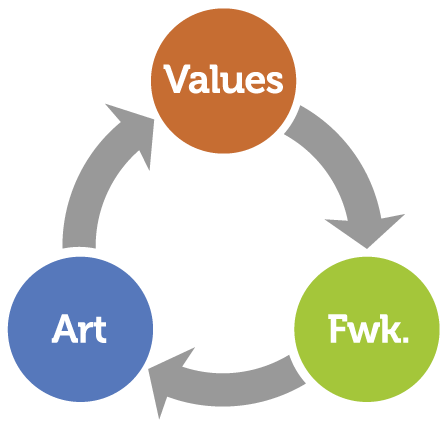
Myths are all around us and every culture has them, but where do they come from? I dare say none of us has invented a widely adopted sacred story (yet). Let’s face it, we’re not accustomed to bootstrapping our sacred myths. Historically, no one person invents a religion; even if it came from a founder or prophet, it only has the legs the community choses to give it. In other words, myths are community creations. Given the need to elevate our behaviors, we can think of the process in three phases:

Three Phases of Myth Making

  1. Sacred Values: We need the notion of sacred values and behaviors, and this is best defined by the community itself. We really do know the answers; we just have to agree and write them down.
    • This is actually not that hard. It starts with mythic awareness, and then coming together to define themes for change.
  2. Myth Framework: We need the masters of metaphors, those who actually create the allegorical imagery and story that we can use to re-program ourselves.
    • This is perhaps the most important phase because it will scope the realization of the myth. Mythical art expresses a shared purpose.
    • The a-priori to mythical art is the shared story. The narrative phase, therefore, is a necessary pre-requisite. This is why we stress the need for a story framework early on in the community myth-making process, which is just a natural expression of a shared belief.
  3. Artistic Myth-crafting: After this come the execution, or creative phase.
    These three phases are described in more detail at Cultera.org.

Artists are the myth realizers – making sacred stories tangible, a necessary pre-requisite to belief. Think about the dimensions of illusion here. For example, a two dimensional surface (the canvass with paint) provides an illusion for a three dimensional form. If the work is figurative, we can infer another dimension, namely the sense of presence of a personality when done well (like a Rembrandt portrait), a fourth dimension. Moreover, if it provides a sense for time past or alternate worlds, we have a fifth dimension (like allegorical art on the Sistine Ceiling). So far we have described qualities what many great works in museums have. They are not necessarily mythical without additional context. The next dimension is narrative context and symbolic meaning. This is what puts art in the realm of myth. The sixth dimension is the portal to the world behind the world, and it’s actually something the viewer brings to the work, i.e. a knowledge of the story. Art has these six dimensions is mythical.

With mythical art, the artist is facilitator of transcendence. Connecting with ‘the world behind’ actually validates current decisions when they are seen as consistent of the laws of that other world, as revealed by mythical art, which by the way, can include dance. Artists with community-sacred values are to be valued as a myth-crafters, those who create the means of collective healing and transformation.

Artists don’t have to dress as priests, mediate and set themselves apart from carnal desires in order to create this sacred art. In fact, it’s not really about the artists themselves. Myths will do their work regardless. It’s the job of the artists to be faithful to the theme and express in the works a heartfelt conviction. This view of the artist, while not new to civilization, is strange to the modern mind.

On a personal note, I’ve come full circle from being an artist who threw away his paint brush to preach a reductionistic gospel of Jesus Christ during two years as a missionary back in the early 1980s, to one who now advocates an expansive vision for making myths as communities write their own gospels, which serve functions of religion. What’s more, this process requires artists to pick up their paint brushes, chisels, pens, musical instruments and whatever other art crafting tools they have at their disposal.

This is trippy because the traditional missionary comes to a people with a message, and seeks to find an aesthetic way to present the pre-conceived – and often ancient – pathways to God. In our new practice, we don’t come with the message – that is the responsibility of the local community. No, we come with a methodology for letting them create their own and helping artists understand the crucial role of mythic art. This pre-supposes a great faith in humanity.

— Roy Zuniga
Feb. 2015 – Langley, WA

copyright © 2015 roy zuniga – all rights reserved

48.040095
-122.406257

Self-directed Conversion

15 Monday Apr 2013

Posted by royzuniga in Uncategorized

≈ Leave a comment

Tags

Christianity, community mythology, conversion, Four Spiritual Laws, mythology, propaganda, social compact, torture

We need to get together and canonize a set of values (that are aligned with goodness) we believe are the universal way forward. There should be a process to ratify them around the world and have them be the holy foundation upon which each culture can create their own stories. In other words, a peace pack of good intent.

What would that look like? Let’s use our imaginations and fast forward to a possible future. Obviously timing of the creation and ratification would be centrally managed, and there would be central guidance on how to do it. We want to avoid creating another hierarchical organization, of course. Execution is naturally de-centralized, starting probably with house groups all around the country (and the world). Outcomes would need to be clearly defined, and there would be a certification process because the values selected would become binding in some way, and normative. A federated set of web sites can help communicate these values to other groups around the world so we all can learn from each other.

The stories that flow from these value sets can and will vary tremendously in content and quality. Regional clusters of cultural traditions will spring up, depending on the local talent, written and visual traditions, etc. Cultural exchanges will happen across communities on a new set of Holidays established for this purpose. There will be a cadence to the year, and even an alignment of sub-set of values and/or themes for the cultural productions depending on the calendar. Thanksgiving, the various solstices, etc. Real heroes will be praised based upon the values they espouse and consciously be made into archetypes for countless stories. As a normal unfolding of mythology, the actual and the fictional will blend into each other. This will not be seen as ‘lying’, i.e. distorting the truth, by others who have different stories. At the same time we want to influence the creation of each other’s value sets in a comparative dialog, so that we can still cohere as a country. Otherwise, some groups would devolve into a hedonistic, sadistic and/or cultic negative spiral of hate. On the contrary, to guarantee a positive spiral of the imagination, those who participate must adhere to the First Principle, i.e. an aspiration toward the good god.

It all starts with value awareness. The only way to want to change is if we see the need for each of us to change individually. And especially those on Wall Street who are driven by cynicism, indifference and greed. They, like the rest of us, need to understand and acknowledge what they believe in. Then they need to see the logical consequences of their decisions. Is top thinking always corrupt? Does absolute power always have to result in absolute corruption? It can’t, or we’re doomed as a civilization and a race. Why did George Washington and the founding fathers accept slavery and South America’s liberator, Simon Bolivar, did not?

Ultimately the self-regulated values-based approach espoused here only makes sense if there is enough to go around for all, and enough room for everyone. Our American Constitution gave protects our right to self-regulation but gives us tools for choosing the direction of our decisions. If planet earth becomes like a lifeboat, i.e. some have to get left behind, then survival does become an exercise in values all right – in favor of those values that ‘preserve the race’ (even if some number of individuals are lost); more likely it will boil down to influence and blood lines rather than skills, abilities or a pristine genetic pool as the criteria for selection. The whole dynamics of myth will be invoked for evil, as it was by Hitler’s propaganda machine. The masses will be programmed to accept their fate for ‘the good of all’, to sacrifice ‘for the homeland’ (or some such story).

Luckily we’re not there yet; at the same time, it’s too easy to imagine that scenario, as is evidenced by recent movies like 2012. It might be another 40-70 years before The Preservation of the Few becomes the primal imperative to sustain civilization, probably after we’ve severely depleted the natural resources of the planet. By the way, don’t get your hopes up about manned missions to space colonies on earth-like planets. We’re not anywhere near being able to colonize any rock in the sun to the scale that it would make an ultimate difference. Earth might end up being just another scorched rock in the sun at the rate we’re going. Anyway, the planet is big enough to sustain us well into the future, if and only if we make the right choices.

How do we make this shift to truly sustainable living? How do we shift the thinking of the rich if not the masses? Can you have a propaganda machine that brain washes the powerful? Isn’t that an oxymoron? It is contradictory if the rich necessarily are on the side of exploitation and selfish preservation. Would it take an act of coercion to change them? Isn’t that how the French aristocracy finally turned (or lost) their heads in favor of democracy? Isn’t revolution and blood-letting the hard earned wisdom of history if you want to change who’s in charge? Maybe. But doesn’t history also teach us that one of the next generations will end up being as bad or worse? How do you permanently change the thinking at the top?

Perhaps a little water-boarding torture will help. Doesn’t that change the decisions of torture victims? Maybe. But does it really change their world view? How do you change someone’s world view without destroying their person as torture does? It took a civil war in America to eventually change the South’s thinking about slavery. That was a lot of blood-letting. What happened in the losers’ mind set in the conversion-by-torture scenario? A voluntary change of will is always better than coercion. We have to understand the psychology of defeat. We have to splice out the violence and replace it with a positive realization. We need a more positive analogy for a change of mind. What happens when a person is willingly ‘sold out’? How does one give up old values and at the same time manage the destruction of former behavior associated with their core sense of being?

How about religious conversion? I was converted to Evangelical Christianity in the distant past. Then I shifted my worldview again, the second time by myself, towards a belief in the power of community mythology. It may be that my first worldview shift at conversion, which was an assisted one, enabled me to shift it again on my own.

My first conversion was leveraged with no small amount of passive threat. The ‘Four Spiritual Laws’ preached to me indicated that: 1) God created all things and created them good; 2) Sin corrupted all things; 3) Christ died to redeem all things, and; 4) therefore I’d better accept Christ (or be corrupt and suitable for Hell). It was a loving humiliation, which unlike torture, co-opted my will without physical pain. The mental logic at conversion, once you accept the premises, is to accept the need for change. This proves, to me at least, that we are capable of willful change that goes against our programming. If I can convert, why can’t a Wall Street baron?

Even though my worldview was destroyed, unlike torture or gunpoint, my personhood and sense of self-worth was not. This is partly because I was not humiliated by a fellow human. At least I thought it I was humbling myself before God. Of course, His proxy the church was standing right there between us facilitating the whole transaction, making me feel good about the decision. Which would explain why I was subsequently inducted into the rank of church missionaries. In any case, religious conversion is an example of a person changing deeply held convictions and behavior patterns over time voluntarily. Immediate change of all behaviors was not required, which helped soften the blow. Thus with hindsight, humility and grace take on new meaning.

In any event, my second conversion was voluntary and self-directed. It required no small amount of separation from the old. The dynamics of self-directed conversion are absolutely critical for us to understand if we are to succeed in non-violent change. Stay tuned. . .

— Roy Zuniga
Kirkland, WA
April 2013

Copyright 2013 Roy Zuniga

A Common Deity

09 Tuesday Apr 2013

Posted by royzuniga in Uncategorized

≈ Leave a comment

Tags

Christianity, community mythology, faith, Jesus, mustard seed, myth making, mythology, religion

What we’re developing here is a universally applicable praxis of spirituality that focuses on the phenomenon and dynamics of faith, and not the specific trappings and content of a canned religion. In other words, we seek to establish universal practices that result in bonding with God and people. How do we know we are successful? At least three criteria must be met:

  1. A personal connection with God that is undeniable, i.e. an experience
  2. The so-called ‘fruit of the spirit’, i.e. a manifestation of a godly personality in inter-personal relationships
  3. Scalable choices, i.e. those decisions that can be applied broadly without detrimental effect on the environment and fellow humans

Have you ever met a holy person, a preacher or guru or prayer warrior or missionary who exudes the presence of God? I have and so have many people across the globe. A connection is undeniable. It’s not so much how they say they connected that is interesting. Instead, for me it is the love and spirit presence they emanate that convinced me a connection is possible, and I experienced the Spirit rushing through me like a fresh waterfall from above. They all spend time establishing that connection and use Scriptures in the context of life experiences as a catalyst for prayer and meditation. In other words, they make the effort, come with good intentions and an open heart. Yes, it’s possible they are duped by spiritual beings (because of the n-level problem described elsewhere). However, with these ‘saints’ we get the sense that they are connected straight to the source. The smell of scammers is more often on the hierarchy in the religious organizations than it is in these saints. So the possibility of a personal connection with God is pillar of faith.

Another other pillar is choice, or put another way: human agency. Nothing happens in this world apart from the actions of people. These two pillars are of course related. If you see a person acting selfishly and not for the greater good, then we know by their fruits that they are not connected to God.

We often think of choice as consumer choices. We have to also consider spiritual choices. In other words, it is not just about a shopping choice, or choice of career and good social behavior. It is also about what spirits we let into our lives to listen to. We often act based on muses we summon. We can pick our influence; we can exorcise undesirable spirits from our dwelling places. Music we listen to, movies we watch, angry talk radio, etc. All of these influences predispose and open our imaginations to being fed. It’s like tossing bread crusts to the sea gulls – put it out there and they will show up. I don’t know the dynamics of spiritual beings, but one thing is for certain, they are hungry for action; and the way they act is through human agency.

So how do we get rid of them? In whose name do we exorcise the foul demons? Since it is our choice, why do we need a name? Can’t they just go because we said so? Or do we need the name of Jesus or some other spiritual bouncer? In the first degree, it is in our own name that we can do wondrous things, because we have the choice. We are not the source of life and goodness. However, we channel it.

Nevertheless, we as humans seem to need a personification of that source. ‘In the name of Jesus’ is what Evangelicals say. Other cultures invoke deities with different names. Some are facts of God. Some embody the quintessential behavior of a holy man, i.e. they a proto-faithful, like Jesus. That is to say, they embody the pattern for our faithful behavior. How do you fill in the blank?

‘In the name of ____________.’

Jesus was said to be God because he could give commands and miracles would happen (wither the fig tree; convert water to wine; heal the sick; raise the dead, etc.). Assuming those acts happened as reported (which is never really the case when humans are involved), let’s flip it around and take the reported proto-faithful-behavior not as evidence, but as a pattern. For the criteria enumerated above, we don’t actually need tricks like turning water into wine. Because of the n-level problem and the factional will applied to the interpretation of those events, we don’t really know they came from God. They don’t really catalyze a personal connection because they result in awe of the performer, and veneration of the Other, which doesn’t further the cause of scalable decisions unless it’s under an organizational control framework. Yes we can use organizations, but they should be intentional by and for the community, and not driven by miracle evidence and a class of intermediaries.

We should remove the exclusive thinking in the Scriptures, for example the ‘I am The Way’ credentials for inter-personal mediation, and rather view what conforms to the criteria above as proto-behavior, i.e. the normative pattern of behavior. Ironically, in Scripture what was interpreted by the mediator class as evidence of God was reportedly touted by Jesus Himself as phenomenon possible by anyone with the ‘faith of a mustard seed’. Jesus himself diminished the miracles as tricks compared with the fruit of personal behavior and decisions. You can move mountains, he said metaphorically.

Thus what makes me suspect some of the Scripture is true are empowering assertions like that. ‘Oh ye of little faith. . . ‘ or ‘He is near you; He is in you’, etc. Despite the controlling intermediary class, these precious insights made it into the Holy Book. Generally they are obfuscated by the exegesis that interprets His ‘miracle’ acts as evidence of deity. In fact, I feel confident to say, those acts were prototype for us to emulate, and likewise not take them as evidence of our deity as some who have figured this out actually do. The only thing they attest to is the ability to manipulate nature; the source of that ability cannot be known, good or bad.

What we have to watch out for are those who exercise a religious pattern of interpretation, i.e. who take the normal miracle-practices and interpret that as evidence of deity and therefore requiring veneration of the intermediary class by the faithful. Give glory to the ‘Father in heaven’, or ‘Gaia’ as some now call her. God has aspects, not a gender; however, our minds require a name.

We should all manifest the fruit of a connected relationship and as such be common deity. Evidence of connection is normative behavior and the agent cannot be mistaken for an intermediary. Rather he or she are demonstrating what must be our ‘new normal’. This is not to say that every person will provide wine from the water faucet at parties. No, miracles have their own logic, and God doesn’t always make an exception to the laws of nature and mortality.

What should be common practice among mortals who are ‘common deity’ is healing and the fruit of the spirit. In the end, the only name that really counts is your own. After all, we God-fashion Him in our image, like so many 16th century capitalists commissioning portraits of religious subjects in the pious garb of their own times. We can paint our own mental icons if we want, if that helps. Or we can flush them out as spiritual crutches and in the end act in our own name. It is time we own up to ourselves as common deities. Believer or not, the only name counts is your own. So then, why not make it a good name? That’s your choice; it’s your decision.

— Roy Zuniga
    April 2013
    Kirkland, WA 


copyright 2013 Roy Zuniga 

Recent Posts

  • Can we still paint ideal figures?
  • Language in the Service of Myth
  • Channeling Intent
  • The Divine Right of Christ
  • The Space God

Archives

  • December 2020
  • August 2020
  • December 2017
  • July 2017
  • June 2017
  • May 2017
  • January 2016
  • December 2015
  • February 2015
  • December 2014
  • November 2014
  • October 2014
  • August 2014
  • June 2014
  • April 2014
  • February 2014
  • April 2013
  • March 2013
  • June 2012
  • May 2012

Categories

  • art
  • mythology
  • Uncategorized
  • Worldview

Meta

  • Create account
  • Log in
  • Entries feed
  • Comments feed
  • WordPress.com

Blog at WordPress.com.

  • Subscribe Subscribed
    • Dynamics of Myth
    • Already have a WordPress.com account? Log in now.
    • Dynamics of Myth
    • Subscribe Subscribed
    • Sign up
    • Log in
    • Report this content
    • View site in Reader
    • Manage subscriptions
    • Collapse this bar
 

Loading Comments...