by Roy Zuniga
Art has an impact. Without someone actually being touched by the work, who can say a painting is art? If it’s not perceived then it is just another object reflecting light. Any item can be seen; beauty is perceived. Art’s essential meaning does not register on a light sensor. Neither does everyone who views a work of art actually perceive its artistic import. The presence we think of being ‘in’ the work is actually only in the viewer’s mind – there is no objective presence in the paint and canvass. Of course, without a work there’s nothing to respond to. Light may reflect from the unobserved art like the sounds of the proverbial unwatched tree falling. Perception of the work as art is everything, which makes judging great art very subjective.
To excel as artists, we need to know what makes truly great art. This actually depends on what we value as individuals, which correlates to what we have learned to value as a culture. Cultural values can go sideways and degenerate. The question should really be ‘what great values should art embody well?’ These question forces us to think about what we need to value going forward as a population, and what stories are we going to develop to ingrain them in our psyche.
Myths, which carry a peoples fundamental beliefs, are manifested through art. Great art in turn has impact by embedding those cultural values and behaviors in our being. In other words, there is cycle that perpetuates certain values, with each generation spinning old myths in a new format. Think of how many incarnations of American superheroes have manifested themselves over the years.
We all participate in this cycle but many of us are not aware of how it’s working on us. Art is central. Impact art and you impact culture and ultimately civilization. Art can be an entry point for change to impact more suitable economic, technical or political decisions. Make people aware of values driving culture, and we have a wedge into this cycle of myth that allows us to adjust the direction of observer’s future choices.
Thus answering the question of what art is, and what great art should be, starts with identifying subjective values that are great. For me, having a sense of connectedness is a supremely good value to have. As do most people, I value a connection with other human beings and creation. This is the foundation for co-existence and long term sustainability. Of course as humans we connect best with our own kind. In my mind, the greatest art has to be the great portraits and figurative works that connect us with the personalities portrayed. So to me, a great work is:
Figurative art that makes us feel we are facing a personality.
To understand this higher calling for the artist, it will help to sort out some of the dimensions that make art excellent, and understand which dimension specifically takes art to that higher level:
- Historical import: art valued for its historical role and impact, not just for the merits of the work as art. Like classic cars, the value of the work increase because of scarcity and historical context.
- Technical mastery of the artist: the work astonishes us with innovation, competence, skill, execution of the paint and materials.
- Subject matter expertise: the work demonstrates deep knowledge of anatomy, perspective, foliage, topography, engineering, etc.
- Formal interest: The composition, how the eye is directed by shapes and teased by color, texture, perspective, golden proportions, balance, dynamism, etc. all work together for maximum impact in relation to the concept of the image.
- Narrative curiosity: the subject matter makes us think about events and a story. For example, it betrays the artist’s struggle, a fairy tale plot line or someone’s success. Something in the work’s subject or how it’s rendered elicits an involuntary response brings us into the context of the work emotionally. The rendering of a beggar boy, or little girl with a bird for example.
- Personal presence: the most elusive quality – the work of art instigates the perception of a personal presence. Think master portrait. We come to respect and even empathize with the subject. That’s part of the beauty of portraits; the only sensitivity required is the ability to recognize other people!
It’s the last one – personal presence – which I’m most interested in. The others can be acquired through study and practice. Rendering personal presence, however, is a sort of alchemy that enables all kinds of mystical scenarios and raises questions about existence. Before we get into that, however, let’s review some of the dimensions of art that no matter how great don’t add up to great art on their own.
1. A dimension that I don’t think is a defining characteristic of the greatest art is historical import. The analogy is of course classic cars. Rare cars are more valuable because of how much of the original car is actually there, not by how well they function. Knock-offs made today my look just as good and be lighter, more efficient, safer, quieter, etc. and still not be worth what a fragile original is. Same for art – the perceptive impact of a medieval painting could be lesser than the work of a modern master, but because of its historical import, the medieval work could be worth more. It may have been the first painting to show two point perspective, for example.
2. Neither is the differentiator having absolute mastery of the illusion. A pencil, a fruit, a hat, a bowl may seem to pop off the surface. We admire what a skilled craftsman can do and may be tempted to try the technique ourselves; after all, if it’s rational, it can be learned. We marvel at these works in the same way we marvel at fine woodworking or precise engineering. Aesthetic delight is in acknowledging the elevated actions of other humans, which somehow projects back on us. Ultimately a heroic effort on a ten foot hyper-realistic portrait is only that unless it also connects with our souls.
3. Medical text books have amazing art that illustrate anatomy in detail. Artistic anatomy books display a mastery of surface anatomy. Yet neither of these in and of themselves translate into us feeling a human connection with the subject matter, although the greatest masters demonstrate knowledge of human anatomy. The reverse is of course true. We may feel a presence in the work – a real empathy and connection at an emotional level. However, if the anatomy is off, we take points off.
4. The key differentiator is not the work’s ability to fool the mind into reacting as if it were encountering something. The mind assesses warm and cool greys and evaluates one to be ‘in front’, for example. The same for colors that are said to be acidic, hot, cool, airy, peaceful, etc. Invoking these associations are an important tool in the artist’s kit. However, in and of themselves these stimulated associations are not the key differentiator. Advertisers use similar techniques to sell products and vacations. And a great work might be devoid of strong visual stimulation.
Neither do formal techniques differentiate great art. As artists we use all sort of gimmicks to trigger involuntary responses, like embedding primal geometry and the golden mean in the composition. Our mind can’t help but perceive the underlying structure, and this creates interest. It’s a way to hold attention on a work that otherwise might not have real depth of content we can connect to. In this category are letters in the background that we can’t help reading any more than a billboard when we’re stopped at a red light. Puzzles that work our sub-conscious can be delightful, and certainly a master portrait that also works in this dimension will be even more fascinating.
5. In a similar vein, an artist might leave marks in paint that are a testament to struggle, which is interesting as a biographical note, and fascinate us, pulling us into the drama. This pricks our curiosity about the plight of the artist and what he was thinking about and struggling with. The wrestled work provides an opportunity for empathy for the audience to be sure.
Aesthetic delight can also come from interpreting symbols in works, like detectives deciphering a Da Vinci code. We want to look for meaning in shapes, animals, coats of arms, etc. Investigative delights can certainly augment the aesthetic experience, as in for example, van Eyck’s ‘The Arnolfini Marriage’ painted in 1434. We can respond at many levels – the wedding narrative invokes our curiosity about the commitment; the symbolism of the dog, the slippers, etc.; the discovery of reflections in the mirror; the sublime execution and richness of contrasting red and green colors all provide us with entertainment. However, do we really feel we know the souls people represented? Or just that we know about them via the symbols?
6. I also don’t believe the greatest art can be achieved without a human component we can empathize with. Sure there are amazingly intimate still life painting like those of Richard Schmidt or Daniel Keys. However, the best still life painting dims when compared to an encounter with a portrait by Rembrandt or Velazquez because we, as humans, value an encounter with a real person above the encounter with a real fruit bowl.
The experience I’m referring to is not instigated empathy, i.e. like the feelings elicited by someone who is tugging your heart strings to get attention. That is not the highest calling for art because it is no more an encounter with a personality than passing by someone on the street whom we might feel for, but don’t deeply engage with. That’s not to say you can’t have a deep engagement through a great portrait of a beggar. That would happen despite the trappings of the subject’s circumstances.
So we’ve seen what can make for great art, but not what I’m really after with understanding the greatest art – art that you can connect with in your soul. When I encounter a Rembrandt or Velazquez portrait I feel a connection the person depicted. This experience is repeatable, although it will vary from observer to observer. What are we connecting to? There is no breathing person there. Here’s where it gets mysterious. If the significance in the recognition, then is the perception of an art work a kind of soul revival? Does it matter if the original subject doesn’t really get any benefit from our adulation of a work about the person? Does art truly immortalize?
Great art has a type of spirit that comes to life when you observe it. If you’ve ever stood mesmerized in front of a Sargent, then you know something is there you can relate to as a person. It would be creepy if it wasn’t so wonderful. Reflected light doesn’t make art; our perception of an entity does. A full experience of art is somewhat mystical, and thus hard to define.
Figurative art that betrays a presence that cannot be explained by a scientific language that only understands paints and canvass as objects, pigments and chemicals. We need a more metaphorical language. The great paintings function as a unit, with a spirit that comes to life as it is observed and internalized. Your attention is what animates it; but the work must first hook you, and it does so with one or more of the visual techniques described above. Look away and it lives not. Look back and it is there engaging you with the intensity only you can throttle. Great art will give to you as long as you let it.
If people are not sensitized to understand and interpret what is before them, art is ineffective, diminished. Thus, paradoxically, the greatest art can only be created in partnership with an audience. No matter how good the work, it won’t be great with an audience of one. When one takes art history, learns the vocabulary of art and visit museums, you are in fact sustaining the art. When the public ceases to participate, the works have no beauty. They revert to being a collection of colorful molecules. As values change, old masterpieces may just fade away. Does that matter? If they were masterpieces to a past generation, does it diminish the works if they are not so to today’s viewers? What value is there in being a historical footnote saying that at some point in time, art we ignore was once valued?
Those who can educate the faithful about what counts in art are very powerful, like the priests of old who educated the religious on what god is and how to worship his attributes. We tend to think of masterworks as having a fixed value. In reality, they are more like stock options, but instead of price fluctuating by demand, the true impact of art fluctuates by the number of people who can perceive them, and the quality they assign to that perception. Perhaps this explains why modern art works can exact such high prices – there is a group that nurtures the appreciation of the works and thus makes them more valuable. However, our institutions have it all wrong if they think a small elite can determine worthiness and masterworks.
There’s a certain protective entitlement of artifacts in museums that, rightly or wrongly, is not tied to any broader audience-impact index. There are many who consider contemporary artists as great as, or even greater than, the pantheon of the ancients. If display space in publicly funded art facilities went to work being appreciated, I suspect we would still see Rembrandts and Sargents, as people still connect to them. But alongside these we would likely see the work of modern masters like Kassan, Assael, Shanks and Liberace.
To appreciate the art, the audience itself must hone its ability to perceive. Wherever you live, you don’t have to go far to enhance your sensibilities. Visit the local farmers market and take time to see the colors, the textures, the smells, the sounds. Pick up objects and feel them. Say hi to the soapmaker and wonder at the materials used. Take it to the next level and open a paint box, look at subject matter and start responding. Study the color transitions on a peach, discern the violet shades in an evening shadow crossing the way, and reveal the warm tones on a blushing cheek, and use highlights and edge to describe where bones meet flesh. A shadow may look grey to you at first, but with every differentiated thought you open up your ability to perceive and translate that insight into paint so that others can perceive as well.
Taken to its highest calling, perception must go beyond invoking the deliciousness of a peach or the sensuousness of a nymph. As in real life, deeper satisfaction comes from establishing a relationship. The ability to discover a person and generate the same response in others through paint is the highest level of art. It goes without saying that to be able to invoke the perception of a personality, the artist himself has to be able to perceive the subject. There are of course varying degrees of perception; not all people can empathize with others or develop deep friendships.
For example, John Singer Sargent’s letters a full of anecdotes about his sitters personalities and lives. Taking a class with David Kassan, one of the things that struck me was the conversation he has with his models. It’s prodding, playful, getting them to respond, to reveal character. It’s no co-incidence that many of his masterful portraits are in fact of people he knows really well, like relatives. You can tell when an artist views his models as mere subject matter, interesting and human for sure, but without a personal connection the end result is a depiction only, without that presence we recognize in the greats. This is the mystery of viewing great master works – there’s a transcendent dimension that creates a presence of character. Perhaps this is why the great portraitist John Singer Sargent was said to require many sittings with his subjects and reportedly scrapped of his canvasses as many as 25 times. It’s not that he couldn’t render a convincing likeness; it’s that he was capturing the ineffable personality of the sitter.
There is a direct correlation between the artist’s capacity for empathy and the ability to create great portraits. The key qualification of an artist is the ability to both perceive the person in the subject, and also stimulate a similar perception in others. A personal encounter is a pre-requisite to rendering a personality. How many introverted artists are capable of this? Do we have to be emotionally maturity to create great art? Certainly we find the time to master techniques. But to encounter a person, we ourselves have to be present, in the moment, and open to understanding the other person. Thus the requirement to perceive first and foremost brings us face to face with the issue many of us avoid by being isolated and absorbed in our own creative process. How we can we socialize? You have to take a genuine interest in other people to be a great portraitist.
By way of negative example, let’s look at those who had trouble connecting, like a Gauguin or Van Gogh. Yes they painted portraits, but more often than not it’s a rendition of modern alienation. You feel a presence, but not necessarily one you can connect to. Van Gogh is better remembered for his landscapes.
Having a relationship with the subject is not as easy as it might sound. Artists study objects. Some instructors tell us to put emotion aside and focus on perceiving the color, form and light. When we get into execution mode, we are responding to things and visual phenomena. We are not thinking about perceiving a soul necessarily. And while we have to get proficient with the machinery of creation, at some point we have get beyond the create-observe dynamic and actually understand the subject and the essential soul/spirit quality we want to instigate in the work. This takes a relationship, which is controlled emotional effort.
When subject friends are not available, the artist may turn to herself in the mirror. When the artist does a portrait, there are really three personalities in the room:
- The artist/creator/discoverer – which requires perception
- The responder observer – the artist as he steps back to experience the work and judge it to make adjustments
- The subject – the person being discovered, i.e. the perceived one
Amazing art has been made just with the first two. Going beyond critical execution to cultivating and understanding the third role is required for making a painting all it can be.
The idea that self-awareness impacts our ability to relate to others and thereby also create great art puts the self-portrait in a new light. When you look at a Rembrandt self-portrait, you are almost gazing into the looking glass that he saw. In his eyes, a depth of understanding and realization that is ineffable, that can only be realized with a gaze eye to eye with a knowing person. The subject is looking at us – or more specifically, looking at me (or you individually). Yet we see the record of the Creator in the room.
Rembrandt the painter has left a stamp on Rembrandt the subject with all the expressive texture on his countenance. The act of painting, secondary in importance yet so very evident, is catching our attention as it catches the light as we look into soulful eyes looking back at us. We understand subconsciously those painted eyes have been looking back at others for centuries. Hundreds, maybe thousands of others. This is a humane moment because, after all, it is the vulnerable Rembrandt we are understanding intuitively, face to face. The 16th century man ‘lives’ making eye contact with us.
To instigate this presence of personality we have to put energy into the material itself. There’s a certain transference of our perception into the material itself that renders it for others. The modern scientific mind can’t explain this.
Medieval alchemists had a special way of looking at the stuff they mixed. They observed properties and behaviors of things and made associations accordingly. They assumed inaccurately that things that behave similarly are made of the same primal stuff. They didn’t have the science to know, for example, that lead is not an immature form of gold because they are both heavy and relatively soft. Alchemists didn’t have the periodic chart, but they did have a systematic approach to their studies, which included gaining insights by observation. They imputed meaning to chemical reactions and interpreted them, trying to gain insight into creation that would allow them to tinker with it.
Likewise, artists view colors in less of a scientific sense, but more in terms of meaning. Artists look for the message of the visual sensations caused by the brush tracks in the paint. Certainly the closer the medium of representation aligns with the thing represented – like brush strokes that mimic skin texture as in a Rembrandt portrait, or a flowery field in a Monet – the more coherent the presentation is and the less the formal aspects get in the way of perception of an illusion.
The continuity of presentation from texture to a human presence is mystical. To the artistic mind there is magic in painting because the medium presents itself simultaneously with the ‘spirit’ in the work in a synchronous duality. The artist is putting mystery into the work by invoking a ‘spirit’ in the work. This is not rational. The artist is able to conjure beings and their new essences at will, placing her on the same side of creativity as God.
‘In the beginning . . .
the earth was formless and void,
and darkness was over the surface of the deep . . .
and God said, ‘Let there be light,’
and there was light.’
— Genesis
To create the universe God, it seems, just needed light before starting to push things around on a surface to make the rest of creation. White light is and has been the energy that makes art possible. Without it we have no images; the surface is ‘formless and void’, it cannot be perceived. With light, the pigments we push around come to life with color, form, symbol and even a spirited presence. Light is energy. We are energy workers manipulating base materials like paint, wax, clay, marble and bronze that reflect and refract the light. Art is not religion: it is creation. With great portraiture, the artist imposes her will on White Light, crafting a personality on the surface of the deep.
copyright 2014 roy zuniga – all rights reserved

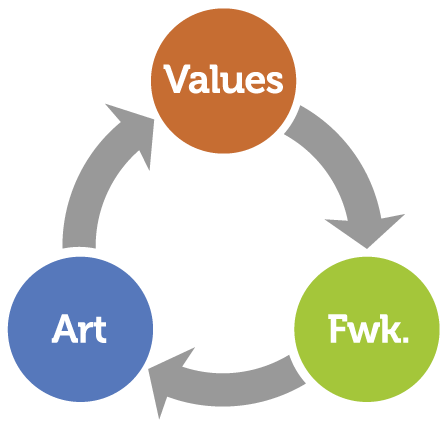
 Dynamics of Myth