• About
  • Blog Spots

Dynamics of Myth

~ using culture to shift our worldviews

Dynamics of Myth

Tag Archives: myth making

Creating Mythic Art

21 Saturday Feb 2015

Posted by royzuniga in art, mythology

≈ Leave a comment

Tags

art, Christianity, community mythology, comparative religion, dynamics of myth, Joseph Campbell, myth making, mythology, religion, Sacred Story

So far I have been looking at myth-making from the perspective of how communities can ‘re-program’ themselves to implement more sustainable behaviors. We can think of this as the ‘human software’ role for myth. The theory is people will empathize with mythic heroes on their journeys and mimic their decision making when faced with analogous circumstances.

However, there is another role for myth as a way to connect to ‘the world behind’, or ‘the other plane’. In this view, myth is the portal, the mystical means by which we can make things right with the gods, and in so doing enhance our spiritual survival. In other words, we go from mythology as a systematic and somewhat objective study of the stories of culture, to a faith-full ‘mythism’. This is a belief in the power of the myth itself. In Campbell’s terms, myth gives you ‘a line to connect with that mystery which you are.’

If we take either one of the approaches without considering the other, we miss out. Focusing on the hereafter without regard to the planet does not lead to integral living: as the planet sours, the daily reality of living contrasted with the spiritual journey towards bliss causes us to live with tension, dissonance and conflict. All sorts of dysfunctions result, including the creation of artificial environments, denial, retreat, escapism and even hatred. Some of the most vitriolic chronic ‘haters’ are those who feel others have come in between them and their journey to bliss.

On the other hand, while focusing on the here and now can help organize and clean up society, it doesn’t address the basic human need for meaning and an explanation of the soul’s afterlife. Do we have to choose between approaches? I think not.

The duality between the pragmatic behavior-focused approach and the spiritual journey has something in common: sacred stories. For community myth-making, these are the stories that hold our core values as exemplified by normative behaviors. For the spiritual pilgrim, these very same stories hold the metaphorical images and concepts that provide a connection with the gods and their normative behaviors. Align the two and we have the formula for cultural transformation. Myths give us the sense that today’s acts can be brought in line with how things are done on the higher plane. It’s imperative, therefore, that we align our mythical world with what life on earth should be. What does that look like?

Myths are all around us and every culture has them, but where do they come from? I dare say none of us has invented a widely adopted sacred story (yet). Let’s face it, we’re not accustomed to bootstrapping our sacred myths. Historically, no one person invents a religion; even if it came from a founder or prophet, it only has the legs the community choses to give it. In other words, myths are community creations. Given the need to elevate our behaviors, we can think of the process in three phases:
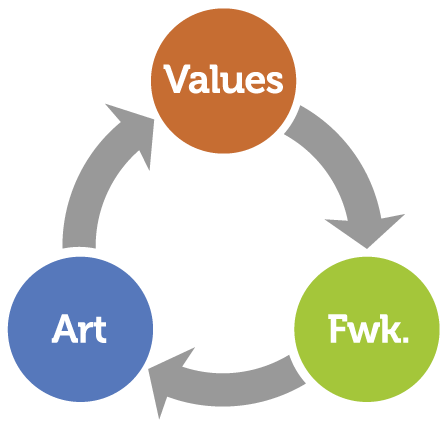
Three Phases of Myth Making

  1. Sacred Values: We need the notion of sacred values and behaviors, and this is best defined by the community itself. We really do know the answers; we just have to agree and write them down.
    • This is actually not that hard. It starts with mythic awareness, and then coming together to define themes for change.
  2. Myth Framework: We need the masters of metaphors, those who actually create the allegorical imagery and story that we can use to re-program ourselves.
    • This is perhaps the most important phase because it will scope the realization of the myth. Mythical art expresses a shared purpose.
    • The a-priori to mythical art is the shared story. The narrative phase, therefore, is a necessary pre-requisite. This is why we stress the need for a story framework early on in the community myth-making process, which is just a natural expression of a shared belief.
  3. Artistic Myth-crafting: After this come the execution, or creative phase.
    These three phases are described in more detail at Cultera.org.

Artists are the myth realizers – making sacred stories tangible, a necessary pre-requisite to belief. Think about the dimensions of illusion here. For example, a two dimensional surface (the canvass with paint) provides an illusion for a three dimensional form. If the work is figurative, we can infer another dimension, namely the sense of presence of a personality when done well (like a Rembrandt portrait), a fourth dimension. Moreover, if it provides a sense for time past or alternate worlds, we have a fifth dimension (like allegorical art on the Sistine Ceiling). So far we have described qualities what many great works in museums have. They are not necessarily mythical without additional context. The next dimension is narrative context and symbolic meaning. This is what puts art in the realm of myth. The sixth dimension is the portal to the world behind the world, and it’s actually something the viewer brings to the work, i.e. a knowledge of the story. Art has these six dimensions is mythical.

With mythical art, the artist is facilitator of transcendence. Connecting with ‘the world behind’ actually validates current decisions when they are seen as consistent of the laws of that other world, as revealed by mythical art, which by the way, can include dance. Artists with community-sacred values are to be valued as a myth-crafters, those who create the means of collective healing and transformation.

Artists don’t have to dress as priests, mediate and set themselves apart from carnal desires in order to create this sacred art. In fact, it’s not really about the artists themselves. Myths will do their work regardless. It’s the job of the artists to be faithful to the theme and express in the works a heartfelt conviction. This view of the artist, while not new to civilization, is strange to the modern mind.

On a personal note, I’ve come full circle from being an artist who threw away his paint brush to preach a reductionistic gospel of Jesus Christ during two years as a missionary back in the early 1980s, to one who now advocates an expansive vision for making myths as communities write their own gospels, which serve functions of religion. What’s more, this process requires artists to pick up their paint brushes, chisels, pens, musical instruments and whatever other art crafting tools they have at their disposal.

This is trippy because the traditional missionary comes to a people with a message, and seeks to find an aesthetic way to present the pre-conceived – and often ancient – pathways to God. In our new practice, we don’t come with the message – that is the responsibility of the local community. No, we come with a methodology for letting them create their own and helping artists understand the crucial role of mythic art. This pre-supposes a great faith in humanity.

— Roy Zuniga
Feb. 2015 – Langley, WA

copyright © 2015 roy zuniga – all rights reserved

48.040095 -122.406257

A Common Deity

09 Tuesday Apr 2013

Posted by royzuniga in Uncategorized

≈ Leave a comment

Tags

Christianity, community mythology, faith, Jesus, mustard seed, myth making, mythology, religion

What we’re developing here is a universally applicable praxis of spirituality that focuses on the phenomenon and dynamics of faith, and not the specific trappings and content of a canned religion. In other words, we seek to establish universal practices that result in bonding with God and people. How do we know we are successful? At least three criteria must be met:

  1. A personal connection with God that is undeniable, i.e. an experience
  2. The so-called ‘fruit of the spirit’, i.e. a manifestation of a godly personality in inter-personal relationships
  3. Scalable choices, i.e. those decisions that can be applied broadly without detrimental effect on the environment and fellow humans

Have you ever met a holy person, a preacher or guru or prayer warrior or missionary who exudes the presence of God? I have and so have many people across the globe. A connection is undeniable. It’s not so much how they say they connected that is interesting. Instead, for me it is the love and spirit presence they emanate that convinced me a connection is possible, and I experienced the Spirit rushing through me like a fresh waterfall from above. They all spend time establishing that connection and use Scriptures in the context of life experiences as a catalyst for prayer and meditation. In other words, they make the effort, come with good intentions and an open heart. Yes, it’s possible they are duped by spiritual beings (because of the n-level problem described elsewhere). However, with these ‘saints’ we get the sense that they are connected straight to the source. The smell of scammers is more often on the hierarchy in the religious organizations than it is in these saints. So the possibility of a personal connection with God is pillar of faith.

Another other pillar is choice, or put another way: human agency. Nothing happens in this world apart from the actions of people. These two pillars are of course related. If you see a person acting selfishly and not for the greater good, then we know by their fruits that they are not connected to God.

We often think of choice as consumer choices. We have to also consider spiritual choices. In other words, it is not just about a shopping choice, or choice of career and good social behavior. It is also about what spirits we let into our lives to listen to. We often act based on muses we summon. We can pick our influence; we can exorcise undesirable spirits from our dwelling places. Music we listen to, movies we watch, angry talk radio, etc. All of these influences predispose and open our imaginations to being fed. It’s like tossing bread crusts to the sea gulls – put it out there and they will show up. I don’t know the dynamics of spiritual beings, but one thing is for certain, they are hungry for action; and the way they act is through human agency.

So how do we get rid of them? In whose name do we exorcise the foul demons? Since it is our choice, why do we need a name? Can’t they just go because we said so? Or do we need the name of Jesus or some other spiritual bouncer? In the first degree, it is in our own name that we can do wondrous things, because we have the choice. We are not the source of life and goodness. However, we channel it.

Nevertheless, we as humans seem to need a personification of that source. ‘In the name of Jesus’ is what Evangelicals say. Other cultures invoke deities with different names. Some are facts of God. Some embody the quintessential behavior of a holy man, i.e. they a proto-faithful, like Jesus. That is to say, they embody the pattern for our faithful behavior. How do you fill in the blank?

‘In the name of ____________.’

Jesus was said to be God because he could give commands and miracles would happen (wither the fig tree; convert water to wine; heal the sick; raise the dead, etc.). Assuming those acts happened as reported (which is never really the case when humans are involved), let’s flip it around and take the reported proto-faithful-behavior not as evidence, but as a pattern. For the criteria enumerated above, we don’t actually need tricks like turning water into wine. Because of the n-level problem and the factional will applied to the interpretation of those events, we don’t really know they came from God. They don’t really catalyze a personal connection because they result in awe of the performer, and veneration of the Other, which doesn’t further the cause of scalable decisions unless it’s under an organizational control framework. Yes we can use organizations, but they should be intentional by and for the community, and not driven by miracle evidence and a class of intermediaries.

We should remove the exclusive thinking in the Scriptures, for example the ‘I am The Way’ credentials for inter-personal mediation, and rather view what conforms to the criteria above as proto-behavior, i.e. the normative pattern of behavior. Ironically, in Scripture what was interpreted by the mediator class as evidence of God was reportedly touted by Jesus Himself as phenomenon possible by anyone with the ‘faith of a mustard seed’. Jesus himself diminished the miracles as tricks compared with the fruit of personal behavior and decisions. You can move mountains, he said metaphorically.

Thus what makes me suspect some of the Scripture is true are empowering assertions like that. ‘Oh ye of little faith. . . ‘ or ‘He is near you; He is in you’, etc. Despite the controlling intermediary class, these precious insights made it into the Holy Book. Generally they are obfuscated by the exegesis that interprets His ‘miracle’ acts as evidence of deity. In fact, I feel confident to say, those acts were prototype for us to emulate, and likewise not take them as evidence of our deity as some who have figured this out actually do. The only thing they attest to is the ability to manipulate nature; the source of that ability cannot be known, good or bad.

What we have to watch out for are those who exercise a religious pattern of interpretation, i.e. who take the normal miracle-practices and interpret that as evidence of deity and therefore requiring veneration of the intermediary class by the faithful. Give glory to the ‘Father in heaven’, or ‘Gaia’ as some now call her. God has aspects, not a gender; however, our minds require a name.

We should all manifest the fruit of a connected relationship and as such be common deity. Evidence of connection is normative behavior and the agent cannot be mistaken for an intermediary. Rather he or she are demonstrating what must be our ‘new normal’. This is not to say that every person will provide wine from the water faucet at parties. No, miracles have their own logic, and God doesn’t always make an exception to the laws of nature and mortality.

What should be common practice among mortals who are ‘common deity’ is healing and the fruit of the spirit. In the end, the only name that really counts is your own. After all, we God-fashion Him in our image, like so many 16th century capitalists commissioning portraits of religious subjects in the pious garb of their own times. We can paint our own mental icons if we want, if that helps. Or we can flush them out as spiritual crutches and in the end act in our own name. It is time we own up to ourselves as common deities. Believer or not, the only name counts is your own. So then, why not make it a good name? That’s your choice; it’s your decision.

— Roy Zuniga
    April 2013
    Kirkland, WA 


copyright 2013 Roy Zuniga 

Recent Posts

  • Can we still paint ideal figures?
  • Language in the Service of Myth
  • Channeling Intent
  • The Divine Right of Christ
  • The Space God

Archives

  • December 2020
  • August 2020
  • December 2017
  • July 2017
  • June 2017
  • May 2017
  • January 2016
  • December 2015
  • February 2015
  • December 2014
  • November 2014
  • October 2014
  • August 2014
  • June 2014
  • April 2014
  • February 2014
  • April 2013
  • March 2013
  • June 2012
  • May 2012

Categories

  • art
  • mythology
  • Uncategorized
  • Worldview

Meta

  • Create account
  • Log in
  • Entries feed
  • Comments feed
  • WordPress.com

Blog at WordPress.com.

  • Subscribe Subscribed
    • Dynamics of Myth
    • Already have a WordPress.com account? Log in now.
    • Dynamics of Myth
    • Subscribe Subscribed
    • Sign up
    • Log in
    • Report this content
    • View site in Reader
    • Manage subscriptions
    • Collapse this bar
 

Loading Comments...