• About
  • Blog Spots

Dynamics of Myth

~ using culture to shift our worldviews

Dynamics of Myth

Tag Archives: religion

A Universal Process for a Personal Worldview

02 Sunday Jul 2017

Posted by royzuniga in art, mythology, Uncategorized, Worldview

≈ Leave a comment

Tags

art, Community, community mythology, faith, intent, intention, Jesus, mythology, religion, Worldview

My worldview guides me, as does yours. I believe in expressing intent as the basis for experience. This world view is also a process that can be applied by everyone. The key is to let ‘the Universe’ have its say in how our intent is fulfilled, considering the intent of others in our domain, and trusting that a suitable outcome will be orchestrated. This is fundamentally a positive outlook. It is also simple. The goal is to have humanity spend less time rationalizing manmade theological problems, and more time actually experiencing life. Nature is in danger from those who don’t know her, who don’t know how connected they really are to her.

I am approaching topics of ultimacy from the personal experience of what works. Praying to Uranthom works for me. Reflexive prayer, i.e. the notion that all spoken prayer for our own benefit, reinforces my intent. Understanding self is so important because being aligned with what makes you tick is the best possible experience for you as an existential ‘node’ in this collective and connected existence. If physical creatures can achieve a ‘heavenly’ experience on earth, why look forward to a non-corporeal existence? Consciousness without physicality is a hell. Whether our souls go to ‘Heaven’ or blend back into a mystical cosmic consciousness, I do not know. I am confident that the Universe that makes Uranthom possible will have a suitable resolution of my consciousness existence.

We get into trouble when we make ‘authoritative’ and exclusive assertions about God the way both Muslim and Christian theologians have over the ages. Conflict arises when the respective believers take the God-speculation literally and defend mutually exclusive absolutes. The line of thought that tries to define God is a dead end. We can be believers without absolutes. In this mode, all world views are necessarily individualistic, which is what I think happens anyway, even to those who believe in the ‘heaven first’ approach where guidance comes down from God.

If you find your mind caught in a web of theological conundrums, it may be helpful to trace back the chain of ideas that led to your beliefs. I did, and it led me to start fresh, from scratch. What kind of conundrums? For example, conflicting ideas about free will vs. predestination; obsession with a physical God who cannot be touched; someone we talk to but who never talks back.  Reconciling undeserved mishaps and tragedies with God’s good purpose for pious people. Talking about both love and eternal punishment in the same conversation. Advocating the never-ending exploitation of a finite earth. Advocating equality of genders while keeping the man as the ‘head.’ Preaching compassion and acceptance while attributing people’s sicknesses and disabilities to sin or laziness. Teaching forgiveness while always finding an enemy to fight. Asserting world peace is on the other side of a war. Thinking like this is making our planet sicker, and we need to change it.

Trace the origin any one of these ideas and you find they go far back, some thousands of years. The writers we read were influenced by ideas they might not properly credit. The Christian worldview goes back to the Greek philosophers, the Stoics, Christianity, kings since Charlemagne who believed in the divine right, the Protestant Reformers, and American conservatism. For example, we celebrate Easter because it recalls Christ’s death and resurrection. Why did He have to die? Shed blood was the atonement for sin. Why can blood atone? Because of pagan beliefs that God(s) demand it for transgression, and to earn favor. Why did Christ specifically have to die? Because he is God incarnate, and as such can atone all of humankind. Why does God have to be incarnate? Because of the theological tradition that requires God to be involved in human affairs, and the certainty that God(s) have to exist somewhere physically, like the Greek pantheon on Olympus. Change your worldview, and you change your destiny.

The tumor of over analyzed worldview tends to grow bigger as each generation tries to sort out one conundrum or the other, resulting in more spaghetti theology. Topics like ‘how do I stay out of hell?’ and other questions become irrelevant. That is all a huge distraction that myopic and weak-willed theologians debate ad-infinitum. Like addicts, they can no longer recognize the simple life and how good it can be. To those invested with years of study of treatises and intellectual traditions, real happiness and peace are a sign of apathy! They can not recognize a completed human being if she was sitting next to them in Sunday morning pew because such people are only expected in heaven. We could play their game and argue with every position that has been taken since Socrates. I do not have the life-energy to do that. Theology for its own sake only produces secure employment for professional mental wrestlers. We have to keep it simple. We can just snip that chain of beliefs at the source, let the weight of conundrums fall to the floor. Life goes on, and we can experiment with alternate foundational principles.

The fundamental worldview question we have to answer is ‘how should we live?’ I have arrived, for now, at a process build on existence as an experience of intent. Intent is simply an affirmation of the desired outcome. This is just a hunch, but so far, it is working for me, manifesting peace of mind and a good life. Note that intent is not the same as will. To will something implies a certain coercion, even if it is your own actions, which is a more aggressive stance that may in fact work against you.

Intent is a passive internal assertion that can be either be silent or can also be reinforced through vocalization, by saying it aloud (as in prayer). Lack of vocalization does not diminish the power of the intent. The ‘Universe’ realizes your intent based on an orchestration process that is opaque to us. I do not see the value of postulating what ‘God’ or ‘the Universe’ thinks and does since by definition it is beyond our grasp. This is why I invented the notion of Uranthom, which is my abstraction layer to what happens ‘out there’.

We express intent many times a day, thinking ‘yes I want a new shirt’, or ‘we pray for a new school for those missionaries, amen!’, or ‘I’d like to sleep in this morning’, or ‘I’d like to be paired with a woman (or man) like that’, or ‘my energy is better spent painting’, for example. We often try to execute on the intent, and this is where we should rather pause and listen to the Universe. Mindfulness is important before taking action, as is patience. I call it ‘manifesting’, which simply means that given some time for processing, those outcomes you intend will be orchestrated along with the intent of others for a more satisfactory resolution. It may not be exactly what you had in mind to start, but examining those desires in light of the outcomes, you will find a good state, one, which inevitably leads to new intent. Thus life evolves in a dialectic with Uranthom, the receptor of our expressions of intent.

If you have a communal intent, like ‘I wish to go to the ball game with my friends’, or ‘we need supporters to donate money to pay for fuel for the ship’, then expressing it helps align the intent of others. The expression can be a post on social media or a prayer in church. Because intent is bubbling up regardless of whether you are in a religious house or not, we do not distinguish between prayer and other expressions of intent. Intent that aligns with that of others is more likely to be realized. This is a driver for social awareness and political action, because, without the expression of an alignment on values, we are not likely to get our way.

Happiness comes from a realization that as you let go, and the manifestations are real, you stop being frustrated about what happens (or doesn’t happen), and start being present to recognize and enjoy goodness. This is parity for the assurance religious people feel when they believe ‘it’s all in God’s hands’. This mindset does not come overnight, especially if you are mired in the conundrums your ancestors fed you with our mother’s milk. Intent that aligns with that of others is more likely to be realized. As is intent that aligns with the progression of the Universe towards harmony, (this assertion, by the way, is an expression of my own intent). If we all share that intent, it will be. The simplicity of the model is the conscious expression (internal or external) of your intent, coupled with a letting go so ‘the Universe’ can manifest that intent.

This all sounds so simple and even mystical. What about all those conundrums that theologians and philosophers have spent lifetimes debating. Are we going to address those questions? I believe a lot of it gets sorted out on its own when you pivot on intent. For example, we don’t have to account for an all knowing God, since ‘God’ knows through our experience. I don’t believe in a God object, a person-like entity who somehow both sits on a throne and at the same time knows everything everywhere and has all power as Christian doctrine affirms. God may, in fact, have some of those attributes, but it is in a distributed fashion.

It is my hunch – and you don’t have to believe this, it’s just my way of dealing with categories of thought that need an accounting – that the ‘the Universe’ achieves omnipresence and omniscience through physical instances of people and other creatures who are embedded within it. ‘Creation’ is a mechanism for self-discovery. Good and evil are really just relative ideas based on the quality of the outcome of intent. Suffering is not a consequence of sin, but rather a consequence of intent and actions that don’t align with a viable existence. Mistaken experiments fail, people learn and change their intent. Look at the Chinese stance towards pollution. They have gone from not caring about it to engineering forest cities. We just have to learn from misguided policies, improve, and move onward towards a healthy expression of a society that doesn’t leave people behind.

Predestination is a moot point, since you are the agent of destiny, if you intend it, it was meant to be. As you realize it, it is also known. As the universe experiences and understands itself through each one of us, this universal consciousness grows. As we expand our experience, we expand the instantiation of knowledge of that area. And we move on. Now don’t ask me about the mechanics of all this. It’s just a myth that helps me explain things I don’t understand, as all good myths do. All this assumes positive intent and has yet to be proven. What will be the intent that wins out in an over-populated world?

Now don’t ask me about the mechanics of all this. It’s just a myth that helps me explain things I don’t understand, as all good myths do. All this assumes positive intent and has yet to be ultimately proven good by humanity. What intent will win out in an over-populated world?

Since you are so important in this whole evolutionary process, it is important to understand the criteria by which you affirm intent. This is the domain of values. Decisions are based on what you consider worthwhile. Some of these are instinctual and innate. We naturally want intimacy or a fun night out with the guys (or gals). We dote on our children by nature. Some behaviors are learned. We defer to elders, distrust strangers or hate to accept help from others. Some values are ideological, such as patriotism and loyalty to a class structure.

Good values come from a common humanity. Despite all the theological conundrums, good values undergird every major religion and provide the redemptive glue that gives them longevity. This is where ‘culture forming’ or ‘cultural engineering’ come into play. What you call it depends on your temperament, but the gist is the same: we understand the dynamics of how humans internalize worldviews, i.e. through prevalent myths, which program the depths of the mind that impact the process and scope of decision making. The arts define these myths, and thus through art, we can change the operating system of the psyche.

As I’ve written elsewhere, Community Mythology is a technique that uses the arts to ‘craft’ a world view into a culture. The idea is that we collectively agree on the set of behaviors, and their underlying values, our common humanity, as colored by the experience of mistaken communities of the past (such as the Nazi experiment). A group comes to mythic awareness by recognizing when cultural artifacts, such as movies, advertising, and political rhetoric are impacting their value system. Awareness is the pre-requisite to a conscious decision process, a kind of ‘pre-qualification’ of the values we let into our intentional decision making. Allowing certain values into our lives is itself an intent.

Make no mistake about it, this a powerful ideological cocktail. The power of the Universe is harnessed with intent, and intent shapes its destiny with humans. Mis-guided collective intent results in ‘evil’, and people consequently suffer. Properly guided intent results in goodness for all those involved. Based on values we deem to be sacred, we have to express our intent, and then, as the saying goes, let go ‘and let God’.

— Roy Zuniga
Langley, WA
Creating Mythic Art

21 Saturday Feb 2015

Posted by royzuniga in art, mythology

≈ Leave a comment

Tags

art, Christianity, community mythology, comparative religion, dynamics of myth, Joseph Campbell, myth making, mythology, religion, Sacred Story

So far I have been looking at myth-making from the perspective of how communities can ‘re-program’ themselves to implement more sustainable behaviors. We can think of this as the ‘human software’ role for myth. The theory is people will empathize with mythic heroes on their journeys and mimic their decision making when faced with analogous circumstances.

However, there is another role for myth as a way to connect to ‘the world behind’, or ‘the other plane’. In this view, myth is the portal, the mystical means by which we can make things right with the gods, and in so doing enhance our spiritual survival. In other words, we go from mythology as a systematic and somewhat objective study of the stories of culture, to a faith-full ‘mythism’. This is a belief in the power of the myth itself. In Campbell’s terms, myth gives you ‘a line to connect with that mystery which you are.’

If we take either one of the approaches without considering the other, we miss out. Focusing on the hereafter without regard to the planet does not lead to integral living: as the planet sours, the daily reality of living contrasted with the spiritual journey towards bliss causes us to live with tension, dissonance and conflict. All sorts of dysfunctions result, including the creation of artificial environments, denial, retreat, escapism and even hatred. Some of the most vitriolic chronic ‘haters’ are those who feel others have come in between them and their journey to bliss.

On the other hand, while focusing on the here and now can help organize and clean up society, it doesn’t address the basic human need for meaning and an explanation of the soul’s afterlife. Do we have to choose between approaches? I think not.

The duality between the pragmatic behavior-focused approach and the spiritual journey has something in common: sacred stories. For community myth-making, these are the stories that hold our core values as exemplified by normative behaviors. For the spiritual pilgrim, these very same stories hold the metaphorical images and concepts that provide a connection with the gods and their normative behaviors. Align the two and we have the formula for cultural transformation. Myths give us the sense that today’s acts can be brought in line with how things are done on the higher plane. It’s imperative, therefore, that we align our mythical world with what life on earth should be. What does that look like?

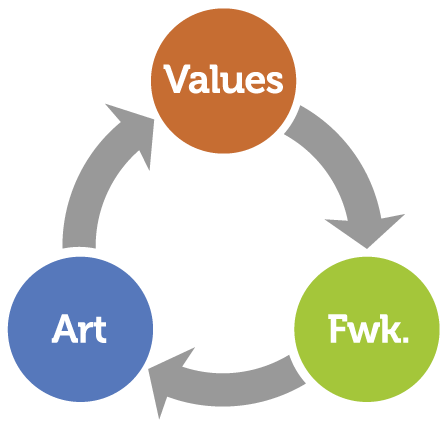
Myths are all around us and every culture has them, but where do they come from? I dare say none of us has invented a widely adopted sacred story (yet). Let’s face it, we’re not accustomed to bootstrapping our sacred myths. Historically, no one person invents a religion; even if it came from a founder or prophet, it only has the legs the community choses to give it. In other words, myths are community creations. Given the need to elevate our behaviors, we can think of the process in three phases:

Three Phases of Myth Making

  1. Sacred Values: We need the notion of sacred values and behaviors, and this is best defined by the community itself. We really do know the answers; we just have to agree and write them down.
    • This is actually not that hard. It starts with mythic awareness, and then coming together to define themes for change.
  2. Myth Framework: We need the masters of metaphors, those who actually create the allegorical imagery and story that we can use to re-program ourselves.
    • This is perhaps the most important phase because it will scope the realization of the myth. Mythical art expresses a shared purpose.
    • The a-priori to mythical art is the shared story. The narrative phase, therefore, is a necessary pre-requisite. This is why we stress the need for a story framework early on in the community myth-making process, which is just a natural expression of a shared belief.
  3. Artistic Myth-crafting: After this come the execution, or creative phase.
    These three phases are described in more detail at Cultera.org.

Artists are the myth realizers – making sacred stories tangible, a necessary pre-requisite to belief. Think about the dimensions of illusion here. For example, a two dimensional surface (the canvass with paint) provides an illusion for a three dimensional form. If the work is figurative, we can infer another dimension, namely the sense of presence of a personality when done well (like a Rembrandt portrait), a fourth dimension. Moreover, if it provides a sense for time past or alternate worlds, we have a fifth dimension (like allegorical art on the Sistine Ceiling). So far we have described qualities what many great works in museums have. They are not necessarily mythical without additional context. The next dimension is narrative context and symbolic meaning. This is what puts art in the realm of myth. The sixth dimension is the portal to the world behind the world, and it’s actually something the viewer brings to the work, i.e. a knowledge of the story. Art has these six dimensions is mythical.

With mythical art, the artist is facilitator of transcendence. Connecting with ‘the world behind’ actually validates current decisions when they are seen as consistent of the laws of that other world, as revealed by mythical art, which by the way, can include dance. Artists with community-sacred values are to be valued as a myth-crafters, those who create the means of collective healing and transformation.

Artists don’t have to dress as priests, mediate and set themselves apart from carnal desires in order to create this sacred art. In fact, it’s not really about the artists themselves. Myths will do their work regardless. It’s the job of the artists to be faithful to the theme and express in the works a heartfelt conviction. This view of the artist, while not new to civilization, is strange to the modern mind.

On a personal note, I’ve come full circle from being an artist who threw away his paint brush to preach a reductionistic gospel of Jesus Christ during two years as a missionary back in the early 1980s, to one who now advocates an expansive vision for making myths as communities write their own gospels, which serve functions of religion. What’s more, this process requires artists to pick up their paint brushes, chisels, pens, musical instruments and whatever other art crafting tools they have at their disposal.

This is trippy because the traditional missionary comes to a people with a message, and seeks to find an aesthetic way to present the pre-conceived – and often ancient – pathways to God. In our new practice, we don’t come with the message – that is the responsibility of the local community. No, we come with a methodology for letting them create their own and helping artists understand the crucial role of mythic art. This pre-supposes a great faith in humanity.

— Roy Zuniga
Feb. 2015 – Langley, WA

copyright © 2015 roy zuniga – all rights reserved

48.040095 -122.406257

Values-first Faith System

09 Saturday Aug 2014

Posted by royzuniga in Uncategorized

≈ Leave a comment

Tags

community mythology, religion, Sacred Story, Worldview

Can an understanding of God exist apart from religion? Theology so far has been so deeply intermingled with the stories about God that it’s hard to imagine doctrine without references to tablets and sermons on the mount. Apparently, for a faith-phenomenon to gain widespread acceptance it has to be infused by severe, wide-spread and hallowed embellishment. Based on that, it seems that story and tradition have to exist for a faith to succeed. The problem is that in most religions, the stories are rigid and outdated.

Assuming stories are still needed for religious success, how then can we turn the model upside down so we can have fresh stories as well as a good faith? A values-first approach can help. Let me explain.

If you assume for a moment that none of the stories in the Bible (or other scriptures) can be taken at face value, i.e. that they exist to justify an agenda, because of the conclusions they justify there’s really nothing objective about them even if some of the events they narrate are historical. In other words, the stories are essential to justify the conclusions being drawn out by the exegete. These conclusions are intended to team certain values and behaviors to the population, and to sanctify them via the veracity of the narratives. This means that you need to do certain things ‘because Jesus said so, and Jesus is God’ as evidenced by the stories of miracles. Ignoring the question of salvation from hell for a minute, that seems like a lot of overhead just to get at good behavior.

What if we just skipped the allusions and articulated the values first? The whole notion of heaven, hell, resurrection, salvation, etc. is not something we have to deal with to arrive at solid practices for life that derive from values we sanctify as a society.

We can even start by selecting the values and behaviors from historical religions that are relevant. We can also start fresh, ignoring the challenge of scrubbing stories that have too much historical baggage for some of us. Why not just start with values and let the population of believers develop practices and stories to help themselves assimilate those behaviors. There is more than one way arrive at value-driven behavior it seems. The traditional prescriptive doctrinal approach requires a supporting infrastructure of religious narrative and tradition. The values-first approach, as we may call it, focuses on the learnings first and lets the supporting narratives be develop organically.

When I speak of embellishment, I’m referring to the rich traditions, stories and other aesthetic dimensions that may be added to simple beliefs. A direct correlation can be made between embellishment and the success of a given religion. The richer the tradition, the more successful the religion. Catholicism comes to mind as a prime example. Counter examples exist in various ascetic sects that reject art and the ‘smells and bell’s, but these are minorities.

What comes first, the core beliefs, or the embellishment? Is it the lesson or the parable? The difficulty we have answering this is an indicator of how inextricably bound myth-making is with the growth of a religion. If the author’s only intent is embellishment for entertainment, as in a successful epic narrative like The Lord of the Rings, you end up with a ‘religious’ devotion to something that isn’t really intended to be a religion. People quote the novel like some would quote Scripture. Is the opposite also true? Can we have we have a value set accepted as sacred truth without the supporting narratives?

An example of the values-first approach is articulations of corporate values. Many companies will have a religion-agnostic set of values like ‘treat others with respect’, ‘assume good intent’, ‘focus on results’, ‘contribute to the success of others, leverage the contributions of others’, etc. These are intended to be internalized by employees so they manifest behaviors that foster collaboration and drive success. Supporting example stories may be given, but these are not seen as religious stories. They are fleeting justifications that can easily be replaced or altered without violation. If the story fits, use it. Sometimes games and exercises are developed to drive home the values as well. While some can become annual events, they are not give the significance of a religious tradition.

Can such ‘corporate’ values in the abstract be ‘sanctified’ and leveraged by the population at large to achieve the same ends as religion, i.e. to drive virtuous behavior of societies? This is an interesting question we should engineer into a pattern for reverse-religion, i.e. a values-first approach to ‘indoctrination’. There would be a certain ‘doctrification’ of narratives from the creative side of the population that is the playing a key role in establishing a new type of shared religion, one that is fuzzy around the narrative edges. The myths are made sacred by collective blessing of the values that drive them.

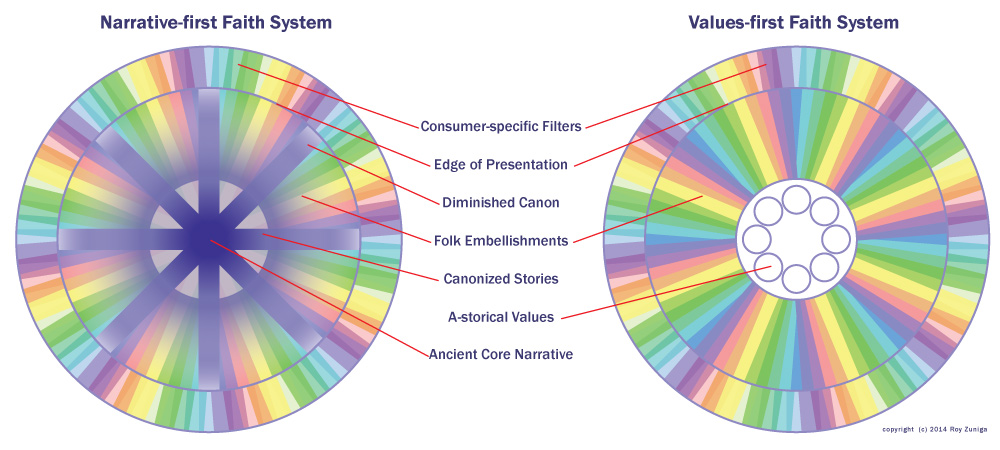
This diagram illustrates the difference between a ‘Narrative-first’ and the ‘Values-first’ approaches.

a-storical-values_sm

On the left, Narrative-first means that an ancient core narrative grew to have holy significance in the tribe, and out of that stories were canonized (into a Bible, for example). Over time as the stories failed to satiate people’s needs, additional folk embellishments were added that were not at the status of Holy Scripture, nevertheless were shared and revered. At a given point in time all of these – the fading canon stories and the sacred folk stories were what a person was presented, i.e. the ‘edge of presentation.’ However, people don’t just assimilate what they are presented, they apply their own filters and weighting, to the point where what they receive is what they want to believe. Note that in the end, the canonized stories blend and fade along with the cacophony of other messages people deem valuable and assimilate. What soaks in varies from person to person.

Note that the Narrative-first system can consume a lot of energy in maintaining the canon stories in the forefront of people’s minds. First, they must be established, which means filtering out anything that didn’t rise the standard. Second, this establishment is done by a select group of experts, which introduces social tension. Third, over time the stories become less relevant, and more and more energy is required to make them stick with people like they did in the beginning. Finally, to maintain a cannon, there is a constant battle between the ardent believers and those who would embellish the faith – the conservatives vs. the liberals.

Now let’s turn to the Values-first approach. Since ‘a-storical’ values are agreed upon first (‘a-storical’ simply means values in the abstract, that are not inherently justified by a sacred core narrative). We can think of them as humanitarian values. In any case, a set of values is made sacred by the community, with some definition and examples. From those values, the community is free to create stories to explain them to various audiences with locale-specific flavors and color. This suite of narratives likewise compose and edge of presentation that any given individual will encounter at a given time. As in the previous example, the user brings their own filters, so the end result is really about the same. People have assimilate what they want to believe in, and stories help tremendously with that programing.

With a Values-first approach, there is a lot less energy and strife expended on sustaining the canon-story establishment because it doesn’t exist. In its place is a tolerant culture of creativity. The key in all this is accepting the new pattern, and fostering a process for the establishment of the sacred humanitarian a-storical value set.

In this paradigm there is no hermeneutic of Scripture – there is only interpretation of art. The sacred values have already been articulated because they came first. Intent is clarified up front. There is no practice of interpreting the text to discern the will of God. The god-will, as we internally know it, was summarily recognized and articulated in the vernacular at the start. Interpretation comes during the embellishment process as we look at the work of artists and try to understand their response to subject matter based on the canonical values they have accepted as the soul-blood of their creative efforts.

Since all religious story is filtered by what the individual projects over it – their current struggles, pain points, pleasures or joys, there has never been a time when a sacred story has landed objectively, i.e. in the same way for everyone. We have been interpreting the narratives with personal filters and imaginative embellishments forever.

Being human is the certification of your right to appeal to your conscience, as validated by your understanding of collective norms, and your assessment of the output of the story writers and artists. The interpretation can be advocated but should not be contentious due to any exclusivity mandate. The idea that there’s one set of canon-stories is gone. Because the values are already clear, the interpretation is about understanding nuances of multiple meanings, each of which is valid from the person’s own perspective (as it always has been). Thus there are no denominational schisms with each side claiming the truth based on interpretation.

In other words, interpretation is not seen to narrow inwards where there’s only room for one truth. Rather, interpretation fans out from values, dividing into endless branches, each of which is capable of carrying and conveying truth for someone. Expansive interpretation based on core values affirms our creativity, variety and humanity and teaches us to co-exist in the process.

Traditional religion, it seems, has the flow of interpretation backwards: we should not narrow down narrative artifacts into a holy cannon, and then use interpretation to drive out the values and lessons. Rather we should start from values derived from our collective life’s lessons and let embellishment and interpretation fan out without limit. But remember, the ensuing unlimited interpretation of the embellishment is not the same as ‘anything goes’: the foundational values constrain the efforts. Thus we can achieve balance between unity of intent and variety of expression, and thereby realize the embellishment which seems to be a pre-requisite for widespread adoption of a faith.

— Roy Zuniga

August 2014
Kirkland, WA

copyright (c) 2014 Roy Zuniga

Values Spawn Religion  

06 Sunday Apr 2014

Posted by royzuniga in Uncategorized

≈ Leave a comment

Tags

dynamics of myth, mythology, principles, religion, values

We often think of religion as the source of our values. We can’t leave Christianity (or Buddhism, or Islam, or Judaism) because we’d cast adrift into a morass of values, not all of which are good. We think of religions as a safe place, where we can come back to – a place where the pastors and leaders can set us straight if we wander, just as they themselves can be set straight if they wander. All of this is based on the values and principles in the Holy Book of whatever religion we follow.

Yet as many of us grow old in religion, we come to realize that we tend to filter, interpret and otherwise mold ‘religious’ and ‘righteous’ practices to conform with how we want to behave. We do largely what we want and pay lip service to a religion. At some point we are living our own interpretation – and if the particular denomination doesn’t suit our taste, we move on to find one that does. In fact, you can become more conservative or liberal at will by joining a church that gives it legitimacy. We fool ourselves into thinking we are obeying God by conforming to the church, forgetting all too quickly that we chose that church. It conformed to us – or our parents we inherited it from – before we conformed to it.

Given this reality, what have we to fear leaving a religion? Do we really lose values if in fact our values have driven the choice of church? Do values and principles in fact go deeper than religion? I suspect they do, and that religions are a way of codifying values and behaviors for a society. Religion is a way of aligning a group of individuals towards the same shared behaviors.

It only follows then, that we can and should come together with kindred spirits and likewise create our own structures and norms to codify the desired behaviors. Creating a religion is not playing God; on the contrary, it is very human. The values that drive it, however, should aspire toward a positive greater good. Where do these noble values come from ultimately? Whether instilled by a divine breath or simply the evolution based on the benefits they deliver, their well spring is the human heart.

The dynamics of religion, then, is about the dynamics of shared values and their manifestation into a socially sacred culture.

— copyright Roy Zuniga 2014

The Sacred Myth

14 Sunday Apr 2013

Posted by royzuniga in Uncategorized

≈ Leave a comment

Tags

community mythology, conspiracy, Illuminati, mythology, religion, Transition economy, Transition US, urban myth, world domination

Myths may be filled with the irrational and fantastic, but neither the process of creating them or of assimilating them is irrational. In fact the orchestration of myth creation can be detected repeated with new content.

Recently I had an engaging dinner with friends who were very concerned about world events and global conspiracies. All kinds of wild and disjoined assertions were flying out – bits of truth projected like so many pellets from a shotgun, each capable of doing some damage to a naïve believer. The only commonality among those hard balls of truth was their source in the voice of a dear friend, and their negative nature. Everything from the meaning of a president’s name to the Federal Reserve to the Catholic Church to the Illuminati to homeland security barbed wire pens to Beyoncé’s satanic signs and symbols during her performance at the super bowl was allegedly hard evidence of a centuries old conspiracy by a corporation that controls all others. All real power in all the world is controlled by a few at the ‘capstone’ of the corporate pyramid. And there were plenty of freakish and well produced videos on YouTube to ‘prove’ it.

As I sought to untangle the reasonable concerns from the irrelevant or downright zany assertions that would pollute any solid understanding of the real situation, my friends got defensive. It seems that you either buy into the general angst, or you get put in the bucket labeled ‘non-believer’. One friend in particular kept bringing up points of religion in defense of certain orthodox positions on Christ. ‘He is the Lamb of God’, ‘He died for our sins’, ‘He was resurrected’. ‘Why would someone die for the sin of others if He wasn’t God?’ she asked.

In my usual fashion I was countering the assertions with non-standard viewpoints. For example, why would God need someone’s blood be shed in order to forgive? Blood atonement has its origins in ancient pagan rituals of animal and human sacrifice to appease the gods. Also, how do we know he was raised from the dead? Only the testimony of a handful of people stand between the universal traditions of the Christian church at Easter and what really happened. And so on.

I was actually less interested the particulars and or winning a theological argument than I was in the phenomenon. Like me in the past, she was programmed and it was coming out. What struck me was the way many of these ‘facts’ of myth were spewed out from some inner repository with no logical connection. In their import those facts were as real as first hand events, and more meaningful. The resurrection is as true as the last presidential election or even the half empty glasses of wine in front of us.

As I listened and bantered tenderly with her, in my mind the only real truth was the phenomenon of how mythical stories were used by her brain to both explain and defend doctrines she had absorbed in religious training in the past. She was also in the process of training herself in the new dogma of world domination by a similar mechanism. Using the media of the internet, she was streaming videos and filing the new ‘facts’ away with those old ones.

Whether true or not, the doctrines of Christianity are highly systematic. It has taken theologians millennia to streamline the thinking and give a defense of their faith. Any good second year seminary student could have countered my bantering with talking points about God’s justice and evidence that demands a verdict about Christ’s divinity. The world conspiracy allegations, however, were new and somewhat disjointed in her mind, even though a richly produced ‘leaked’ video about Illuminati induction talk does a fairly nice job of typing everything together into a one world power narrative worthy of a Hollywood production.

A barrage of facts from both of these more or less systematic streams of thought came gushing forth at the same time in what could be taken by some as a nutty jumble of incoherent thoughts. The religious mind, it seems, needs to have a coherent narrative for history with a greater meaning. Here, right before my ears, I was confronted with both the all-powerful Christ and the all-powerful evil world power. (This brings up an interesting point for another day: the indoctrination of those who do not think systematically results in piecemeal understanding and a sporadic, spotty defense of the faith.) It was interesting to see the dynamics of myth at play, both on the input of new doctrine and the use of that in defense of a world view. She brought up every snowball in her arsenal to lovingly throw back at me, even as she was legitimately concerned and wanted another opinion on the matter.

My view on the matter, for what it’s worth, is that there are nuggets of truth in these urban myths. There is also a lot of fear being fostered by these ‘leaked’ disclosures about what is really going on. If they are so powerful, why would they allow such propaganda to be released? We always have to think about who stands to benefit from fear and the negative imagination. Remember the arms race in the cold war and the MAD (mutual assured destruction) doctrine? Russia and the US kept building up their nuclear stockpiles an industries based on fear, and greatly expanded the great military complex. The same can be said for the exponential growth of Homeland Security in response to 911. Now the dynamic is shifting from external to internal threats. The more the rednecks arm themselves to the teeth to defend themselves against the one world government, the more Homeland Security has to be prepared to deal with them. Fear and rumor are sadly fueling an internal arms race in America.

There is another way, one of positive imagination and local thought. Not that we ignore world events, but the focus of community movements like Transition US is to un-plug from dependency on the global economy and monetary systems that will fail and or dominate us. We can come together and form resilient communities. Transition communities farm, barter, trade services and seeds and generally take very healthy positive steps towards a sustainable lifestyle.

Of course that only works while there is law and order in the land. If everything really unravels, a half million starving city dwellers will overwhelm a transition community like a pestilence of locusts eating everything in their wake. If it comes to that, God help us because not even medieval-like walled cities would stop those with modern tanks and missiles. Only the few with enough wealth and forethought to build bunkers and fund defensive forces can survive. We can’t let it come to that, and the only way to avoid that is if everyone collectively calms down and starts making the right choices driven by a faith in universal goodness.

The bottom line for me is choice: we can’t prove or disprove the Illuminati conspiracy any more than we can disprove Christ’s divinity or alien visitation of the ancient Aztecs. Our fundamental choice then is about the direction of our beliefs: do we take the negative fear driven arm-yourself-to-the teeth view? Or do we tie back to our first principle for life, that fundamental human aspiration toward God, and the genuine assertions of individuals achieving a personal, recurring, momentary connection with a God? It is the human experience of the Divine that keeps the aspiration going, along with an inner good-god awareness.

This aspiration towards God has been present across time and civilizations. Call it the God-principle, good vs. evil, Christ against Lucifer, good / bad karma or whatever. All cultures have similar notions, some with personalities in the metaphors for good and evil, others impersonal energies. Our fundamental choice is whether we are going to believe the aspiration can be realized. That is the only source of hope and positive energy.

Personally I have to believe God is there because I actually had a mystical experience, an exorcism and a ‘baptism in the spirit’ in my early twenties. I can connect with God and have faith in the progress of goodness, as have many in other faiths. The Biblical statement about the Spirit of God that ‘He is near you, He is in you’ rings very true for me personally. My assertion of that can’t be denied, as neither can yours. No do we need to deny each other’s experiences of faith. The new normal has to be tolerance for good behavior, regardless its sources.

In other words, the spiritual consciousness, which is full of metaphor and story, is necessary for us to make good choices. That is Enlightenment to me. Not the melting away into a state where you are not aware of temporal concerns and understand that all is illusion. That doesn’t bring forth proactive good choices. We have to avoid world views that result in passivity and inaction; our problems need attention! Solid focus and mass-decision making for a positive direction in our only salvation. The mechanism for this choice is to unplug for the media and take ownership of the myths and mental ‘proof-points’ we will us to defend those choices. Each community has to make its choices locally.

The ruling elite do have a choice – and they can only make it themselves, i.e. it has to be a local re-programming, and it has to happen soon. We can’t wait a generation. This makes documenting and disseminating the process for community mythology urgent. Those in the inner circle have to diffuse their own negative tendencies. Whatever it is about capitalism that isn’t working has to be changed, and not necessarily swapped out for an equally bankrupt version of socialism. There is another way that is sustainable. We can plan it; some are living it.

There is no proof in an appeal to mythical facts beyond the deep knowledge that these new local beliefs are part of a social contract. This is The New Sacred, as I have called it elsewhere. They are not ‘true’ because the miracle making characters in our myths are actually historical figures with ‘real’ supernatural powers. They are true because we created them together in a solemn process of collective sacred myth making based on shared values we hold Holy in the deepest sense of the word.

— Roy Zuniga
Kirkland, WA
April 2013

A Common Deity

09 Tuesday Apr 2013

Posted by royzuniga in Uncategorized

≈ Leave a comment

Tags

Christianity, community mythology, faith, Jesus, mustard seed, myth making, mythology, religion

What we’re developing here is a universally applicable praxis of spirituality that focuses on the phenomenon and dynamics of faith, and not the specific trappings and content of a canned religion. In other words, we seek to establish universal practices that result in bonding with God and people. How do we know we are successful? At least three criteria must be met:

  1. A personal connection with God that is undeniable, i.e. an experience
  2. The so-called ‘fruit of the spirit’, i.e. a manifestation of a godly personality in inter-personal relationships
  3. Scalable choices, i.e. those decisions that can be applied broadly without detrimental effect on the environment and fellow humans

Have you ever met a holy person, a preacher or guru or prayer warrior or missionary who exudes the presence of God? I have and so have many people across the globe. A connection is undeniable. It’s not so much how they say they connected that is interesting. Instead, for me it is the love and spirit presence they emanate that convinced me a connection is possible, and I experienced the Spirit rushing through me like a fresh waterfall from above. They all spend time establishing that connection and use Scriptures in the context of life experiences as a catalyst for prayer and meditation. In other words, they make the effort, come with good intentions and an open heart. Yes, it’s possible they are duped by spiritual beings (because of the n-level problem described elsewhere). However, with these ‘saints’ we get the sense that they are connected straight to the source. The smell of scammers is more often on the hierarchy in the religious organizations than it is in these saints. So the possibility of a personal connection with God is pillar of faith.

Another other pillar is choice, or put another way: human agency. Nothing happens in this world apart from the actions of people. These two pillars are of course related. If you see a person acting selfishly and not for the greater good, then we know by their fruits that they are not connected to God.

We often think of choice as consumer choices. We have to also consider spiritual choices. In other words, it is not just about a shopping choice, or choice of career and good social behavior. It is also about what spirits we let into our lives to listen to. We often act based on muses we summon. We can pick our influence; we can exorcise undesirable spirits from our dwelling places. Music we listen to, movies we watch, angry talk radio, etc. All of these influences predispose and open our imaginations to being fed. It’s like tossing bread crusts to the sea gulls – put it out there and they will show up. I don’t know the dynamics of spiritual beings, but one thing is for certain, they are hungry for action; and the way they act is through human agency.

So how do we get rid of them? In whose name do we exorcise the foul demons? Since it is our choice, why do we need a name? Can’t they just go because we said so? Or do we need the name of Jesus or some other spiritual bouncer? In the first degree, it is in our own name that we can do wondrous things, because we have the choice. We are not the source of life and goodness. However, we channel it.

Nevertheless, we as humans seem to need a personification of that source. ‘In the name of Jesus’ is what Evangelicals say. Other cultures invoke deities with different names. Some are facts of God. Some embody the quintessential behavior of a holy man, i.e. they a proto-faithful, like Jesus. That is to say, they embody the pattern for our faithful behavior. How do you fill in the blank?

‘In the name of ____________.’

Jesus was said to be God because he could give commands and miracles would happen (wither the fig tree; convert water to wine; heal the sick; raise the dead, etc.). Assuming those acts happened as reported (which is never really the case when humans are involved), let’s flip it around and take the reported proto-faithful-behavior not as evidence, but as a pattern. For the criteria enumerated above, we don’t actually need tricks like turning water into wine. Because of the n-level problem and the factional will applied to the interpretation of those events, we don’t really know they came from God. They don’t really catalyze a personal connection because they result in awe of the performer, and veneration of the Other, which doesn’t further the cause of scalable decisions unless it’s under an organizational control framework. Yes we can use organizations, but they should be intentional by and for the community, and not driven by miracle evidence and a class of intermediaries.

We should remove the exclusive thinking in the Scriptures, for example the ‘I am The Way’ credentials for inter-personal mediation, and rather view what conforms to the criteria above as proto-behavior, i.e. the normative pattern of behavior. Ironically, in Scripture what was interpreted by the mediator class as evidence of God was reportedly touted by Jesus Himself as phenomenon possible by anyone with the ‘faith of a mustard seed’. Jesus himself diminished the miracles as tricks compared with the fruit of personal behavior and decisions. You can move mountains, he said metaphorically.

Thus what makes me suspect some of the Scripture is true are empowering assertions like that. ‘Oh ye of little faith. . . ‘ or ‘He is near you; He is in you’, etc. Despite the controlling intermediary class, these precious insights made it into the Holy Book. Generally they are obfuscated by the exegesis that interprets His ‘miracle’ acts as evidence of deity. In fact, I feel confident to say, those acts were prototype for us to emulate, and likewise not take them as evidence of our deity as some who have figured this out actually do. The only thing they attest to is the ability to manipulate nature; the source of that ability cannot be known, good or bad.

What we have to watch out for are those who exercise a religious pattern of interpretation, i.e. who take the normal miracle-practices and interpret that as evidence of deity and therefore requiring veneration of the intermediary class by the faithful. Give glory to the ‘Father in heaven’, or ‘Gaia’ as some now call her. God has aspects, not a gender; however, our minds require a name.

We should all manifest the fruit of a connected relationship and as such be common deity. Evidence of connection is normative behavior and the agent cannot be mistaken for an intermediary. Rather he or she are demonstrating what must be our ‘new normal’. This is not to say that every person will provide wine from the water faucet at parties. No, miracles have their own logic, and God doesn’t always make an exception to the laws of nature and mortality.

What should be common practice among mortals who are ‘common deity’ is healing and the fruit of the spirit. In the end, the only name that really counts is your own. After all, we God-fashion Him in our image, like so many 16th century capitalists commissioning portraits of religious subjects in the pious garb of their own times. We can paint our own mental icons if we want, if that helps. Or we can flush them out as spiritual crutches and in the end act in our own name. It is time we own up to ourselves as common deities. Believer or not, the only name counts is your own. So then, why not make it a good name? That’s your choice; it’s your decision.

— Roy Zuniga
    April 2013
    Kirkland, WA 


copyright 2013 Roy Zuniga 

Recent Posts

  • Can we still paint ideal figures?
  • Language in the Service of Myth
  • Channeling Intent
  • The Divine Right of Christ
  • The Space God

Archives

  • December 2020
  • August 2020
  • December 2017
  • July 2017
  • June 2017
  • May 2017
  • January 2016
  • December 2015
  • February 2015
  • December 2014
  • November 2014
  • October 2014
  • August 2014
  • June 2014
  • April 2014
  • February 2014
  • April 2013
  • March 2013
  • June 2012
  • May 2012

Categories

  • art
  • mythology
  • Uncategorized
  • Worldview

Meta

  • Create account
  • Log in
  • Entries feed
  • Comments feed
  • WordPress.com

Blog at WordPress.com.

  • Subscribe Subscribed
    • Dynamics of Myth
    • Already have a WordPress.com account? Log in now.
    • Dynamics of Myth
    • Subscribe Subscribed
    • Sign up
    • Log in
    • Report this content
    • View site in Reader
    • Manage subscriptions
    • Collapse this bar
 

Loading Comments...