• About
  • Blog Spots

Dynamics of Myth

~ using culture to shift our worldviews

Dynamics of Myth

Tag Archives: Sacred Story

Creating Mythic Art

21 Saturday Feb 2015

Posted by royzuniga in art, mythology

≈ Leave a comment

Tags

art, Christianity, community mythology, comparative religion, dynamics of myth, Joseph Campbell, myth making, mythology, religion, Sacred Story

So far I have been looking at myth-making from the perspective of how communities can ‘re-program’ themselves to implement more sustainable behaviors. We can think of this as the ‘human software’ role for myth. The theory is people will empathize with mythic heroes on their journeys and mimic their decision making when faced with analogous circumstances.

However, there is another role for myth as a way to connect to ‘the world behind’, or ‘the other plane’. In this view, myth is the portal, the mystical means by which we can make things right with the gods, and in so doing enhance our spiritual survival. In other words, we go from mythology as a systematic and somewhat objective study of the stories of culture, to a faith-full ‘mythism’. This is a belief in the power of the myth itself. In Campbell’s terms, myth gives you ‘a line to connect with that mystery which you are.’

If we take either one of the approaches without considering the other, we miss out. Focusing on the hereafter without regard to the planet does not lead to integral living: as the planet sours, the daily reality of living contrasted with the spiritual journey towards bliss causes us to live with tension, dissonance and conflict. All sorts of dysfunctions result, including the creation of artificial environments, denial, retreat, escapism and even hatred. Some of the most vitriolic chronic ‘haters’ are those who feel others have come in between them and their journey to bliss.

On the other hand, while focusing on the here and now can help organize and clean up society, it doesn’t address the basic human need for meaning and an explanation of the soul’s afterlife. Do we have to choose between approaches? I think not.

The duality between the pragmatic behavior-focused approach and the spiritual journey has something in common: sacred stories. For community myth-making, these are the stories that hold our core values as exemplified by normative behaviors. For the spiritual pilgrim, these very same stories hold the metaphorical images and concepts that provide a connection with the gods and their normative behaviors. Align the two and we have the formula for cultural transformation. Myths give us the sense that today’s acts can be brought in line with how things are done on the higher plane. It’s imperative, therefore, that we align our mythical world with what life on earth should be. What does that look like?

Myths are all around us and every culture has them, but where do they come from? I dare say none of us has invented a widely adopted sacred story (yet). Let’s face it, we’re not accustomed to bootstrapping our sacred myths. Historically, no one person invents a religion; even if it came from a founder or prophet, it only has the legs the community choses to give it. In other words, myths are community creations. Given the need to elevate our behaviors, we can think of the process in three phases:
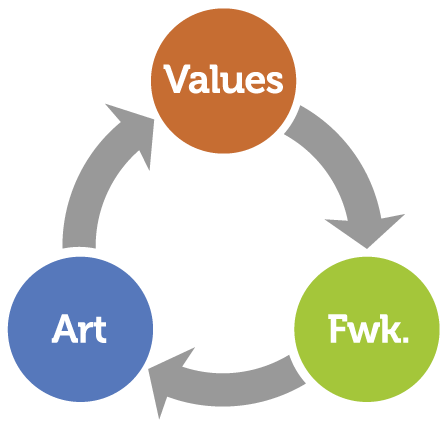
Three Phases of Myth Making

  1. Sacred Values: We need the notion of sacred values and behaviors, and this is best defined by the community itself. We really do know the answers; we just have to agree and write them down.
    • This is actually not that hard. It starts with mythic awareness, and then coming together to define themes for change.
  2. Myth Framework: We need the masters of metaphors, those who actually create the allegorical imagery and story that we can use to re-program ourselves.
    • This is perhaps the most important phase because it will scope the realization of the myth. Mythical art expresses a shared purpose.
    • The a-priori to mythical art is the shared story. The narrative phase, therefore, is a necessary pre-requisite. This is why we stress the need for a story framework early on in the community myth-making process, which is just a natural expression of a shared belief.
  3. Artistic Myth-crafting: After this come the execution, or creative phase.
    These three phases are described in more detail at Cultera.org.

Artists are the myth realizers – making sacred stories tangible, a necessary pre-requisite to belief. Think about the dimensions of illusion here. For example, a two dimensional surface (the canvass with paint) provides an illusion for a three dimensional form. If the work is figurative, we can infer another dimension, namely the sense of presence of a personality when done well (like a Rembrandt portrait), a fourth dimension. Moreover, if it provides a sense for time past or alternate worlds, we have a fifth dimension (like allegorical art on the Sistine Ceiling). So far we have described qualities what many great works in museums have. They are not necessarily mythical without additional context. The next dimension is narrative context and symbolic meaning. This is what puts art in the realm of myth. The sixth dimension is the portal to the world behind the world, and it’s actually something the viewer brings to the work, i.e. a knowledge of the story. Art has these six dimensions is mythical.

With mythical art, the artist is facilitator of transcendence. Connecting with ‘the world behind’ actually validates current decisions when they are seen as consistent of the laws of that other world, as revealed by mythical art, which by the way, can include dance. Artists with community-sacred values are to be valued as a myth-crafters, those who create the means of collective healing and transformation.

Artists don’t have to dress as priests, mediate and set themselves apart from carnal desires in order to create this sacred art. In fact, it’s not really about the artists themselves. Myths will do their work regardless. It’s the job of the artists to be faithful to the theme and express in the works a heartfelt conviction. This view of the artist, while not new to civilization, is strange to the modern mind.

On a personal note, I’ve come full circle from being an artist who threw away his paint brush to preach a reductionistic gospel of Jesus Christ during two years as a missionary back in the early 1980s, to one who now advocates an expansive vision for making myths as communities write their own gospels, which serve functions of religion. What’s more, this process requires artists to pick up their paint brushes, chisels, pens, musical instruments and whatever other art crafting tools they have at their disposal.

This is trippy because the traditional missionary comes to a people with a message, and seeks to find an aesthetic way to present the pre-conceived – and often ancient – pathways to God. In our new practice, we don’t come with the message – that is the responsibility of the local community. No, we come with a methodology for letting them create their own and helping artists understand the crucial role of mythic art. This pre-supposes a great faith in humanity.

— Roy Zuniga
Feb. 2015 – Langley, WA

copyright © 2015 roy zuniga – all rights reserved
48.040095 -122.406257

Values-first Faith System

09 Saturday Aug 2014

Posted by royzuniga in Uncategorized

≈ Leave a comment

Tags

community mythology, religion, Sacred Story, Worldview

Can an understanding of God exist apart from religion? Theology so far has been so deeply intermingled with the stories about God that it’s hard to imagine doctrine without references to tablets and sermons on the mount. Apparently, for a faith-phenomenon to gain widespread acceptance it has to be infused by severe, wide-spread and hallowed embellishment. Based on that, it seems that story and tradition have to exist for a faith to succeed. The problem is that in most religions, the stories are rigid and outdated.

Assuming stories are still needed for religious success, how then can we turn the model upside down so we can have fresh stories as well as a good faith? A values-first approach can help. Let me explain.

If you assume for a moment that none of the stories in the Bible (or other scriptures) can be taken at face value, i.e. that they exist to justify an agenda, because of the conclusions they justify there’s really nothing objective about them even if some of the events they narrate are historical. In other words, the stories are essential to justify the conclusions being drawn out by the exegete. These conclusions are intended to team certain values and behaviors to the population, and to sanctify them via the veracity of the narratives. This means that you need to do certain things ‘because Jesus said so, and Jesus is God’ as evidenced by the stories of miracles. Ignoring the question of salvation from hell for a minute, that seems like a lot of overhead just to get at good behavior.

What if we just skipped the allusions and articulated the values first? The whole notion of heaven, hell, resurrection, salvation, etc. is not something we have to deal with to arrive at solid practices for life that derive from values we sanctify as a society.

We can even start by selecting the values and behaviors from historical religions that are relevant. We can also start fresh, ignoring the challenge of scrubbing stories that have too much historical baggage for some of us. Why not just start with values and let the population of believers develop practices and stories to help themselves assimilate those behaviors. There is more than one way arrive at value-driven behavior it seems. The traditional prescriptive doctrinal approach requires a supporting infrastructure of religious narrative and tradition. The values-first approach, as we may call it, focuses on the learnings first and lets the supporting narratives be develop organically.

When I speak of embellishment, I’m referring to the rich traditions, stories and other aesthetic dimensions that may be added to simple beliefs. A direct correlation can be made between embellishment and the success of a given religion. The richer the tradition, the more successful the religion. Catholicism comes to mind as a prime example. Counter examples exist in various ascetic sects that reject art and the ‘smells and bell’s, but these are minorities.

What comes first, the core beliefs, or the embellishment? Is it the lesson or the parable? The difficulty we have answering this is an indicator of how inextricably bound myth-making is with the growth of a religion. If the author’s only intent is embellishment for entertainment, as in a successful epic narrative like The Lord of the Rings, you end up with a ‘religious’ devotion to something that isn’t really intended to be a religion. People quote the novel like some would quote Scripture. Is the opposite also true? Can we have we have a value set accepted as sacred truth without the supporting narratives?

An example of the values-first approach is articulations of corporate values. Many companies will have a religion-agnostic set of values like ‘treat others with respect’, ‘assume good intent’, ‘focus on results’, ‘contribute to the success of others, leverage the contributions of others’, etc. These are intended to be internalized by employees so they manifest behaviors that foster collaboration and drive success. Supporting example stories may be given, but these are not seen as religious stories. They are fleeting justifications that can easily be replaced or altered without violation. If the story fits, use it. Sometimes games and exercises are developed to drive home the values as well. While some can become annual events, they are not give the significance of a religious tradition.

Can such ‘corporate’ values in the abstract be ‘sanctified’ and leveraged by the population at large to achieve the same ends as religion, i.e. to drive virtuous behavior of societies? This is an interesting question we should engineer into a pattern for reverse-religion, i.e. a values-first approach to ‘indoctrination’. There would be a certain ‘doctrification’ of narratives from the creative side of the population that is the playing a key role in establishing a new type of shared religion, one that is fuzzy around the narrative edges. The myths are made sacred by collective blessing of the values that drive them.

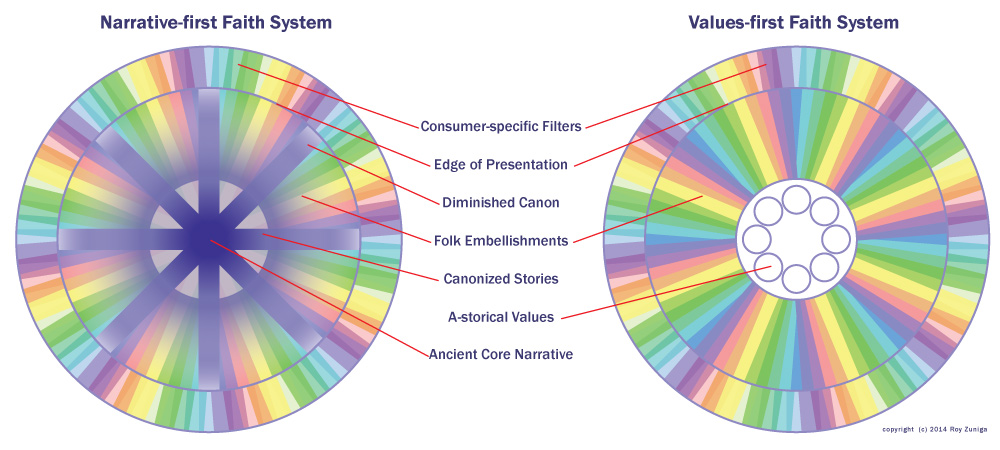
This diagram illustrates the difference between a ‘Narrative-first’ and the ‘Values-first’ approaches.

a-storical-values_sm

On the left, Narrative-first means that an ancient core narrative grew to have holy significance in the tribe, and out of that stories were canonized (into a Bible, for example). Over time as the stories failed to satiate people’s needs, additional folk embellishments were added that were not at the status of Holy Scripture, nevertheless were shared and revered. At a given point in time all of these – the fading canon stories and the sacred folk stories were what a person was presented, i.e. the ‘edge of presentation.’ However, people don’t just assimilate what they are presented, they apply their own filters and weighting, to the point where what they receive is what they want to believe. Note that in the end, the canonized stories blend and fade along with the cacophony of other messages people deem valuable and assimilate. What soaks in varies from person to person.

Note that the Narrative-first system can consume a lot of energy in maintaining the canon stories in the forefront of people’s minds. First, they must be established, which means filtering out anything that didn’t rise the standard. Second, this establishment is done by a select group of experts, which introduces social tension. Third, over time the stories become less relevant, and more and more energy is required to make them stick with people like they did in the beginning. Finally, to maintain a cannon, there is a constant battle between the ardent believers and those who would embellish the faith – the conservatives vs. the liberals.

Now let’s turn to the Values-first approach. Since ‘a-storical’ values are agreed upon first (‘a-storical’ simply means values in the abstract, that are not inherently justified by a sacred core narrative). We can think of them as humanitarian values. In any case, a set of values is made sacred by the community, with some definition and examples. From those values, the community is free to create stories to explain them to various audiences with locale-specific flavors and color. This suite of narratives likewise compose and edge of presentation that any given individual will encounter at a given time. As in the previous example, the user brings their own filters, so the end result is really about the same. People have assimilate what they want to believe in, and stories help tremendously with that programing.

With a Values-first approach, there is a lot less energy and strife expended on sustaining the canon-story establishment because it doesn’t exist. In its place is a tolerant culture of creativity. The key in all this is accepting the new pattern, and fostering a process for the establishment of the sacred humanitarian a-storical value set.

In this paradigm there is no hermeneutic of Scripture – there is only interpretation of art. The sacred values have already been articulated because they came first. Intent is clarified up front. There is no practice of interpreting the text to discern the will of God. The god-will, as we internally know it, was summarily recognized and articulated in the vernacular at the start. Interpretation comes during the embellishment process as we look at the work of artists and try to understand their response to subject matter based on the canonical values they have accepted as the soul-blood of their creative efforts.

Since all religious story is filtered by what the individual projects over it – their current struggles, pain points, pleasures or joys, there has never been a time when a sacred story has landed objectively, i.e. in the same way for everyone. We have been interpreting the narratives with personal filters and imaginative embellishments forever.

Being human is the certification of your right to appeal to your conscience, as validated by your understanding of collective norms, and your assessment of the output of the story writers and artists. The interpretation can be advocated but should not be contentious due to any exclusivity mandate. The idea that there’s one set of canon-stories is gone. Because the values are already clear, the interpretation is about understanding nuances of multiple meanings, each of which is valid from the person’s own perspective (as it always has been). Thus there are no denominational schisms with each side claiming the truth based on interpretation.

In other words, interpretation is not seen to narrow inwards where there’s only room for one truth. Rather, interpretation fans out from values, dividing into endless branches, each of which is capable of carrying and conveying truth for someone. Expansive interpretation based on core values affirms our creativity, variety and humanity and teaches us to co-exist in the process.

Traditional religion, it seems, has the flow of interpretation backwards: we should not narrow down narrative artifacts into a holy cannon, and then use interpretation to drive out the values and lessons. Rather we should start from values derived from our collective life’s lessons and let embellishment and interpretation fan out without limit. But remember, the ensuing unlimited interpretation of the embellishment is not the same as ‘anything goes’: the foundational values constrain the efforts. Thus we can achieve balance between unity of intent and variety of expression, and thereby realize the embellishment which seems to be a pre-requisite for widespread adoption of a faith.

— Roy Zuniga

August 2014
Kirkland, WA

copyright (c) 2014 Roy Zuniga

Recent Posts

  • Can we still paint ideal figures?
  • Language in the Service of Myth
  • Channeling Intent
  • The Divine Right of Christ
  • The Space God

Archives

  • December 2020
  • August 2020
  • December 2017
  • July 2017
  • June 2017
  • May 2017
  • January 2016
  • December 2015
  • February 2015
  • December 2014
  • November 2014
  • October 2014
  • August 2014
  • June 2014
  • April 2014
  • February 2014
  • April 2013
  • March 2013
  • June 2012
  • May 2012

Categories

  • art
  • mythology
  • Uncategorized
  • Worldview

Meta

  • Create account
  • Log in
  • Entries feed
  • Comments feed
  • WordPress.com

Blog at WordPress.com.

  • Subscribe Subscribed
    • Dynamics of Myth
    • Already have a WordPress.com account? Log in now.
    • Dynamics of Myth
    • Subscribe Subscribed
    • Sign up
    • Log in
    • Report this content
    • View site in Reader
    • Manage subscriptions
    • Collapse this bar
 

Loading Comments...