• About
  • Blog Spots

Dynamics of Myth

~ using culture to shift our worldviews

Dynamics of Myth

Tag Archives: Worldview

Channeling Intent

18 Tuesday Aug 2020

Posted by royzuniga in Uncategorized

≈ Leave a comment

Tags

Christianity, Existentialism, philosophy, Worldview

When we deliberately express intent we are functioning as ‘mind’ for the Universe, which then reacts as ‘muscle’ to produce the desired effect. This is metaphorical, of course. How an individual’s expression of intent causes a response in our world is a mystery. We don’t have language for it. We need a myth to drive home the point, but that’s beyond the scope of this particular post. So let’s try a mundane analogy.

If I wake up on a Sunday and decide to go for a run, my body activates in anticipation without me needing to think about how to give explicit instructions to each muscle. My legs are restless, itching to move, like a dog ready for a walk (your actual experience may vary). Which is different than when I decide to lay in bed watching a morning show. 

I’ve found the universe responds to my intent. I won’t get into specific cases here because each can be argued by those looking for a polemic, and it would derail the point intended here, namely, that your worldview shapes what you can wish for. 

As we articulate intent, there is a mysterious orchestration that considers other intentions being expressed in our world, and where possible, an alignment is made that enables as many of them to be fulfilled as possible. Yes, it is an ecosystem of intent/fulfillment, and yes, it is amoral in the sense that two contradictory intents can be fulfilled at the same time. Once satisfied, we are personally thankful and move on to the next intent. And so the cycle goes: my ‘mind’ — our collective ‘mind’ — and the ‘muscle’ of the Universe working together. This is a matter of faith: you either believe it or you don’t. Not much you can scientifically prove in these assertions. 

Rather than defend them, I’d like to focus on how intent itself is formed. Where does it come from? Why do I spend my energy forming certain intents and not others? Why is it that I can’t desire certain things or behaviors even if rationally I recognize them as laudable, perhaps for someone else. For example, why do so many of us know deep in our hearts that we live an unsustainable consumer lifestyle, but can’t seem to get into the groove of a minimalistic sustainment lifestyle? Why, on the other hand, are third world villagers happy with so little? Many don’t form any intent around the Western consumer lifestyle. Why is that? Isn’t it obvious, we think as Americans, that if you can accumulate stuff, you should? Demand drives supply, and that creates jobs.  

I articulate certain intentions because I believe they are the right ones. I have conviction about them. But what does it mean to know what you want? Obviously, you know what you want, and when you want it. You can even rationalize why in terms that fit in your world view. But why is that particular desire there in you, or even in a whole segment of society, so that your desire is normal. But do you really know how that all got there, and what the root cause is that allowed your mind to even conceive of that intent as a desirable outcome? 

Let’s assume that intent is essentially a life force that all creatures have. There’s a lot of controversy around the nature of will, and frankly, it’s not something that can be proven one way or the other. Philosophers have recognized intent as a ‘will to life’ (Schoppenhauer), or a ‘will to power’ (Nietsche). Whether it is inherent to us, or ‘the thing in itself’ outside of us (Kant), I’ll leave as a mystery for now. Here I want to focus on the boundaries put on the expression of intent by our worldviews, by the sacred stories we accept and how they frame how we think. If the nature of intent is in the eyes of the philosopher, we can look at behaviors. What is the structure of the expression? 

Rainwater flows according to the contours of the landscape. It doesn’t accumulate on hill tops, but rather finds its way through valleys and ravines into rivers and ponds, pulled by gravity. The topology of a landscape dictates likely areas for water to pool. 

Think of your worldview as the topology of your mind. Desires flow within predefined channels. Depending on the contours, desires can only accumulate in certain ‘pools’ of intent. For example, if we believe in the progress of history and a heavenly kingdom, we can’t really express intent for reincarnation. On the other hand, if freedom means lack of desire for material comfort, your desires will be for happiness only in the ascetic life. Industrial progress is meaningless, to be loathed. 

We can recognize that the formation of specific intents is a function of the mind. To formulate intent, we think in terms of outcomes. Something formed my mind so that desires get channeled in only certain ways. The formative forces molding the topology of our mind are the myths we hold sacred. We’ve become accustomed to thinking about myths as written texts of great import, like the Iliad, Vedic literature, the Talmud, the New Testament, the Koran, etc. In reality, sacred stories evolve and vary as much as language does. Think of all the languages and dialects in the world — that gives you a rough idea of how many myth and myth variations there are. The less codified they are into a holy book like the Bible, the more they vary by region and need. 

As Joseph Campbell has pointed out, Myth allows us to talk about topics that language otherwise can’t handle, like the Afterlife. Without creation stories, we could not formulate meta concepts about life after death. Do we go to heaven to be with Jesus, or reincarnate repeatedly until we achieve Nirvana? Sacred stories constrain how believers can think about the answers. Sacred myths open us up to categories of thought and practice we otherwise would not have. 

As a young man, a paradigm shift happened when I adopted a new sacred story about God and humanity. I ran across a few Evangelicals who gave me categories of thought for the Holy Spirit, which I then exercised to great effect. I will never forget this spiritual experience. I had been evangelizing and preaching in Northern Ireland, converting people, and we went to a house church in the evening. Believers there were very Charismatic, which means that they believed in the ‘gifts of the Holy Spirit’, and spoke in tongues. They praised God without inhibition and I got so caught up in the euphoria that I felt a rush of freshness pour through me like a waterfall. It was the Spirit of God flowing through me! I was elated and stunned at discovering a dimension of my humanity that I didn’t know existed. The Charismatic worldview allowed for this experience. Without the worldview shift, I would not have formulated such intent, nor experienced the shift in the experience of reality.

If I had bumped into Budhists or some other religion instead of the Evangelicals, and was open to their message, I’d be exercising my spiritual faculties within a different framework and therefore different experiences. In other words, the texts and traditions we adopt as sacred provide us with a framework within which we can exercise our spiritual faculties. It provides a topology for the flow of spiritual intent, and hence the manifestations that can arise from those expressions. The same can be said about the expression of any intent. It is bounded by the channels in our worldview. 

To illustrate the point, let’s compare hypothetical expressions of intent based on three philosopher’s worldviews: 

  • A. Schopenhauer: If we think the cycle of will deterministically results in Craving → Fulfillment → Boredom that leads to a pessimistic despair to be escaped only via asceticism, i.e. the renunciation of cravings, then the believer will channel all intent towards one of those ends. 
  • F. Nietzsche: If we believe that personal passionate choice in the service of master morality is the right application of intent, then we’ll work towards the prosperity of those who strive to be ubermensch, and marginalize the existence of a slave class with their despicable slave morality.  
  • S. Kierkegaard: Or we can simply accept Christianity with Jesus as the reference point as he lives in the pages of the Bible, and express our intent as opposition to a lame and self-serving Christendom.

In these examples, the worldview bounds the possibilities of individual intent. Worldviews are shaped by the metanarratives, the collection of stories and myths we hold sacred. The framework of the story we adopt creates the channels for possible action in our mind, deepened by an emotional connection which is the function of empathy for the characters in the myth. 

Thus we can affirm that the ‘topology’ shaped in our mind is deterministic of the types of intent that can be expressed. Therefore, great weight and importance must be placed on the sacred narratives. They are our future. We shouldn’t be victims to them, but rather their God, so to speak. We must learn to author them. 

The Moses of this world, the Joseph Smiths, the Buddhas and the Mohammeds who invent or otherwise articulate religious worldviews end up creating the channels through which millions will funnel their desires and actions, conceiving and articulating intents that get orchestrated by the Universe into our day-to-day reality. Nietzsche understood this dynamic and created his own sacred text in ‘Thus Spake Zarathustra’ to help channel how his followers thought about things like eternal recurrence. Our reality is literally shaped by the myth makers. 

Thus the creators of the sacred myths wield immense ‘control’ over the future of humanity. Frankly, people can’t live without the stories they hold sacred. How we evolved to be this way is a good question that frankly may never be answered. Some say we are hard-wired for language. Perhaps we are hard-wired for myth as well. In any case, this is how we articulate intent. If we passively accept worldviews that preempt certain necessary outcomes, then we seal our own doom. We have a moral obligation to take control of the myth-making process to preclude unsustainable behaviors, and predispose those that are.

This is easier said than done. We all know that people groups with sustainable behaviors can’t defend themselves against the onslaught of militarized consumerism. Nor do we necessarily want to bring back old myths we find archaic and even insulting to science. The evangelical experience also teaches us that blanket conversion of entire populations is unrealistic. Whatever the answer is, we have to try knowing that myth-authoring and dissemination plays a central role. 

— Roy Zuniga
August 2020
Duvall, WA
A Universal Process for a Personal Worldview

02 Sunday Jul 2017

Posted by royzuniga in art, mythology, Uncategorized, Worldview

≈ Leave a comment

Tags

art, Community, community mythology, faith, intent, intention, Jesus, mythology, religion, Worldview

My worldview guides me, as does yours. I believe in expressing intent as the basis for experience. This world view is also a process that can be applied by everyone. The key is to let ‘the Universe’ have its say in how our intent is fulfilled, considering the intent of others in our domain, and trusting that a suitable outcome will be orchestrated. This is fundamentally a positive outlook. It is also simple. The goal is to have humanity spend less time rationalizing manmade theological problems, and more time actually experiencing life. Nature is in danger from those who don’t know her, who don’t know how connected they really are to her.

I am approaching topics of ultimacy from the personal experience of what works. Praying to Uranthom works for me. Reflexive prayer, i.e. the notion that all spoken prayer for our own benefit, reinforces my intent. Understanding self is so important because being aligned with what makes you tick is the best possible experience for you as an existential ‘node’ in this collective and connected existence. If physical creatures can achieve a ‘heavenly’ experience on earth, why look forward to a non-corporeal existence? Consciousness without physicality is a hell. Whether our souls go to ‘Heaven’ or blend back into a mystical cosmic consciousness, I do not know. I am confident that the Universe that makes Uranthom possible will have a suitable resolution of my consciousness existence.

We get into trouble when we make ‘authoritative’ and exclusive assertions about God the way both Muslim and Christian theologians have over the ages. Conflict arises when the respective believers take the God-speculation literally and defend mutually exclusive absolutes. The line of thought that tries to define God is a dead end. We can be believers without absolutes. In this mode, all world views are necessarily individualistic, which is what I think happens anyway, even to those who believe in the ‘heaven first’ approach where guidance comes down from God.

If you find your mind caught in a web of theological conundrums, it may be helpful to trace back the chain of ideas that led to your beliefs. I did, and it led me to start fresh, from scratch. What kind of conundrums? For example, conflicting ideas about free will vs. predestination; obsession with a physical God who cannot be touched; someone we talk to but who never talks back.  Reconciling undeserved mishaps and tragedies with God’s good purpose for pious people. Talking about both love and eternal punishment in the same conversation. Advocating the never-ending exploitation of a finite earth. Advocating equality of genders while keeping the man as the ‘head.’ Preaching compassion and acceptance while attributing people’s sicknesses and disabilities to sin or laziness. Teaching forgiveness while always finding an enemy to fight. Asserting world peace is on the other side of a war. Thinking like this is making our planet sicker, and we need to change it.

Trace the origin any one of these ideas and you find they go far back, some thousands of years. The writers we read were influenced by ideas they might not properly credit. The Christian worldview goes back to the Greek philosophers, the Stoics, Christianity, kings since Charlemagne who believed in the divine right, the Protestant Reformers, and American conservatism. For example, we celebrate Easter because it recalls Christ’s death and resurrection. Why did He have to die? Shed blood was the atonement for sin. Why can blood atone? Because of pagan beliefs that God(s) demand it for transgression, and to earn favor. Why did Christ specifically have to die? Because he is God incarnate, and as such can atone all of humankind. Why does God have to be incarnate? Because of the theological tradition that requires God to be involved in human affairs, and the certainty that God(s) have to exist somewhere physically, like the Greek pantheon on Olympus. Change your worldview, and you change your destiny.

The tumor of over analyzed worldview tends to grow bigger as each generation tries to sort out one conundrum or the other, resulting in more spaghetti theology. Topics like ‘how do I stay out of hell?’ and other questions become irrelevant. That is all a huge distraction that myopic and weak-willed theologians debate ad-infinitum. Like addicts, they can no longer recognize the simple life and how good it can be. To those invested with years of study of treatises and intellectual traditions, real happiness and peace are a sign of apathy! They can not recognize a completed human being if she was sitting next to them in Sunday morning pew because such people are only expected in heaven. We could play their game and argue with every position that has been taken since Socrates. I do not have the life-energy to do that. Theology for its own sake only produces secure employment for professional mental wrestlers. We have to keep it simple. We can just snip that chain of beliefs at the source, let the weight of conundrums fall to the floor. Life goes on, and we can experiment with alternate foundational principles.

The fundamental worldview question we have to answer is ‘how should we live?’ I have arrived, for now, at a process build on existence as an experience of intent. Intent is simply an affirmation of the desired outcome. This is just a hunch, but so far, it is working for me, manifesting peace of mind and a good life. Note that intent is not the same as will. To will something implies a certain coercion, even if it is your own actions, which is a more aggressive stance that may in fact work against you.

Intent is a passive internal assertion that can be either be silent or can also be reinforced through vocalization, by saying it aloud (as in prayer). Lack of vocalization does not diminish the power of the intent. The ‘Universe’ realizes your intent based on an orchestration process that is opaque to us. I do not see the value of postulating what ‘God’ or ‘the Universe’ thinks and does since by definition it is beyond our grasp. This is why I invented the notion of Uranthom, which is my abstraction layer to what happens ‘out there’.

We express intent many times a day, thinking ‘yes I want a new shirt’, or ‘we pray for a new school for those missionaries, amen!’, or ‘I’d like to sleep in this morning’, or ‘I’d like to be paired with a woman (or man) like that’, or ‘my energy is better spent painting’, for example. We often try to execute on the intent, and this is where we should rather pause and listen to the Universe. Mindfulness is important before taking action, as is patience. I call it ‘manifesting’, which simply means that given some time for processing, those outcomes you intend will be orchestrated along with the intent of others for a more satisfactory resolution. It may not be exactly what you had in mind to start, but examining those desires in light of the outcomes, you will find a good state, one, which inevitably leads to new intent. Thus life evolves in a dialectic with Uranthom, the receptor of our expressions of intent.

If you have a communal intent, like ‘I wish to go to the ball game with my friends’, or ‘we need supporters to donate money to pay for fuel for the ship’, then expressing it helps align the intent of others. The expression can be a post on social media or a prayer in church. Because intent is bubbling up regardless of whether you are in a religious house or not, we do not distinguish between prayer and other expressions of intent. Intent that aligns with that of others is more likely to be realized. This is a driver for social awareness and political action, because, without the expression of an alignment on values, we are not likely to get our way.

Happiness comes from a realization that as you let go, and the manifestations are real, you stop being frustrated about what happens (or doesn’t happen), and start being present to recognize and enjoy goodness. This is parity for the assurance religious people feel when they believe ‘it’s all in God’s hands’. This mindset does not come overnight, especially if you are mired in the conundrums your ancestors fed you with our mother’s milk. Intent that aligns with that of others is more likely to be realized. As is intent that aligns with the progression of the Universe towards harmony, (this assertion, by the way, is an expression of my own intent). If we all share that intent, it will be. The simplicity of the model is the conscious expression (internal or external) of your intent, coupled with a letting go so ‘the Universe’ can manifest that intent.

This all sounds so simple and even mystical. What about all those conundrums that theologians and philosophers have spent lifetimes debating. Are we going to address those questions? I believe a lot of it gets sorted out on its own when you pivot on intent. For example, we don’t have to account for an all knowing God, since ‘God’ knows through our experience. I don’t believe in a God object, a person-like entity who somehow both sits on a throne and at the same time knows everything everywhere and has all power as Christian doctrine affirms. God may, in fact, have some of those attributes, but it is in a distributed fashion.

It is my hunch – and you don’t have to believe this, it’s just my way of dealing with categories of thought that need an accounting – that the ‘the Universe’ achieves omnipresence and omniscience through physical instances of people and other creatures who are embedded within it. ‘Creation’ is a mechanism for self-discovery. Good and evil are really just relative ideas based on the quality of the outcome of intent. Suffering is not a consequence of sin, but rather a consequence of intent and actions that don’t align with a viable existence. Mistaken experiments fail, people learn and change their intent. Look at the Chinese stance towards pollution. They have gone from not caring about it to engineering forest cities. We just have to learn from misguided policies, improve, and move onward towards a healthy expression of a society that doesn’t leave people behind.

Predestination is a moot point, since you are the agent of destiny, if you intend it, it was meant to be. As you realize it, it is also known. As the universe experiences and understands itself through each one of us, this universal consciousness grows. As we expand our experience, we expand the instantiation of knowledge of that area. And we move on. Now don’t ask me about the mechanics of all this. It’s just a myth that helps me explain things I don’t understand, as all good myths do. All this assumes positive intent and has yet to be proven. What will be the intent that wins out in an over-populated world?

Now don’t ask me about the mechanics of all this. It’s just a myth that helps me explain things I don’t understand, as all good myths do. All this assumes positive intent and has yet to be ultimately proven good by humanity. What intent will win out in an over-populated world?

Since you are so important in this whole evolutionary process, it is important to understand the criteria by which you affirm intent. This is the domain of values. Decisions are based on what you consider worthwhile. Some of these are instinctual and innate. We naturally want intimacy or a fun night out with the guys (or gals). We dote on our children by nature. Some behaviors are learned. We defer to elders, distrust strangers or hate to accept help from others. Some values are ideological, such as patriotism and loyalty to a class structure.

Good values come from a common humanity. Despite all the theological conundrums, good values undergird every major religion and provide the redemptive glue that gives them longevity. This is where ‘culture forming’ or ‘cultural engineering’ come into play. What you call it depends on your temperament, but the gist is the same: we understand the dynamics of how humans internalize worldviews, i.e. through prevalent myths, which program the depths of the mind that impact the process and scope of decision making. The arts define these myths, and thus through art, we can change the operating system of the psyche.

As I’ve written elsewhere, Community Mythology is a technique that uses the arts to ‘craft’ a world view into a culture. The idea is that we collectively agree on the set of behaviors, and their underlying values, our common humanity, as colored by the experience of mistaken communities of the past (such as the Nazi experiment). A group comes to mythic awareness by recognizing when cultural artifacts, such as movies, advertising, and political rhetoric are impacting their value system. Awareness is the pre-requisite to a conscious decision process, a kind of ‘pre-qualification’ of the values we let into our intentional decision making. Allowing certain values into our lives is itself an intent.

Make no mistake about it, this a powerful ideological cocktail. The power of the Universe is harnessed with intent, and intent shapes its destiny with humans. Mis-guided collective intent results in ‘evil’, and people consequently suffer. Properly guided intent results in goodness for all those involved. Based on values we deem to be sacred, we have to express our intent, and then, as the saying goes, let go ‘and let God’.

— Roy Zuniga
Langley, WA

Values-first Faith System

09 Saturday Aug 2014

Posted by royzuniga in Uncategorized

≈ Leave a comment

Tags

community mythology, religion, Sacred Story, Worldview

Can an understanding of God exist apart from religion? Theology so far has been so deeply intermingled with the stories about God that it’s hard to imagine doctrine without references to tablets and sermons on the mount. Apparently, for a faith-phenomenon to gain widespread acceptance it has to be infused by severe, wide-spread and hallowed embellishment. Based on that, it seems that story and tradition have to exist for a faith to succeed. The problem is that in most religions, the stories are rigid and outdated.

Assuming stories are still needed for religious success, how then can we turn the model upside down so we can have fresh stories as well as a good faith? A values-first approach can help. Let me explain.

If you assume for a moment that none of the stories in the Bible (or other scriptures) can be taken at face value, i.e. that they exist to justify an agenda, because of the conclusions they justify there’s really nothing objective about them even if some of the events they narrate are historical. In other words, the stories are essential to justify the conclusions being drawn out by the exegete. These conclusions are intended to team certain values and behaviors to the population, and to sanctify them via the veracity of the narratives. This means that you need to do certain things ‘because Jesus said so, and Jesus is God’ as evidenced by the stories of miracles. Ignoring the question of salvation from hell for a minute, that seems like a lot of overhead just to get at good behavior.

What if we just skipped the allusions and articulated the values first? The whole notion of heaven, hell, resurrection, salvation, etc. is not something we have to deal with to arrive at solid practices for life that derive from values we sanctify as a society.

We can even start by selecting the values and behaviors from historical religions that are relevant. We can also start fresh, ignoring the challenge of scrubbing stories that have too much historical baggage for some of us. Why not just start with values and let the population of believers develop practices and stories to help themselves assimilate those behaviors. There is more than one way arrive at value-driven behavior it seems. The traditional prescriptive doctrinal approach requires a supporting infrastructure of religious narrative and tradition. The values-first approach, as we may call it, focuses on the learnings first and lets the supporting narratives be develop organically.

When I speak of embellishment, I’m referring to the rich traditions, stories and other aesthetic dimensions that may be added to simple beliefs. A direct correlation can be made between embellishment and the success of a given religion. The richer the tradition, the more successful the religion. Catholicism comes to mind as a prime example. Counter examples exist in various ascetic sects that reject art and the ‘smells and bell’s, but these are minorities.

What comes first, the core beliefs, or the embellishment? Is it the lesson or the parable? The difficulty we have answering this is an indicator of how inextricably bound myth-making is with the growth of a religion. If the author’s only intent is embellishment for entertainment, as in a successful epic narrative like The Lord of the Rings, you end up with a ‘religious’ devotion to something that isn’t really intended to be a religion. People quote the novel like some would quote Scripture. Is the opposite also true? Can we have we have a value set accepted as sacred truth without the supporting narratives?

An example of the values-first approach is articulations of corporate values. Many companies will have a religion-agnostic set of values like ‘treat others with respect’, ‘assume good intent’, ‘focus on results’, ‘contribute to the success of others, leverage the contributions of others’, etc. These are intended to be internalized by employees so they manifest behaviors that foster collaboration and drive success. Supporting example stories may be given, but these are not seen as religious stories. They are fleeting justifications that can easily be replaced or altered without violation. If the story fits, use it. Sometimes games and exercises are developed to drive home the values as well. While some can become annual events, they are not give the significance of a religious tradition.

Can such ‘corporate’ values in the abstract be ‘sanctified’ and leveraged by the population at large to achieve the same ends as religion, i.e. to drive virtuous behavior of societies? This is an interesting question we should engineer into a pattern for reverse-religion, i.e. a values-first approach to ‘indoctrination’. There would be a certain ‘doctrification’ of narratives from the creative side of the population that is the playing a key role in establishing a new type of shared religion, one that is fuzzy around the narrative edges. The myths are made sacred by collective blessing of the values that drive them.

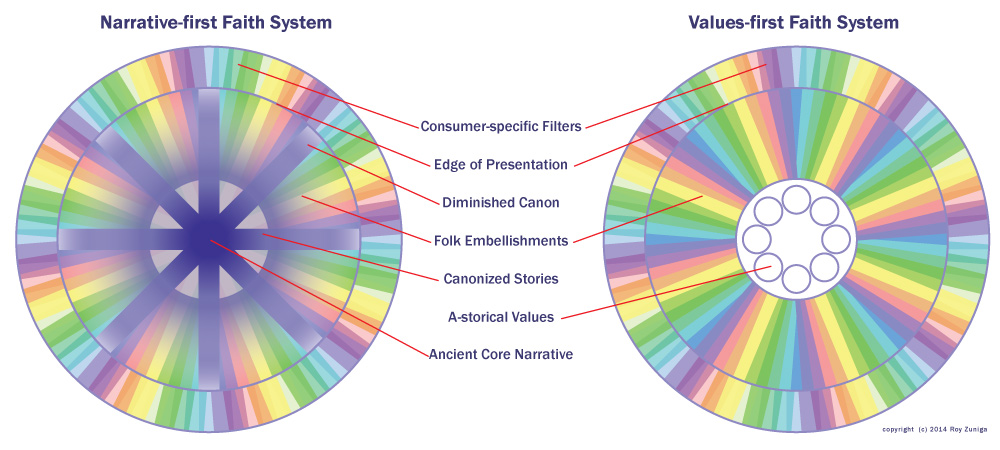
This diagram illustrates the difference between a ‘Narrative-first’ and the ‘Values-first’ approaches.

a-storical-values_sm

On the left, Narrative-first means that an ancient core narrative grew to have holy significance in the tribe, and out of that stories were canonized (into a Bible, for example). Over time as the stories failed to satiate people’s needs, additional folk embellishments were added that were not at the status of Holy Scripture, nevertheless were shared and revered. At a given point in time all of these – the fading canon stories and the sacred folk stories were what a person was presented, i.e. the ‘edge of presentation.’ However, people don’t just assimilate what they are presented, they apply their own filters and weighting, to the point where what they receive is what they want to believe. Note that in the end, the canonized stories blend and fade along with the cacophony of other messages people deem valuable and assimilate. What soaks in varies from person to person.

Note that the Narrative-first system can consume a lot of energy in maintaining the canon stories in the forefront of people’s minds. First, they must be established, which means filtering out anything that didn’t rise the standard. Second, this establishment is done by a select group of experts, which introduces social tension. Third, over time the stories become less relevant, and more and more energy is required to make them stick with people like they did in the beginning. Finally, to maintain a cannon, there is a constant battle between the ardent believers and those who would embellish the faith – the conservatives vs. the liberals.

Now let’s turn to the Values-first approach. Since ‘a-storical’ values are agreed upon first (‘a-storical’ simply means values in the abstract, that are not inherently justified by a sacred core narrative). We can think of them as humanitarian values. In any case, a set of values is made sacred by the community, with some definition and examples. From those values, the community is free to create stories to explain them to various audiences with locale-specific flavors and color. This suite of narratives likewise compose and edge of presentation that any given individual will encounter at a given time. As in the previous example, the user brings their own filters, so the end result is really about the same. People have assimilate what they want to believe in, and stories help tremendously with that programing.

With a Values-first approach, there is a lot less energy and strife expended on sustaining the canon-story establishment because it doesn’t exist. In its place is a tolerant culture of creativity. The key in all this is accepting the new pattern, and fostering a process for the establishment of the sacred humanitarian a-storical value set.

In this paradigm there is no hermeneutic of Scripture – there is only interpretation of art. The sacred values have already been articulated because they came first. Intent is clarified up front. There is no practice of interpreting the text to discern the will of God. The god-will, as we internally know it, was summarily recognized and articulated in the vernacular at the start. Interpretation comes during the embellishment process as we look at the work of artists and try to understand their response to subject matter based on the canonical values they have accepted as the soul-blood of their creative efforts.

Since all religious story is filtered by what the individual projects over it – their current struggles, pain points, pleasures or joys, there has never been a time when a sacred story has landed objectively, i.e. in the same way for everyone. We have been interpreting the narratives with personal filters and imaginative embellishments forever.

Being human is the certification of your right to appeal to your conscience, as validated by your understanding of collective norms, and your assessment of the output of the story writers and artists. The interpretation can be advocated but should not be contentious due to any exclusivity mandate. The idea that there’s one set of canon-stories is gone. Because the values are already clear, the interpretation is about understanding nuances of multiple meanings, each of which is valid from the person’s own perspective (as it always has been). Thus there are no denominational schisms with each side claiming the truth based on interpretation.

In other words, interpretation is not seen to narrow inwards where there’s only room for one truth. Rather, interpretation fans out from values, dividing into endless branches, each of which is capable of carrying and conveying truth for someone. Expansive interpretation based on core values affirms our creativity, variety and humanity and teaches us to co-exist in the process.

Traditional religion, it seems, has the flow of interpretation backwards: we should not narrow down narrative artifacts into a holy cannon, and then use interpretation to drive out the values and lessons. Rather we should start from values derived from our collective life’s lessons and let embellishment and interpretation fan out without limit. But remember, the ensuing unlimited interpretation of the embellishment is not the same as ‘anything goes’: the foundational values constrain the efforts. Thus we can achieve balance between unity of intent and variety of expression, and thereby realize the embellishment which seems to be a pre-requisite for widespread adoption of a faith.

— Roy Zuniga

August 2014
Kirkland, WA

copyright (c) 2014 Roy Zuniga

Recent Posts

  • Can we still paint ideal figures?
  • Language in the Service of Myth
  • Channeling Intent
  • The Divine Right of Christ
  • The Space God

Archives

  • December 2020
  • August 2020
  • December 2017
  • July 2017
  • June 2017
  • May 2017
  • January 2016
  • December 2015
  • February 2015
  • December 2014
  • November 2014
  • October 2014
  • August 2014
  • June 2014
  • April 2014
  • February 2014
  • April 2013
  • March 2013
  • June 2012
  • May 2012

Categories

  • art
  • mythology
  • Uncategorized
  • Worldview

Meta

  • Create account
  • Log in
  • Entries feed
  • Comments feed
  • WordPress.com

Blog at WordPress.com.

  • Subscribe Subscribed
    • Dynamics of Myth
    • Already have a WordPress.com account? Log in now.
    • Dynamics of Myth
    • Subscribe Subscribed
    • Sign up
    • Log in
    • Report this content
    • View site in Reader
    • Manage subscriptions
    • Collapse this bar
 

Loading Comments...